
WATER QUALITY KNOWLEDGE CENTER
Orange, red or brown staining, metallic taste, visible particles, or clear water that turns rusty after standing can be consistent with iron—but those clues do not identify the iron form, concentration or source. Iron can come from groundwater, a well system or corroding iron or steel components, and the right treatment depends on what testing shows.
Useful benchmark: EPA and California use 0.3 mg/L as a secondary drinking-water standard for iron because of consumer-acceptance effects such as color, sediment, metallic taste and staining. A secondary standard is not the same thing as a health-based primary contaminant limit.
Water Fixers Plumbing & Filtration • California Central Coast • CA License #719792 • Se Habla Español

CLUES ARE NOT A WATER TEST
The pattern can help decide what to test and where to sample. It should not be used to diagnose iron from appearance alone.
POSSIBLE CLUE
Staining on sinks, tubs, toilets or laundry can be consistent with iron. Corrosion products, sediment and mixed water-quality issues can look similar, so color alone is not proof.
POSSIBLE CLUE
Iron can contribute metallic taste, rusty color or sediment. The same symptoms can also involve plumbing materials or other constituents.
USEFUL PATTERN
Dissolved ferrous iron may be nearly invisible when water is first drawn, then oxidize and form yellow-orange or reddish particles after contact with air. Testing is still needed to confirm the cause.

Helpful diagnostic: compare more than one fixture and compare hot and cold water. A problem limited to one fixture or only the hot side can point toward local plumbing or water-heater conditions rather than the incoming source alone.
DISSOLVED • PARTICULATE • BIOLOGICAL
Iron is a naturally occurring element. Groundwater can dissolve iron from soil and rock, and iron can also enter water from corrosion of iron or steel well casing, pipes or other components.
Dissolved (ferrous) iron can be clear when it first leaves the faucet and later oxidize. Oxidized (ferric) iron is already in a particulate or rust-like form that can settle or stain. Iron bacteria are a separate biological issue: they use iron and can produce rusty deposits and slime in wells and plumbing. A stain does not tell you which of these is present.
TEST BEFORE YOU SIZE TREATMENT
A useful test plan starts with the water source and the treatment question. Iron concentration matters, but pH, hardness, manganese, turbidity and whether the iron is dissolved or already oxidized can change the treatment design. For an existing system, comparing raw and treated samples can help show whether the equipment is doing its job.
START HERE
Municipal water, private well, shared system or another source? Note whether the issue is whole-home, fixture-specific, hot-only, cold-only or intermittent.
TEST
Measure iron and the supporting chemistry needed for design. Depending on the problem, that can include total or dissolved iron, pH, hardness, manganese and turbidity.
PLAN
Particulate iron, dissolved iron and iron-bacteria problems can require different equipment or well-system work. Choose the treatment path from the result rather than from stain color alone.
AESTHETIC + EQUIPMENT EFFECTS
Iron is commonly handled as a taste, color, staining and equipment concern. EPA and California list 0.3 mg/L as a secondary standard tied to consumer acceptance—not as a primary health-based MCL. A property can still have unrelated health-relevant contaminants, especially on a private well, so an iron result should not be treated as a complete water-safety assessment.
AROUND THE HOME
Iron can leave reddish or orange staining, create visible sediment and contribute metallic taste. Laundry, fixtures and surfaces can be affected even when the water is otherwise usable.
PLUMBING + EQUIPMENT
Iron deposits can foul fixtures, cartridges, softener resin, water heaters, pumps and plumbing. Iron bacteria can create slime and clogging that calls for a different response than ordinary dissolved iron.
TREATMENT AFTER TESTING
Dissolved iron: treatment may use oxidation followed by filtration or another iron-removal process selected for the water chemistry. Some water softeners can handle limited dissolved ferrous iron when the manufacturer’s rating and water conditions allow it.
Oxidized iron: particulate filtration can be useful when the iron is already in a solid form, but filter sizing and loading matter.
Iron bacteria: a filter alone may not solve the source. Well or plumbing cleaning, disinfection and a broader treatment plan can be necessary.
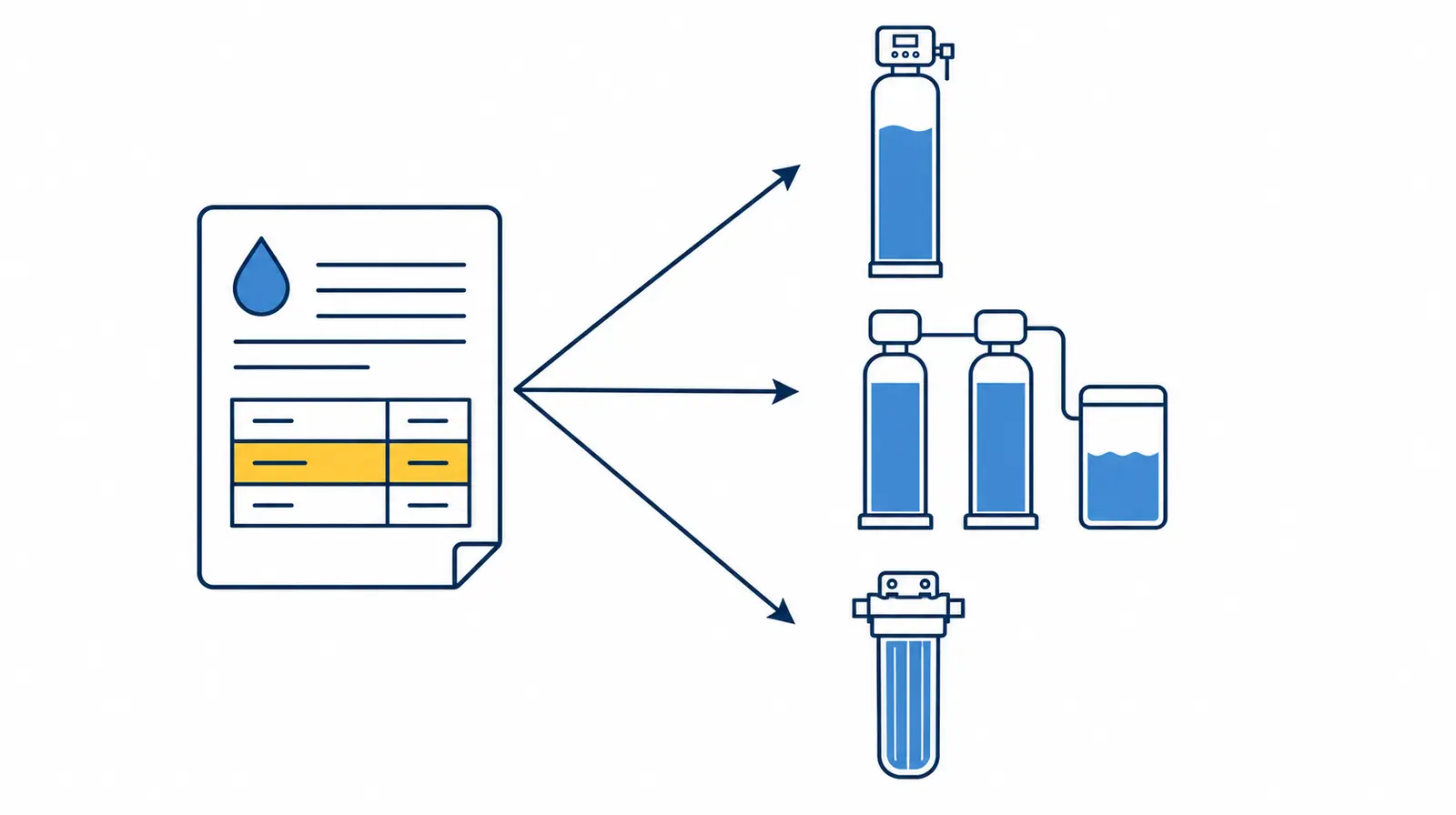
Iron treatment is not one universal tank. The treatment train should match the iron form, concentration, pH, competing constituents, household flow and the system’s maintenance requirements.
AVOID THE WRONG TOOL
Several common water-treatment devices can help in specific conditions, but none should be assumed to be a universal iron solution.
LIMITATION
A sediment filter can capture oxidized particles. It does not necessarily remove iron that is still dissolved in the water.
LIMITATION
Carbon is useful for specific taste, odor and disinfectant concerns when properly selected. Ordinary carbon should not be treated as a universal iron-removal medium.
LIMITATION
A softener may remove limited dissolved ferrous iron within documented equipment and chemistry limits. Oxidized iron or iron-bacteria problems can foul equipment and require a different approach.
WHERE TO GO NEXT
Use the next page that matches what you are trying to confirm or treat. If you do not know the iron form or source, start with testing.
DIAGNOSIS
Measure iron and the supporting chemistry before choosing treatment.
PRIVATE WELL
Use a well-specific strategy when the issue begins in groundwater or the well system.
WHOLE HOME
Explore point-of-entry treatment when staining or fouling affects the home broadly.
COMPARE
Compare dark staining and manganese-related treatment considerations when the symptoms overlap.
OFFICIAL WATER-QUALITY RESOURCES
These public sources explain why iron is listed under secondary drinking-water standards and provide the 0.3 mg/L consumer-acceptance benchmark used for public water.
FREQUENTLY ASKED QUESTIONS
Iron in drinking water is commonly managed under secondary, aesthetic standards for taste, color, sediment and staining. The EPA and California secondary benchmark is 0.3 mg/L. That does not mean an iron result proves the water is otherwise safe; private wells and changing water conditions may call for broader testing.
EPA and California list 0.3 mg/L as a secondary drinking-water standard for iron. Secondary standards address consumer-acceptance effects such as color, sediment, metallic taste and reddish or orange staining rather than serving as primary health-based contaminant limits.
Dissolved ferrous iron can be nearly colorless when water is first drawn. After exposure to oxygen it can oxidize into rust-colored particles. Testing is needed to confirm that iron is the cause and to measure the concentration.
Sometimes. Some softeners can remove limited dissolved ferrous iron when the manufacturer rating and water chemistry allow it. Oxidized iron and iron-bacteria problems can foul a softener and may require filtration, oxidation or well-system treatment instead.
It can capture iron that is already oxidized into particles. It does not necessarily remove dissolved iron that passes through the filter before oxidizing.
Iron bacteria are naturally occurring microorganisms that can use iron and oxygen and create rusty deposits and slime in wells and plumbing. They are a different problem from dissolved iron and may require well or plumbing cleaning and disinfection rather than only a filter change.
Reverse osmosis can reduce iron under suitable conditions at a point of use, but higher iron levels can foul small RO equipment and an under-sink system does not protect the rest of the home from staining or fouling. Whole-home iron problems are usually evaluated at the point of entry.
Compare several fixtures and compare hot and cold water. A problem limited to one fixture, one branch or only hot water can suggest a plumbing or water-heater source. A whole-home cold-water pattern can point toward incoming water or existing treatment. Sampling at more than one point can help separate those possibilities.
No. Dissolved calcium and magnesium pass through ordinary sediment filtration.
No. Spotting is a useful clue, but testing is needed to measure hardness and to consider other dissolved constituents.
No. Under-sink RO is generally a point-of-use drinking-water treatment. Whole-house ion-exchange softening is the primary household treatment associated with hardness reduction.
TEST FIRST • THEN CHOOSE THE TREATMENT
Water Fixers can help you test the water, separate a source-water problem from plumbing or equipment issues, and match the treatment approach to the iron form and the property’s actual conditions.
Water Fixers Plumbing & Filtration • Santa Maria, CA • California License #719792 • 805-928-6444
CALL NOW! Se Habla Español!