
WATER QUALITY KNOWLEDGE CENTER
Black or dark staining can be a clue, but it cannot confirm manganese or tell you whether the level is important for drinking water. The useful next step is a laboratory result, then treatment selected for the actual chemistry.
Updated for California’s June 2026 manganese guidance. This page separates appearance clues, public-water benchmarks, testing, and treatment so you can make the next decision from evidence.
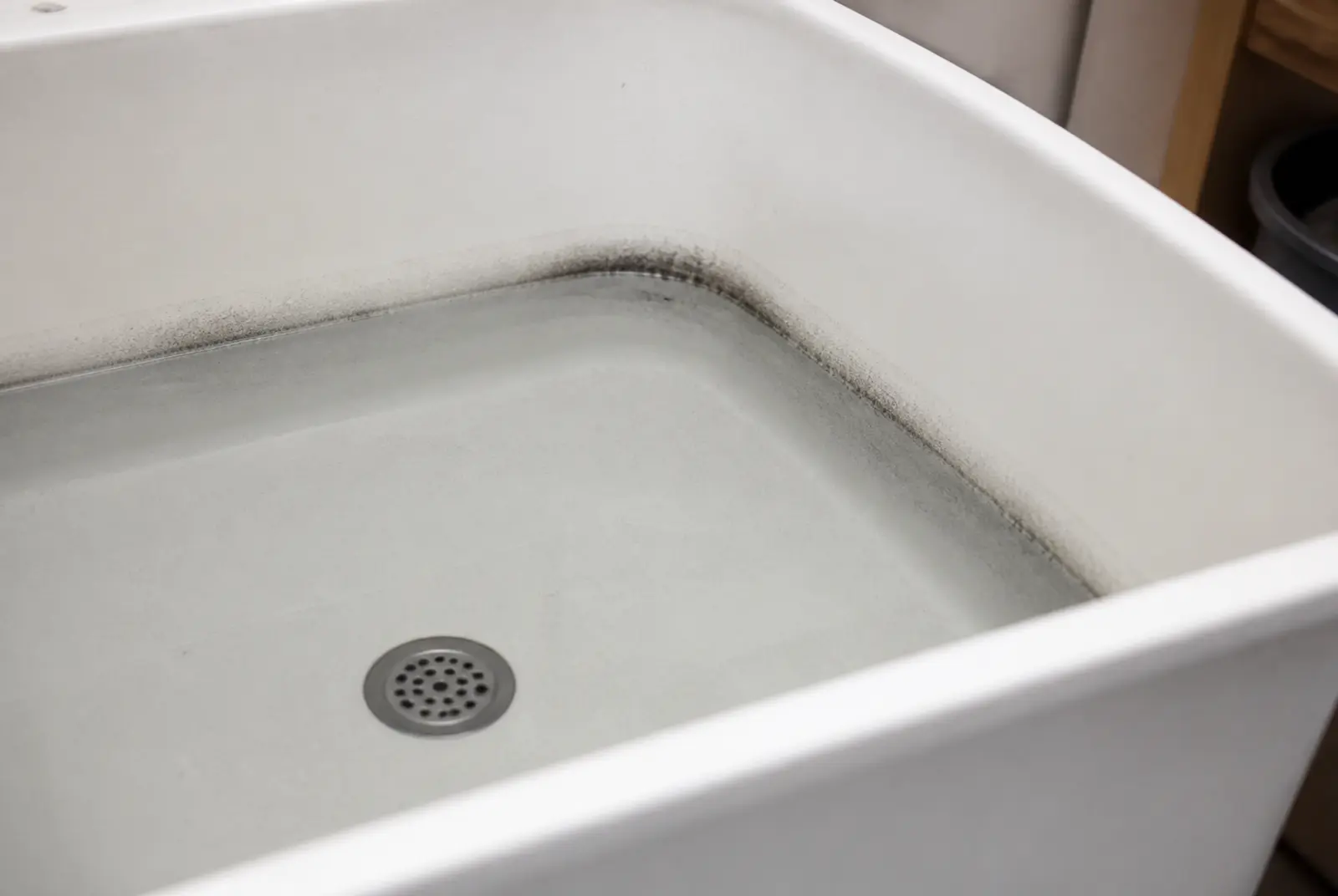
Dark deposits can be consistent with manganese, but color alone is not a diagnosis.
QUICK ANSWER
California updated its manganese notification and response levels on June 2, 2026. These figures are especially useful when reading a laboratory result, but they do not turn a stain into a concentration measurement.
California secondary MCL and current notification level. The secondary standard addresses staining, color and other aesthetic effects. California applies the secondary MCL to community water systems.
California response level. The State Water Board identifies this as the level where health-advisory context and stronger response actions become important, with particular attention to formula-fed infants.
Black, gray or brown deposits can have several causes. Laboratory testing is what tells you whether manganese is present and at what concentration.
Private well note: the public-water benchmarks above are useful context, but a private-well owner should interpret the actual lab result with qualified water-treatment and, when health questions are involved, public-health guidance.
WHAT YOU MAY NOTICE
Dark deposits on sinks, tubs, toilets or laundry can be consistent with manganese. Iron, sediment and plumbing deposits can overlap in appearance.
Dissolved manganese can be colorless at the tap and become darker as it oxidizes. That behavior is a clue, not a concentration reading.
Oxidized manganese can appear as particles. A particle filter may catch solids while dissolved manganese passes through.
EPA lists black-to-brown color, black staining and bitter metallic taste among effects associated with manganese above its federal secondary guideline.
WHY FORM MATTERS
Manganese occurs naturally in rocks, soil, groundwater and some surface-water sources. Groundwater chemistry can release manganese from aquifer materials, and changes in oxygen or treatment conditions can shift it between dissolved and oxidized forms.
Dissolved manganese: may be clear and invisible in freshly drawn water. Ordinary sediment filtration does not reliably remove the dissolved form.
Oxidized manganese: forms particles or deposits that can be captured by suitable filtration, but the upstream oxidation step and filter design still have to fit the water chemistry.
Iron and manganese can coexist and can produce overlapping staining, but their oxidation behavior and treatment limits are not identical. The site keeps them as separate guides for that reason.
Rotten-egg odor can involve hydrogen sulfide, sulfur bacteria, a water heater or other causes. Do not treat odor as proof of manganese.
TEST BEFORE TREATMENT
A useful test should answer more than “is manganese present?” Treatment selection can change with the manganese concentration and form, iron, pH, hardness, turbidity and other source-water conditions. If odor is part of the complaint, test and diagnose that separately rather than assuming one cause.
Measure both when staining or dark particles are present. Coexisting metals can change media loading and pretreatment needs.
Oxidation and media performance are strongly affected by pH. A treatment that works at one pH may underperform at another.
Hardness matters when considering any limited ion-exchange/softener role and helps prevent one treatment objective from being confused with another.
Suspended solids help distinguish a filtration problem from dissolved manganese that needs conversion before filtration.
TREATMENT AFTER TESTING
Oxidation followed by filtration is a common treatment path because dissolved manganese must often be converted into a filterable form. Manganese-rated oxidizing media can combine parts of that process when the water falls within the media and equipment limits.
A water softener can have a limited role for some dissolved manganese conditions only when the concentration, pH, hardness and manufacturer rating support it. Oxidized manganese can foul softener resin, so a softener should not be treated as the universal answer.
Carbon, UV, sediment filtration and generic RO are not universal whole-house manganese solutions. They solve different problems, and equipment should be selected for the actual result rather than the symptom alone.
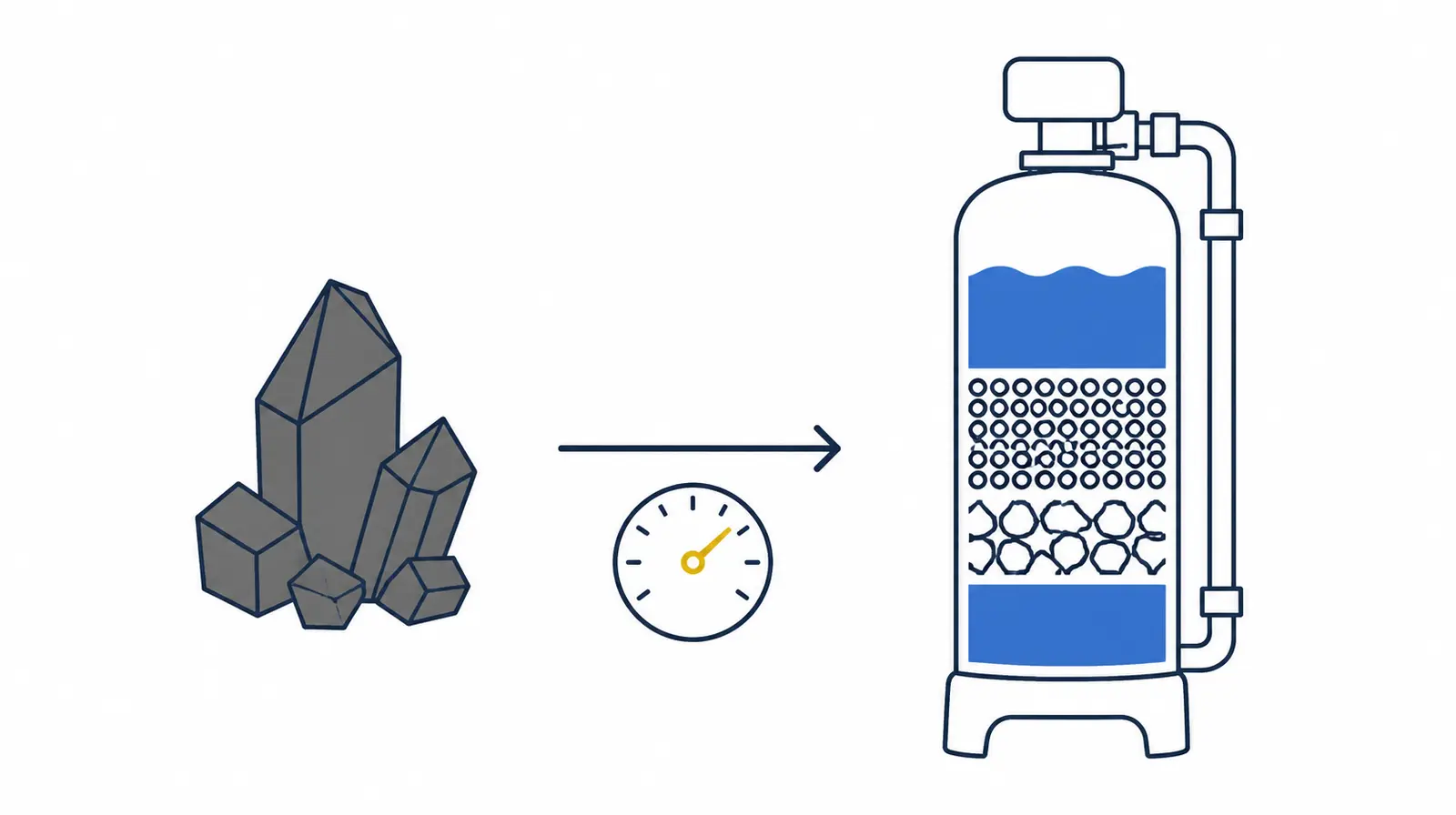
The correct oxidation and filtration sequence depends on the measured water chemistry and the equipment rating.
MANGANESE VS. IRON
Often associated with black or dark-brown staining and dark particles. Its oxidation can be more demanding than iron at the same water conditions.
Often associated with orange, red-brown or rusty staining. Iron can coexist with manganese and should usually be measured at the same time when staining is unexplained.
Both can occur naturally in groundwater, can change from dissolved to oxidized forms, and can foul fixtures or treatment equipment. Neither should be diagnosed from color alone.
READING A LAB RESULT
The ranges below describe current California public-water benchmarks. They are not a substitute for the lab report, a public-water notice, or health guidance for a specific household.
This is at or below California’s secondary MCL and current notification level. If staining still occurs, the source may involve another constituent, plumbing deposits, intermittent conditions or a different sample point.
This is above California’s secondary MCL / notification level but not above the current response level. Community water systems have communication and compliance obligations; private wells need result-specific interpretation.
This exceeds California’s current manganese response level. Follow any public-water notice or agency guidance. For a private well, get qualified guidance on drinking-water use and treatment rather than relying on appearance or a website alone.
Infant formula: California specifically calls out formula-fed infants as a group of concern at elevated manganese levels. If a result or public notice raises that issue, follow the State Water Board or other public-health guidance for the water being used.
RELATED WATER FIXERS GUIDANCE
Start with testing when the concentration, source or treatment objective is unknown.
Compare iron when stains are red-brown, orange or mixed with darker deposits.
Use the well-water treatment path when source water may have multiple measured conditions that need a treatment sequence.
Use whole-house filtration service for installation, maintenance, repair or replacement of supported treatment equipment.
OFFICIAL RESOURCES
Current California manganese regulation, health context, notification level and response level.
Federal secondary drinking-water standards, including the 0.05 mg/L manganese aesthetic guideline.
Groundwater science explaining how natural water-rock interactions and aquifer chemistry can mobilize geogenic constituents such as manganese.
FREQUENTLY ASKED QUESTIONS
Water Fixers can help you test the water, understand what the result means for treatment, and choose a system only after the chemistry supports it.
Water Fixers Plumbing & Filtration • 805-928-6444 • California License #719792
CALL NOW! Se Habla Español!