
COMMERCIAL & INDUSTRIAL • DEIONIZATION • CENTRAL COAST
Deionization (DI) uses ion-exchange resin to reduce dissolved charged ions in water. For commercial and process-water applications, it is often used as a polishing step after appropriate pretreatment or reverse osmosis rather than as a one-size-fits-all first treatment stage.
Water Fixers can help evaluate the required water quality, feed-water conditions, operating demand, existing equipment and service plan before recommending the next step.
38+ Years on the Central Coast • California License #719792
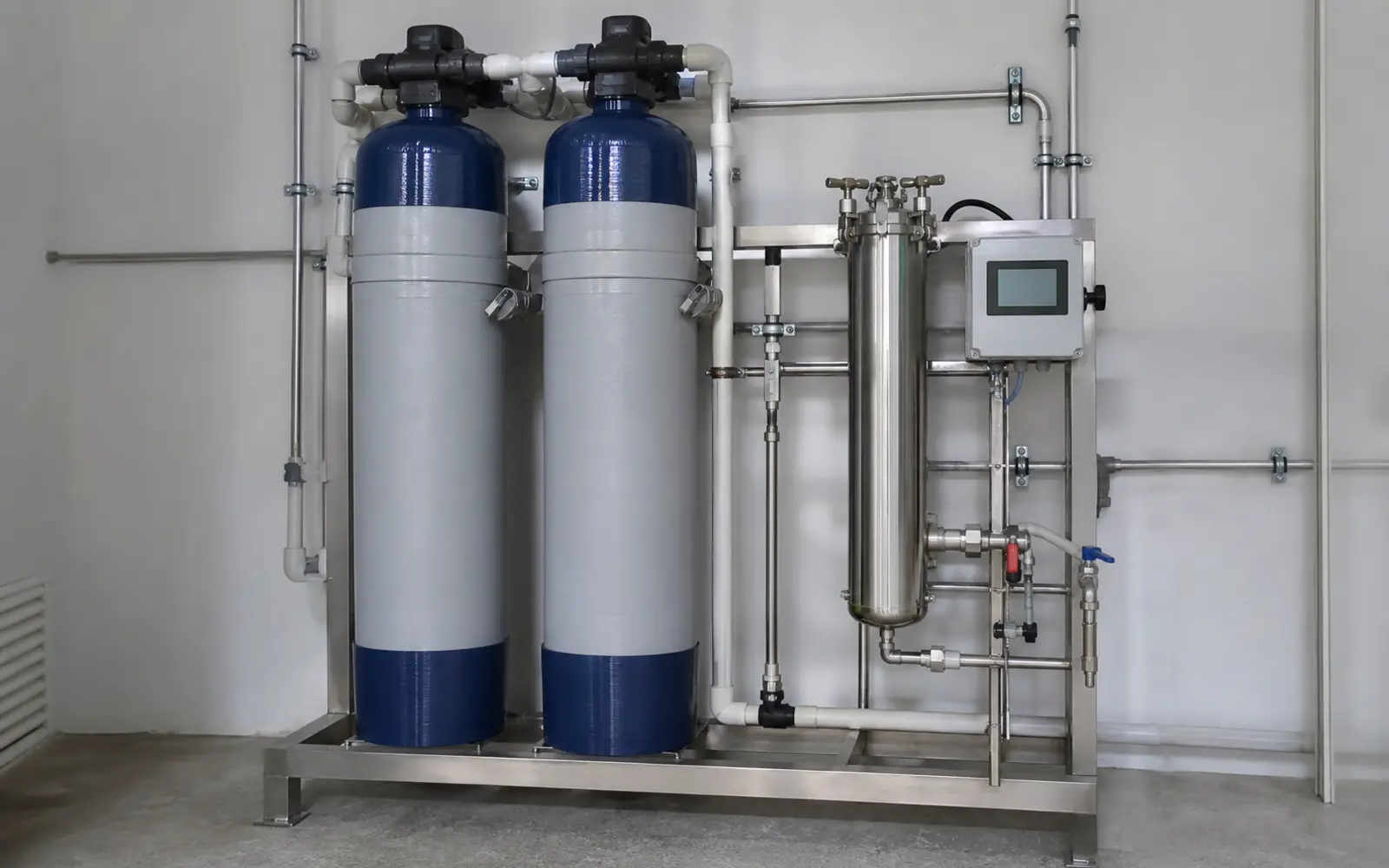
WHAT DI ACTUALLY DOES
DI is a form of ion exchange. Cation resin and anion resin remove positively and negatively charged dissolved ions. In mixed-bed systems, both resin types are combined for higher-purity polishing. The correct arrangement depends on the feed water and the required finished-water quality.
DI is used to reduce dissolved ionic material such as mineral and salt ions. The exact removal profile depends on resin chemistry and system design.
Where higher purity is required, DI is commonly positioned after pretreatment or RO so the resin handles a lower ionic load and can be used more efficiently.
DI by itself does not establish microbiological safety and is not a complete treatment for particles, chlorine, organics or every nonionic substance.
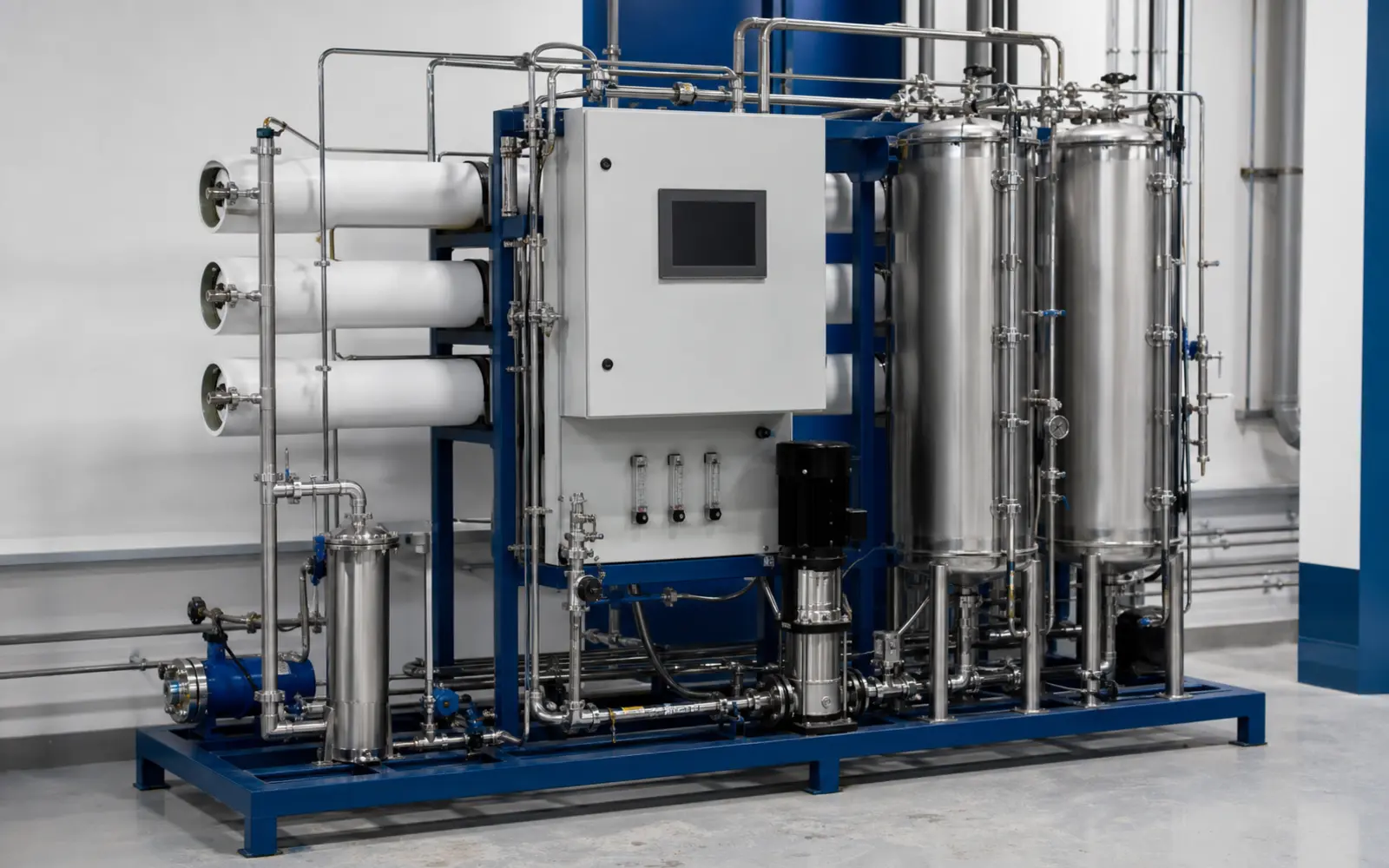
HOW DEIONIZATION WORKS
Cation-exchange resin trades positively charged ions for hydrogen ions. Anion-exchange resin trades negatively charged ions for hydroxide ions. The hydrogen and hydroxide combine to form water while the removed ions remain on the resin until its exchange capacity is exhausted.
Systems may use separate cation/anion vessels, mixed-bed polishing, exchange tanks or other configurations. The right choice depends on the required water quality, flow, operating pattern and service strategy.
DI VS. OTHER TREATMENT STEPS
A process-water system works best when each stage has a defined job. Choosing the technology from the requirement prevents one device from being asked to do work it was not designed to do.
RO uses a membrane to reject a broad range of dissolved material and is often used upstream of DI when a process requires higher-purity water.
DI targets charged dissolved ions with ion-exchange resin. It is often used when ionic purity needs to be pushed beyond the upstream treatment result.
Softening is cation exchange focused on hardness control. It is valuable pretreatment in some systems but is not the same as full deionization.
Carbon and particulate filtration address different targets such as chlorine, taste/odor, sediment or selected organics. They do not substitute for DI when ionic removal is the requirement.
DESIGN STARTS WITH THE REQUIRED RESULT
Before selecting resin tanks or polishing stages, define what the application actually requires. Useful inputs include feed-water chemistry, upstream treatment, peak flow, daily volume, run time, storage requirements, acceptable pressure loss and the finished-water metric your process uses.
Know the incoming dissolved-ion load and any upstream filtration, softening or RO already in service.
Use the project or equipment requirement—often conductivity, resistivity or another documented quality target—rather than a vague “pure water” label.
Peak flow, total volume, duty cycle, standby needs and storage can materially change the practical DI configuration.
MONITORING & RESIN SERVICE
Ion-exchange resin has finite capacity. As it approaches exhaustion, product-water quality changes. Commercial DI systems are commonly monitored with conductivity, resistivity or another application-specific metric so tank exchange, regeneration or service can be planned before the water falls outside the required range.
The service plan may involve exchange tanks, on-site regeneration, off-site regeneration, redundancy, lead/lag arrangements or another strategy. Water Fixers can review the installed system and the operating requirement before recommending a maintenance approach.
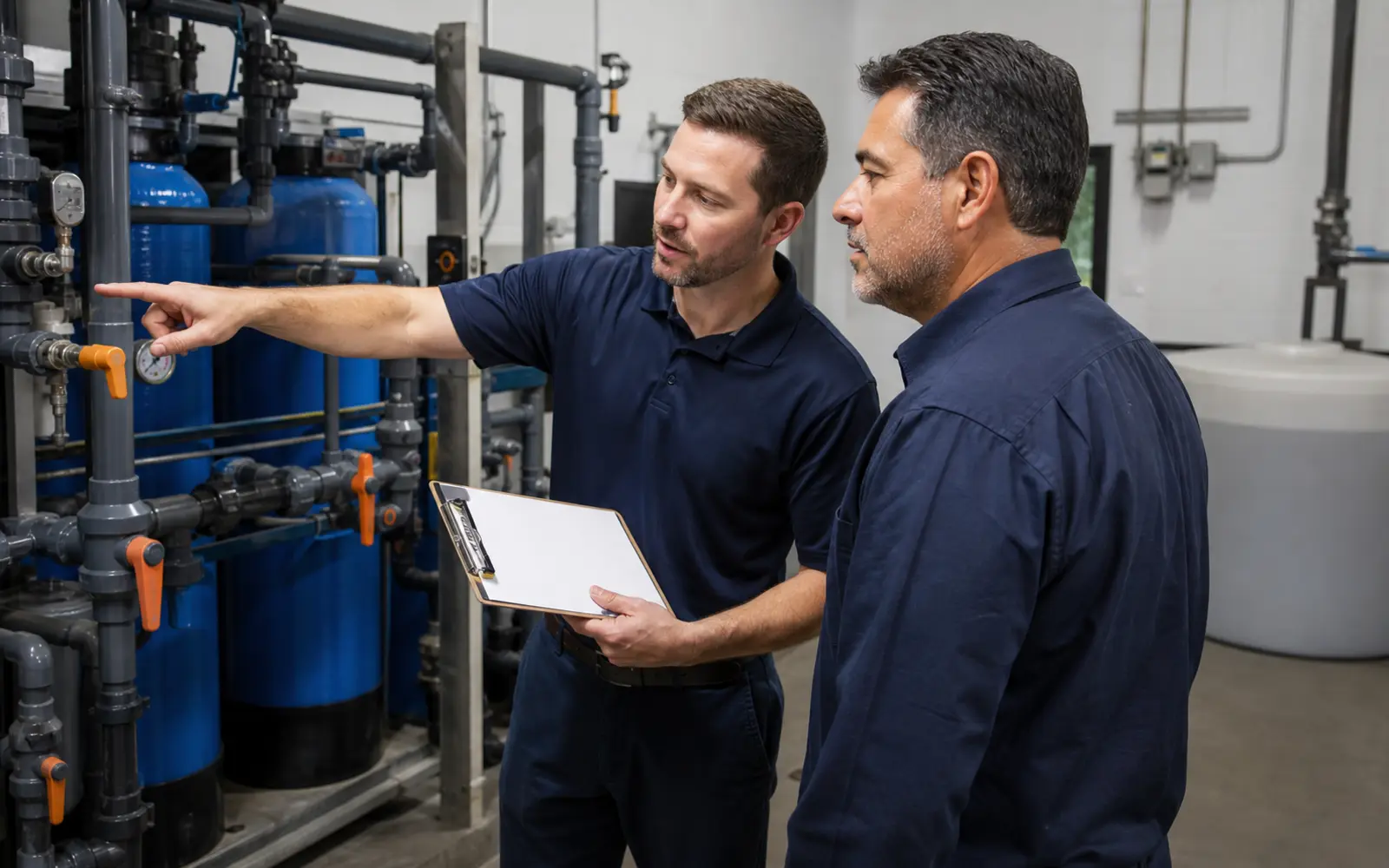
KEEP THE TREATMENT JOBS SEPARATE
Sediment and suspended solids are better handled with appropriate pretreatment so DI resin is not asked to perform a filtration job.
Carbon or another appropriate treatment may be needed when disinfectant residuals or selected organics are part of the feed-water problem.
Low ionic content does not by itself prove microbiological safety. Disinfection and sanitary design must be addressed separately where the application requires them.
RELATED COMMERCIAL & PROCESS WATER SERVICES
For multi-stage planning that may combine pretreatment, RO, DI, polishing, storage and distribution.
For membrane-system selection, service and RO-specific treatment requirements.
For feed-water characterization and diagnostic testing before equipment decisions are made.
For broader process, higher-flow and operating-critical water-treatment planning.
For general business water-treatment needs that do not specifically require DI or a high-purity process train.
BEFORE THE SERVICE CONVERSATION
Municipal, well, treated process water or RO permeate can present very different ionic loads.
List pretreatment, softeners, RO skids, storage tanks, pumps and any current DI vessels.
Bring the equipment or process specification when one exists, including any conductivity or resistivity limit.
Peak flow, gallons per day, batch size and run schedule affect capacity, redundancy and service frequency.
If an existing system is underperforming, note alarms, product-water readings, pressure changes, resin age and recent upstream changes.
DEIONIZATION FAQ
COMMERCIAL & INDUSTRIAL WATER
Tell Water Fixers what the water is feeding, the quality the process requires, the flow and volume, and what equipment is already installed. We can help determine whether the next step is testing, pretreatment, RO, DI polishing, service or a broader process-water review.
Water Fixers Plumbing & Filtration • Santa Maria, CA • Serving California’s Central Coast • License #719792
CALL NOW! Se Habla Español!