









TIPS FROM HARLEY • HARD WATER GUIDE
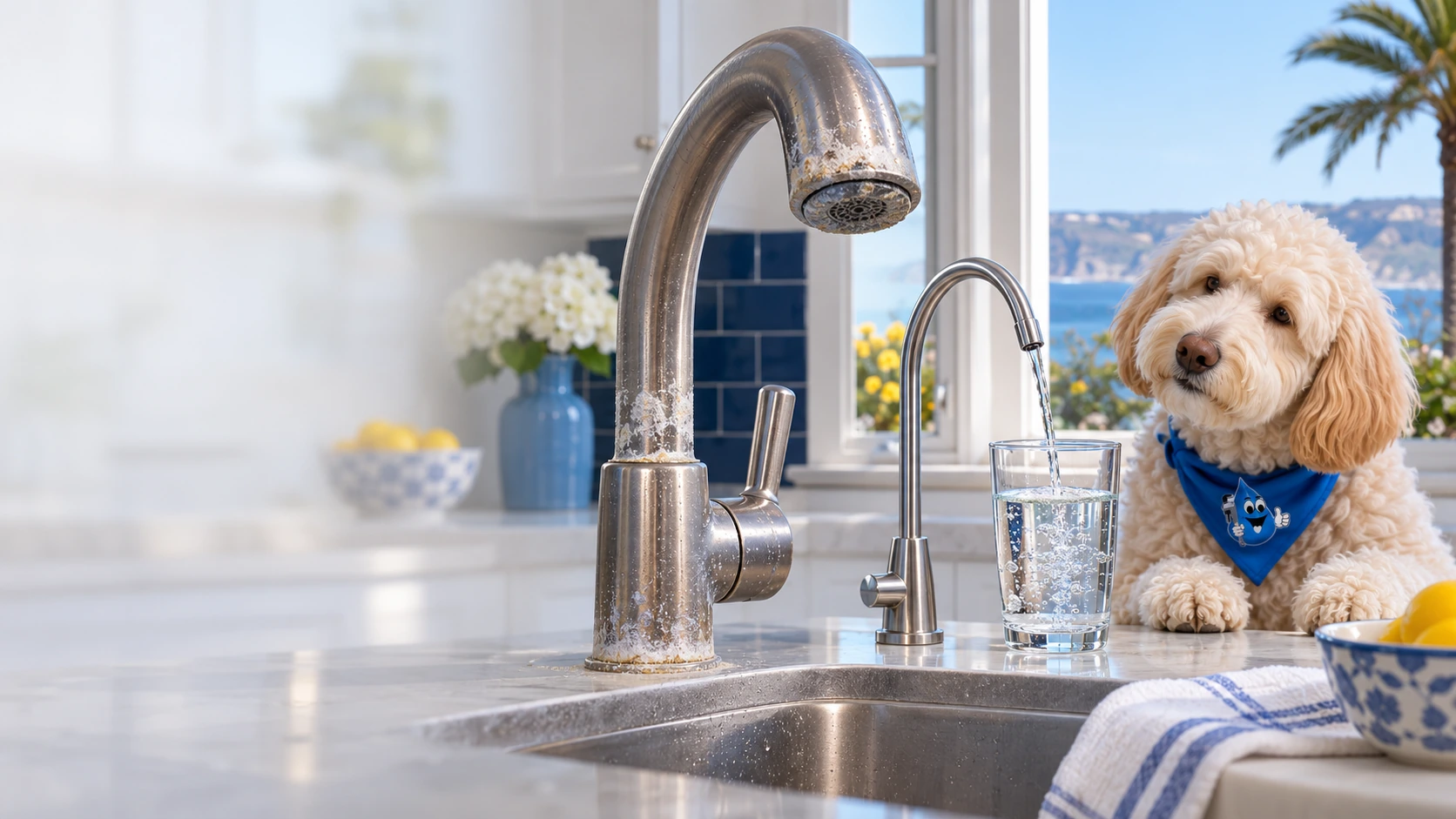
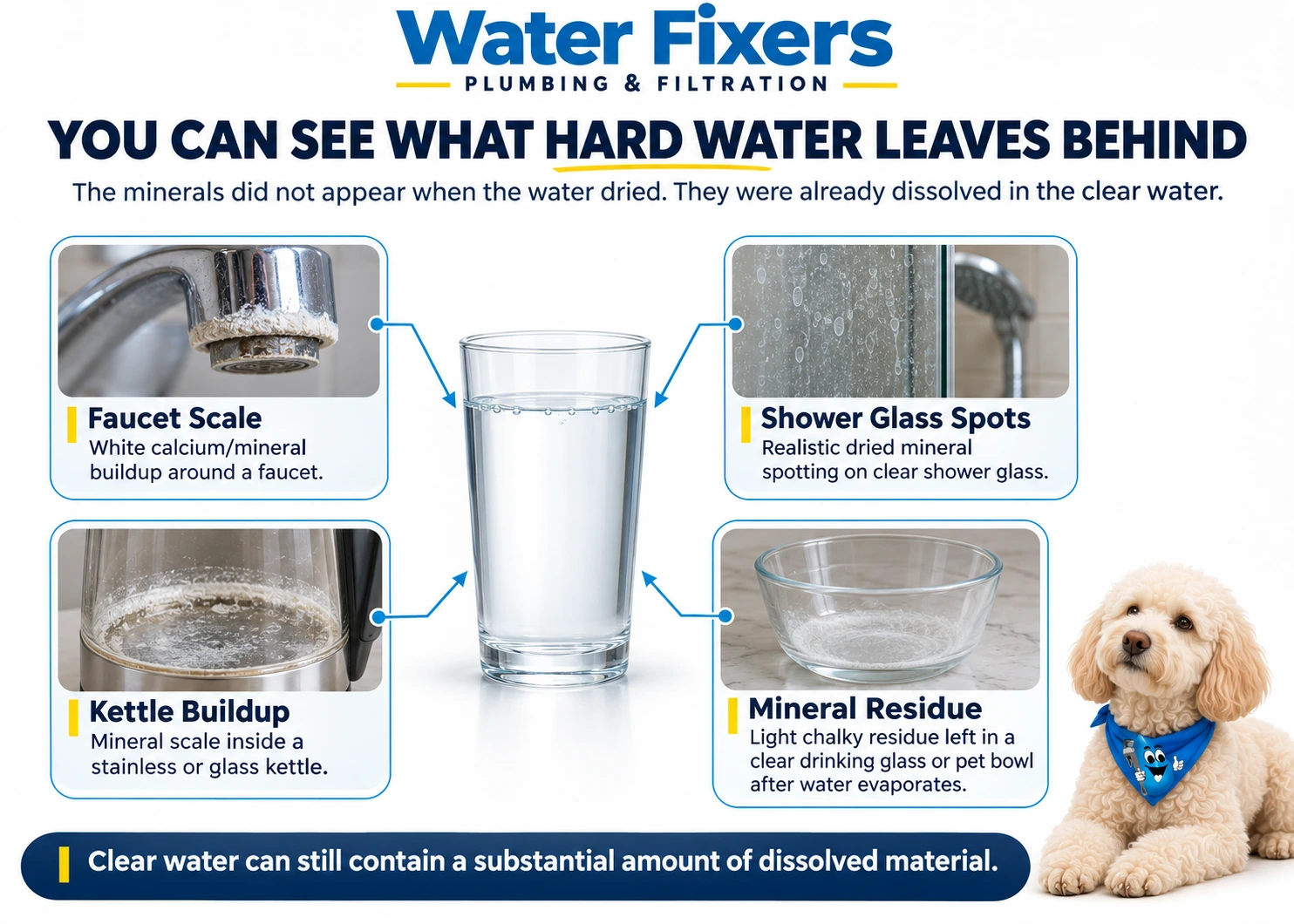
Hard water is easy to recognize once it leaves white scale on a faucet, spots on shower glass, or buildup inside a kettle. But that visible residue points to a bigger idea: clear water can still carry a substantial dissolved mineral load.
Harley’s Short Version
A softener controls hardness throughout the home. RO treats the water you drink. They solve different problems—and in many homes, they work best together.
Explore Water Softeners
Explore Reverse Osmosis
Start With Water Testing
Quick Answer: Do You Need a Water Softener, Reverse Osmosis, or Both?
Use a water softener when the problem is hardness throughout the home. It targets dissolved calcium and magnesium before hard water reaches showers, fixtures, the water heater, dishwasher, washing machine, and other plumbing.
Use reverse osmosis when the goal is lower-dissolved-solids drinking water. An under-sink RO system treats water at the point of use for drinking, cooking, refrigerator water, and ice where connected.
Use both when you want whole-home hardness control and purified drinking water. The softener handles the house-wide hardness problem first; RO then treats the smaller volume of water your family actually consumes.
| Goal | Best fit | Why |
|---|---|---|
| Reduce hardness throughout the home | Water softener | Targets calcium and magnesium before water reaches household fixtures and appliances. |
| Reduce dissolved solids in drinking water | Reverse osmosis | Uses membrane separation at the drinking-water point. |
| Whole-home hardness control + purified drinking water | Softener + RO | Each system handles the part of the water problem it is designed to treat. |
First: What Is That White Stuff Hard Water Leaves Behind?
Hard water contains dissolved calcium and magnesium. When that water evaporates from a faucet, shower door, glass, kettle, or other surface, some of those minerals can remain behind as visible scale or spotting.
The important word is dissolved. Those minerals are not necessarily floating around as visible grains that can simply be strained out. They can be present as dissolved ions in water that looks completely clean and clear.
That is why hard water is such a useful way to explain water treatment. It gives homeowners something they can actually see that demonstrates a much larger principle:
Clear water can still carry dissolved material.
Not Everything in Water Is a Particle
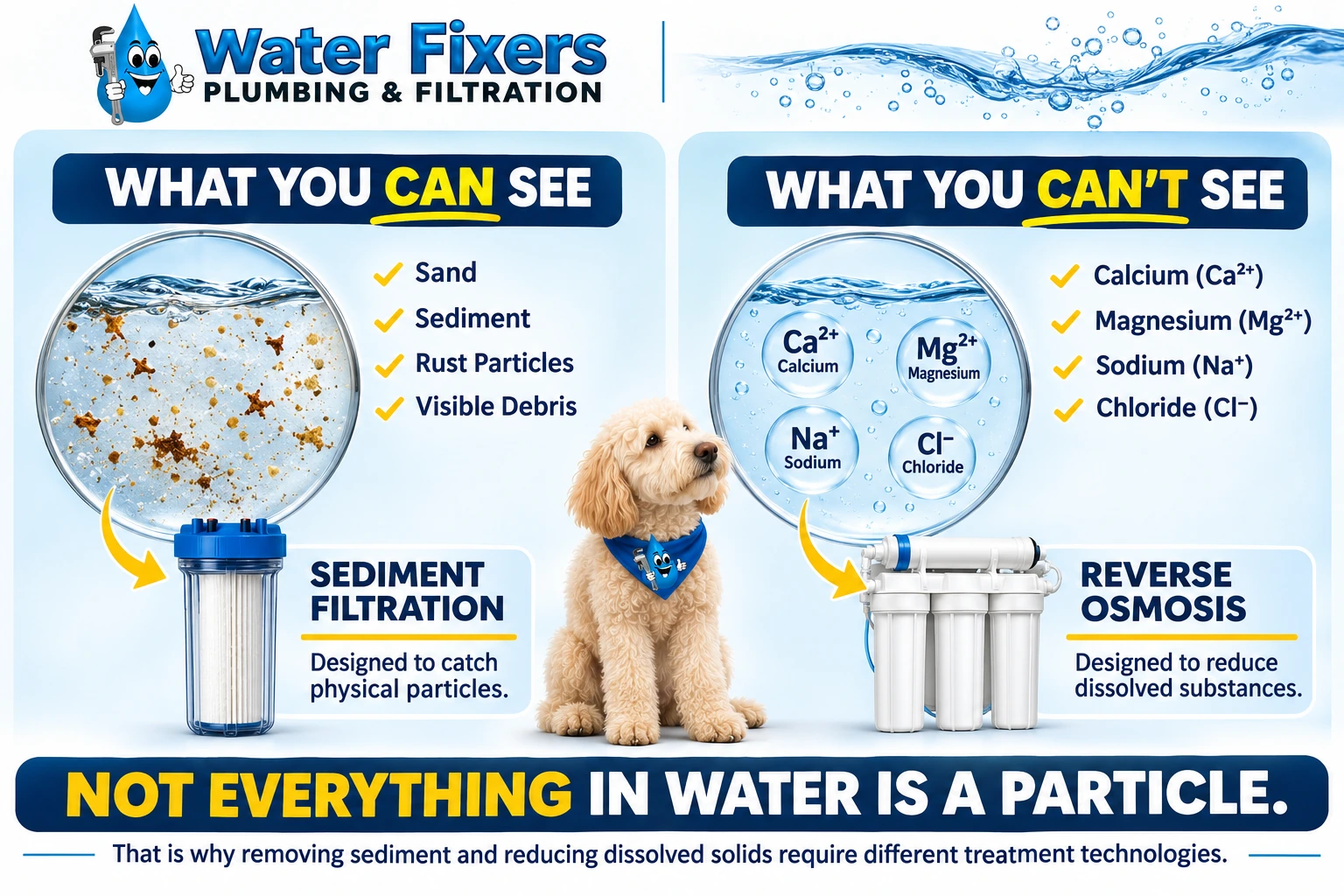
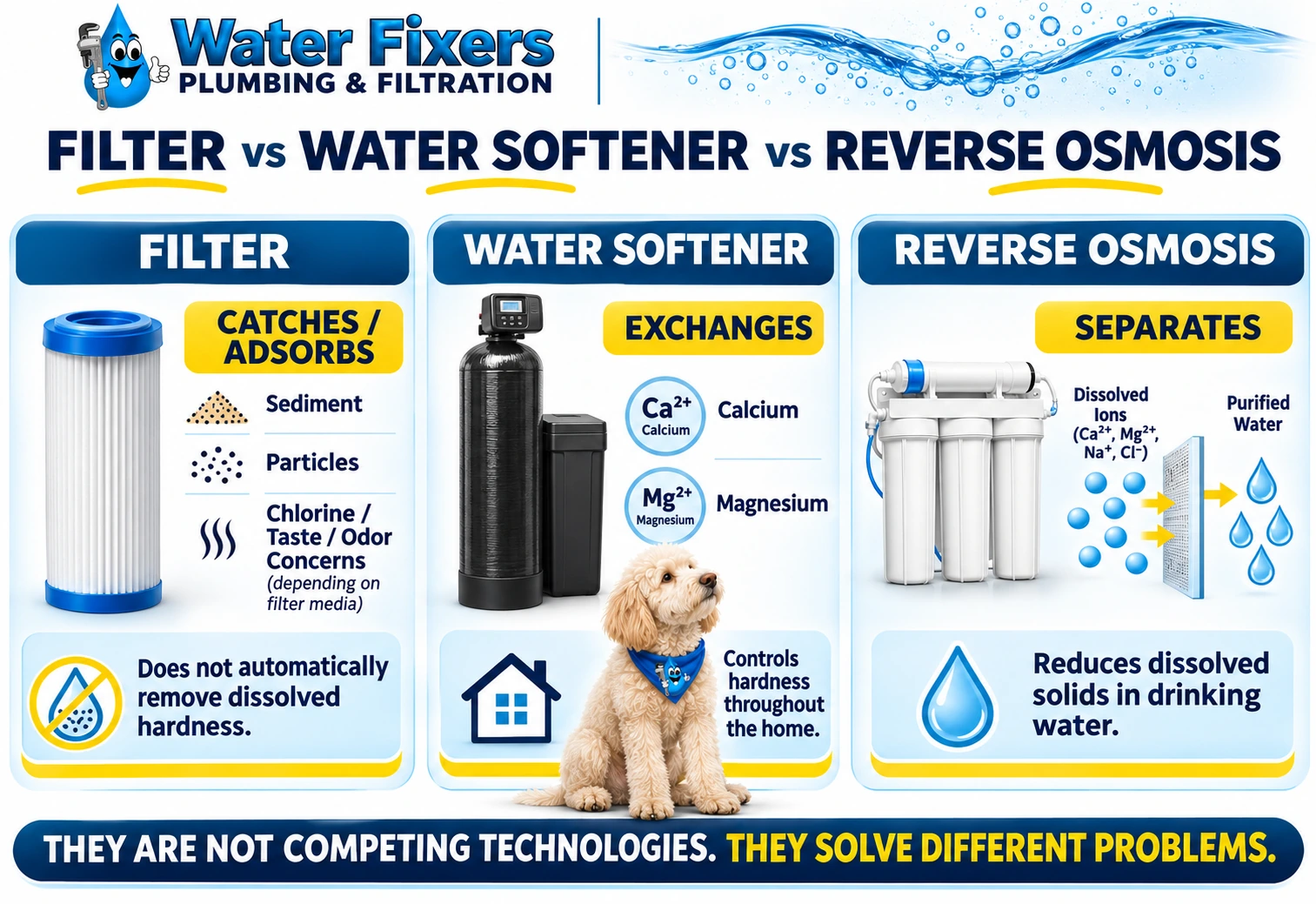
This is where a lot of water-treatment confusion starts. A homeowner may think, “I already have a filter, so isn’t everything being removed?” But different treatment technologies perform different jobs.
A sediment filter is designed to capture physical material such as sand, rust, or sediment. Carbon media can be useful for certain taste, odor, chlorine, and organic-compound concerns depending on the media and system design. But dissolved hardness minerals are a different problem.
Calcium and magnesium can exist in the water at the ionic level. That means a filter that catches particles is not automatically removing the dissolved mineral load.
Filter, Water Softener, and RO: Three Different Jobs
The easiest way to understand a complete water-treatment strategy is to stop thinking of every piece of equipment as “a filter.” A filter, a water softener, and an RO system can all be valuable, but they are not interchangeable.
- Filtration: Depending on the media, helps address particles, sediment, chlorine, taste, odor, and specific targeted concerns.
- Water softening: Primarily addresses calcium and magnesium hardness throughout the home.
- Reverse osmosis: Uses membrane separation to substantially reduce dissolved solids in drinking water.
That means the better question is not, “Which system is best?” It is:
What problem are we trying to solve—and where in the home is it happening?
What Does a Water Softener Actually Do?
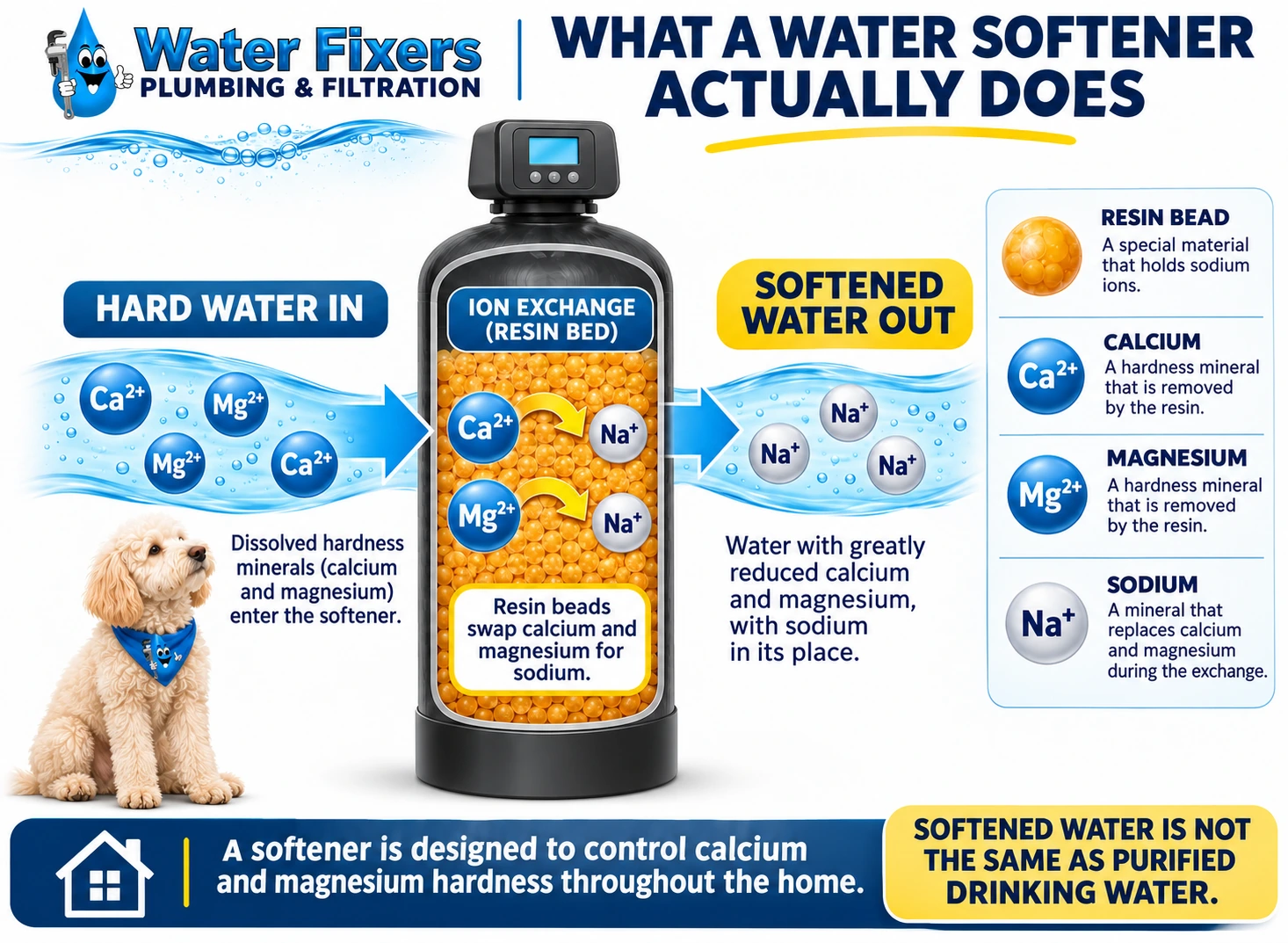
A traditional ion-exchange water softener is designed specifically to control hardness. Hard water flows through a resin bed where calcium and magnesium ions are exchanged for sodium or potassium ions, depending on how the system is configured.
The result is softened water throughout the plumbing system. That makes a softener particularly valuable for problems that happen throughout the house:
- White scale around faucets and fixtures
- Spotting on shower glass
- Scale stress on water heaters
- Hard-water buildup in dishwashers and washing machines
- Soap and detergent performance
- Hardness-related maintenance throughout the plumbing system
A softener is excellent at its job. But its job is hardness control. Softened water is not the same thing as purified drinking water.
If a Softener Removes Hardness, Why Add Reverse Osmosis?
Because the softener and RO are solving different parts of the water-quality problem.
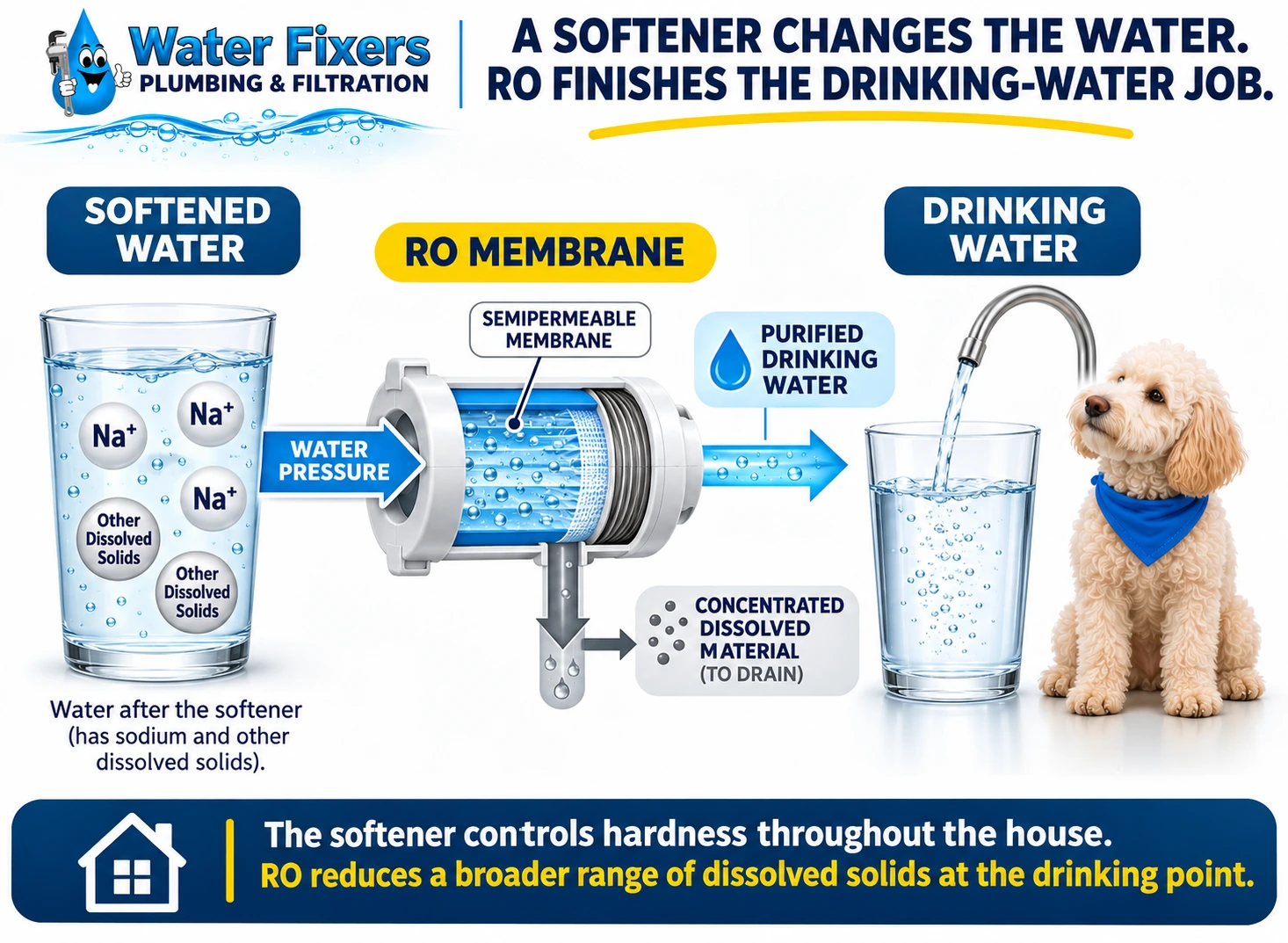
After an ion-exchange softener, calcium and magnesium hardness is greatly reduced, but the water still contains dissolved substances. The softening process can also add sodium to the water as part of the exchange process.
A properly selected reverse osmosis system at the kitchen can then reduce a much broader portion of the dissolved-solids load in the water used for drinking and cooking.
That makes the relationship easy to remember:
Water Softener
Protects the home from hardness.
Whole-home treatment for calcium and magnesium.
Reverse Osmosis
Treats the water you consume.
Point-of-use reduction of dissolved solids for drinking water.
Why a Softener + RO Combination Makes So Much Sense
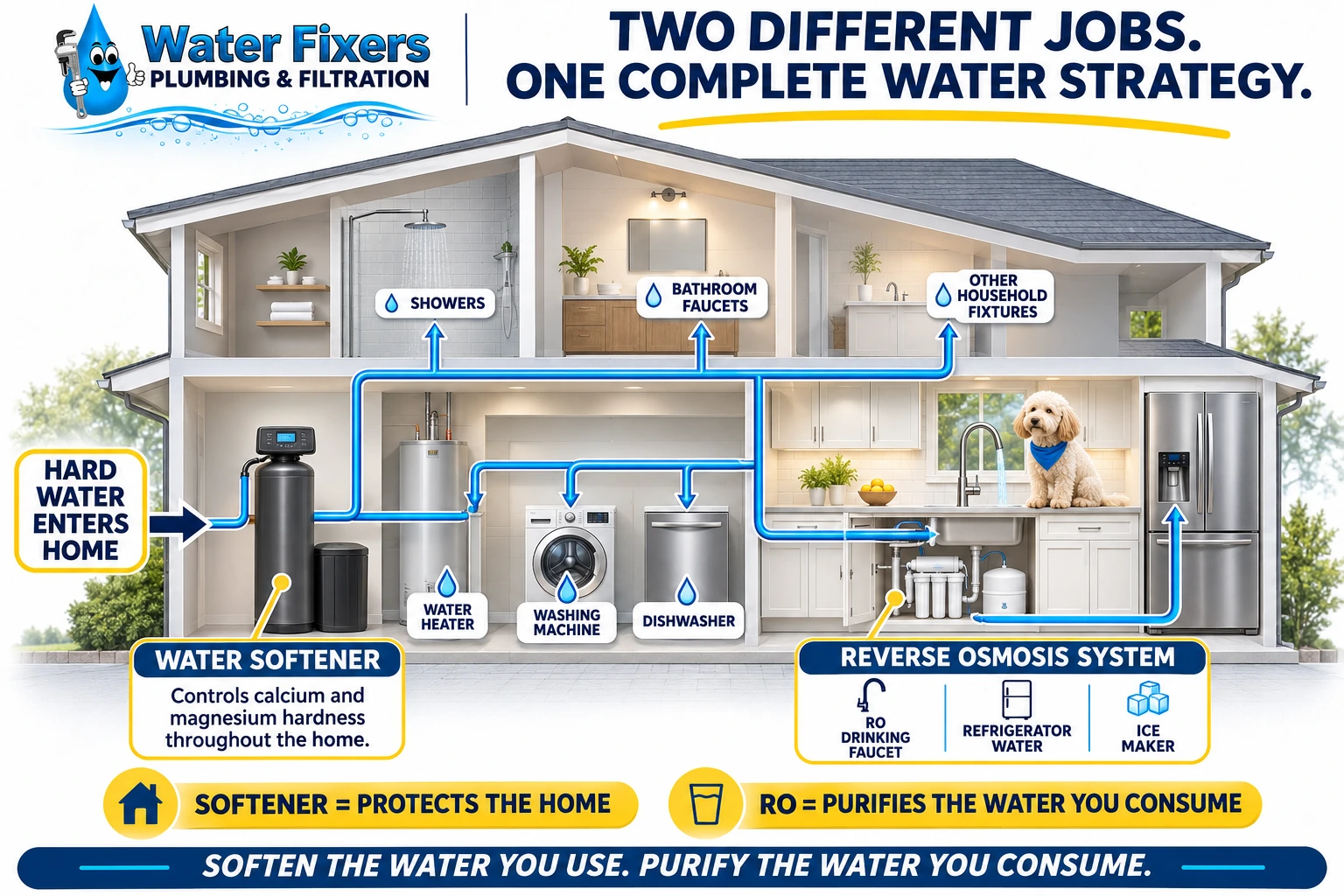
Picture the water entering the home. Before treatment, hardness minerals travel everywhere the water travels: the water heater, showers, faucets, dishwasher, washing machine, and kitchen.
A whole-home softener addresses that hardness before it spreads throughout the plumbing system. Then, at the kitchen, a reverse-osmosis system gives the water used for drinking, cooking, refrigerator water, and potentially ice another level of treatment.
Soften the water you use.
Purify the water you consume.
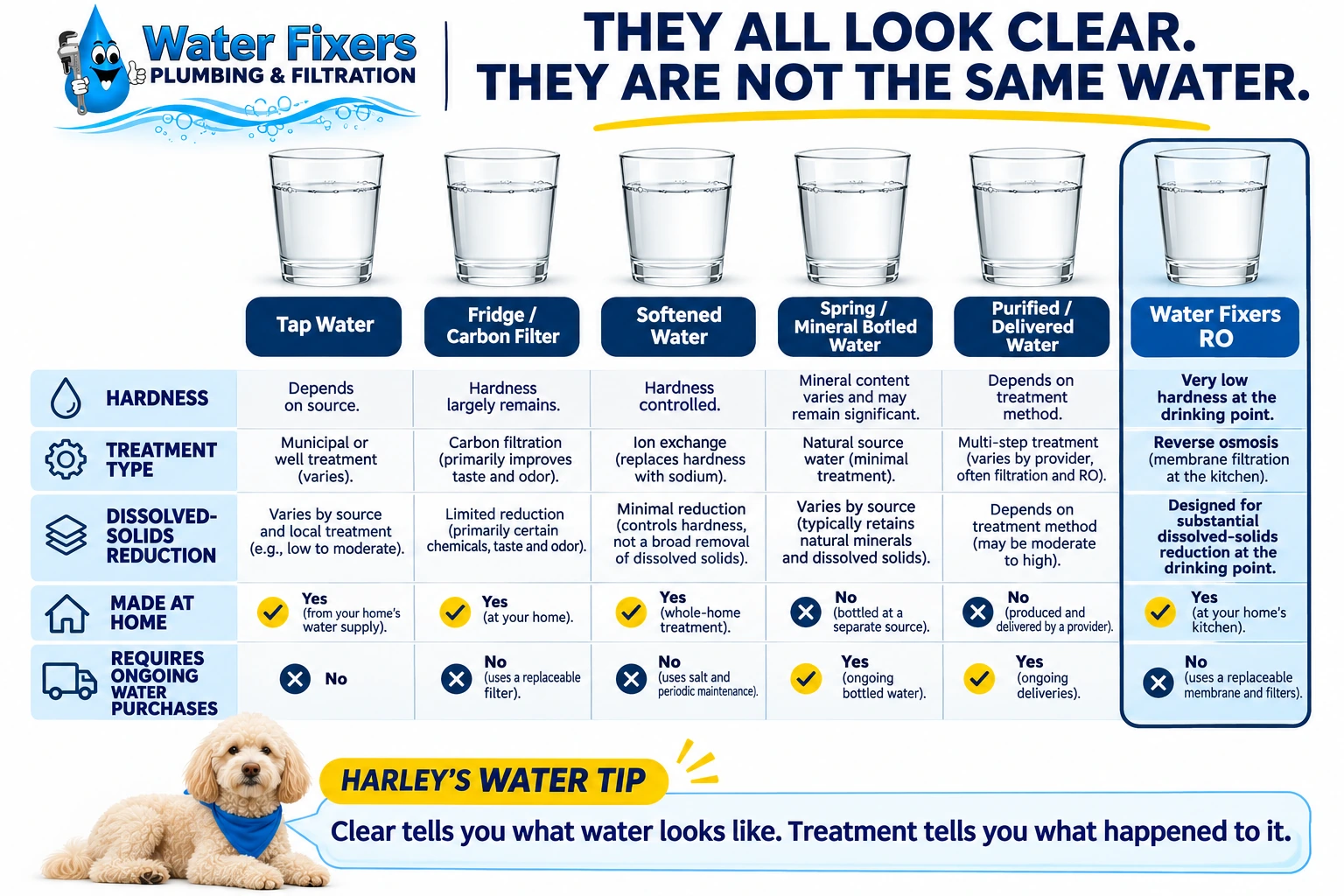
They All Look Clear. They’re Not the Same Water.
A clear glass of tap water, refrigerator-filtered water, softened water, spring water, purified bottled water, and RO water can all look almost identical. Appearance alone does not tell you what treatment the water received.
This matters because phrases like filtered water and bottled water are not specific treatment methods.
A refrigerator filter is commonly built around carbon filtration. A water softener targets hardness. Bottled water may be spring, mineral, purified, distilled, or RO-treated. A home RO system uses membrane separation right where the water is consumed.
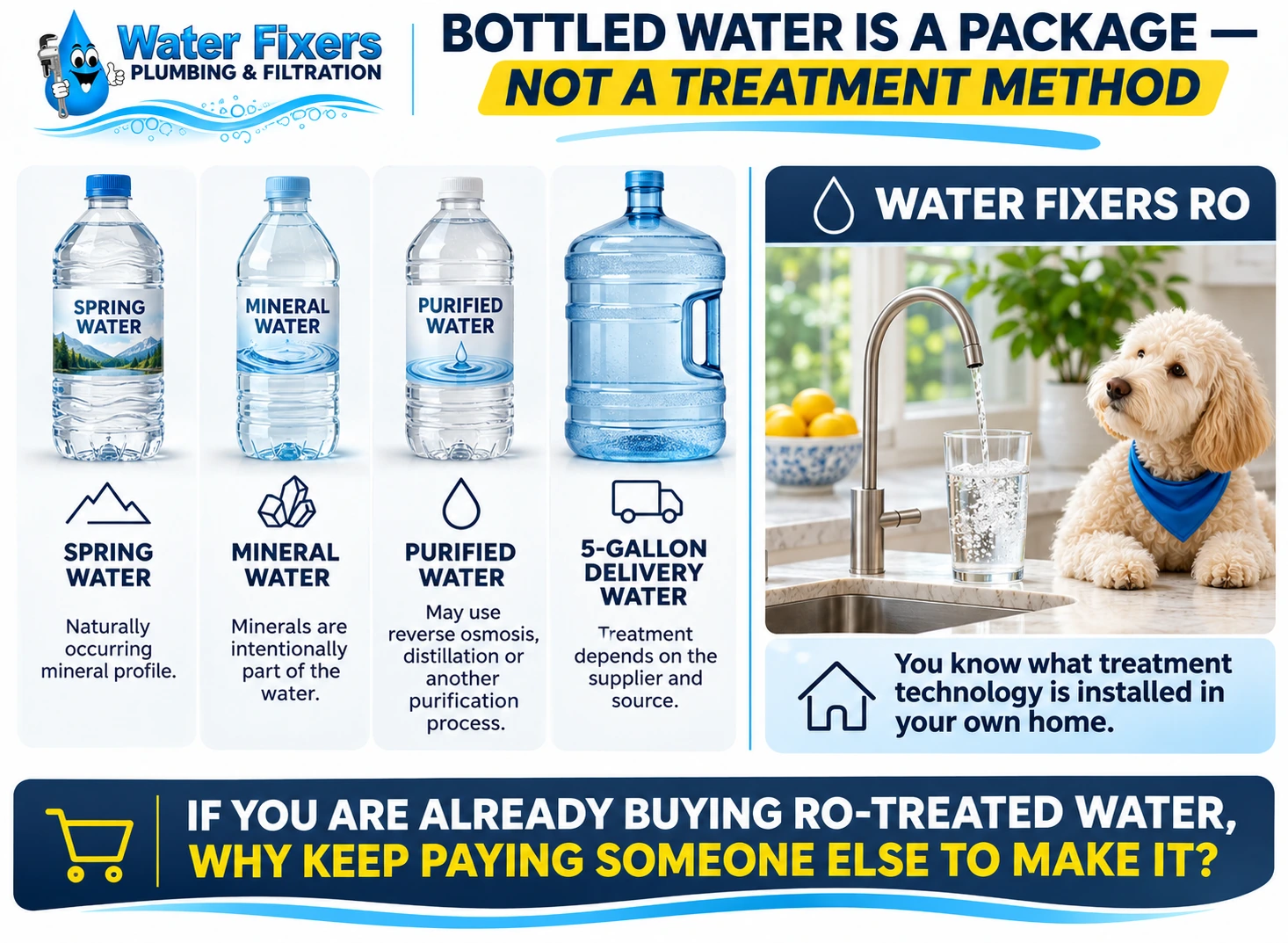
Bottled Water Is Packaging, Not a Treatment Method
This is one of the most overlooked points in the bottled-water conversation. Two bottles sitting next to each other can contain water with very different mineral profiles and treatment histories.
- Spring water: Comes from a spring source and may retain naturally occurring minerals.
- Mineral water: Mineral content is part of the product.
- Purified water: May be produced using reverse osmosis, distillation, deionization, or other purification processes.
- Five-gallon delivery water: Treatment varies by provider and product.
This creates a simple question for homeowners who are already buying purified or RO-treated water:
If you’re already paying someone else to make purified water, why not make it at home?
A properly installed home RO system can provide treated drinking water without repeatedly hauling cases of bottles, storing jugs, scheduling deliveries, or running out. If you are weighing that choice, see our detailed bottled water vs. reverse osmosis cost comparison.
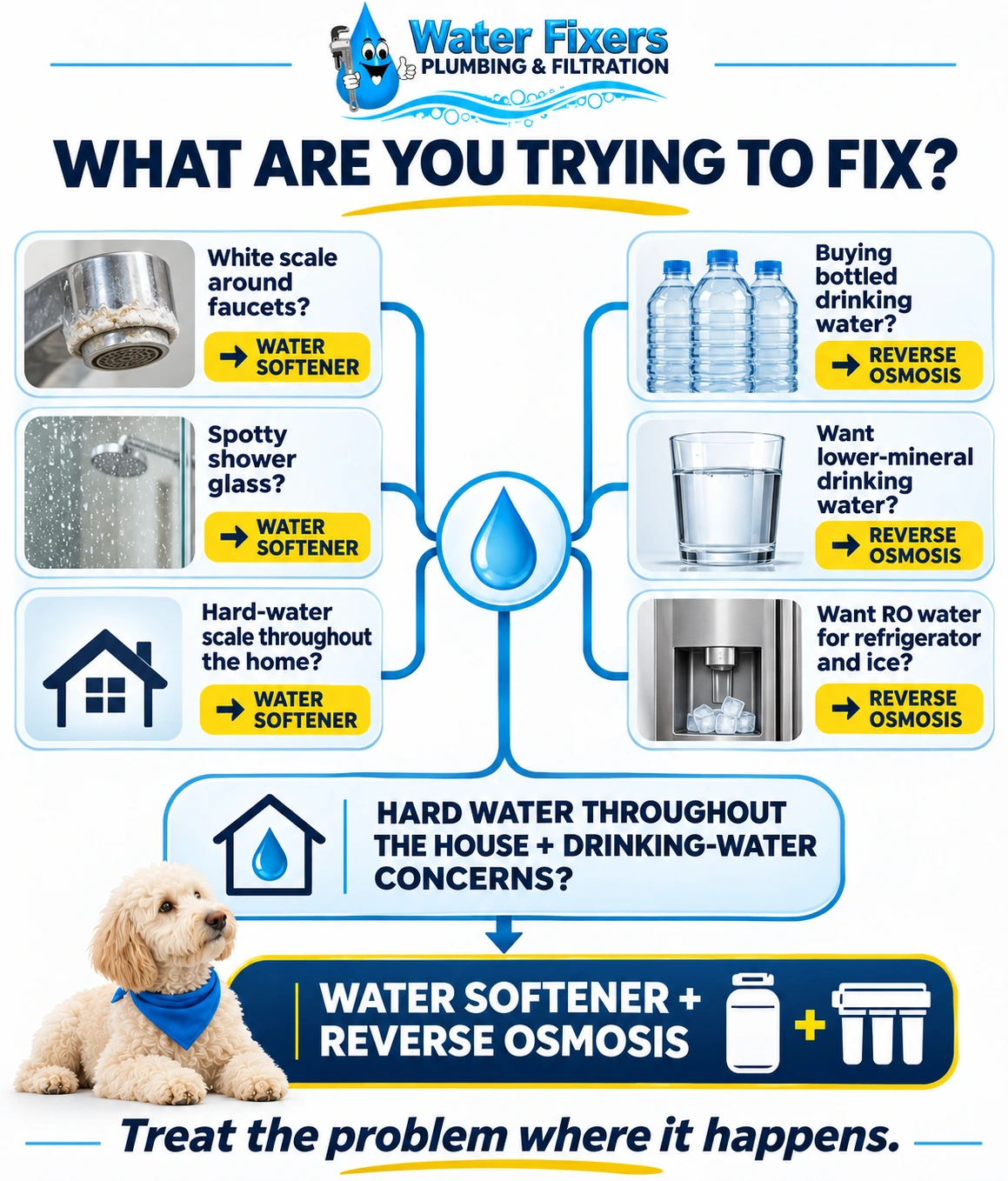
Do You Need a Softener, RO, or Both?
The answer depends on what you are actually trying to fix.
If you see white scale throughout the home: that points toward a whole-home hardness problem, which is where a softener belongs.
If you dislike the taste or mineral content of your drinking water, buy bottled water, or want treated water at the kitchen and refrigerator: that points toward RO.
If you have both problems: the strongest strategy may be a softener for the whole home plus RO for drinking water.
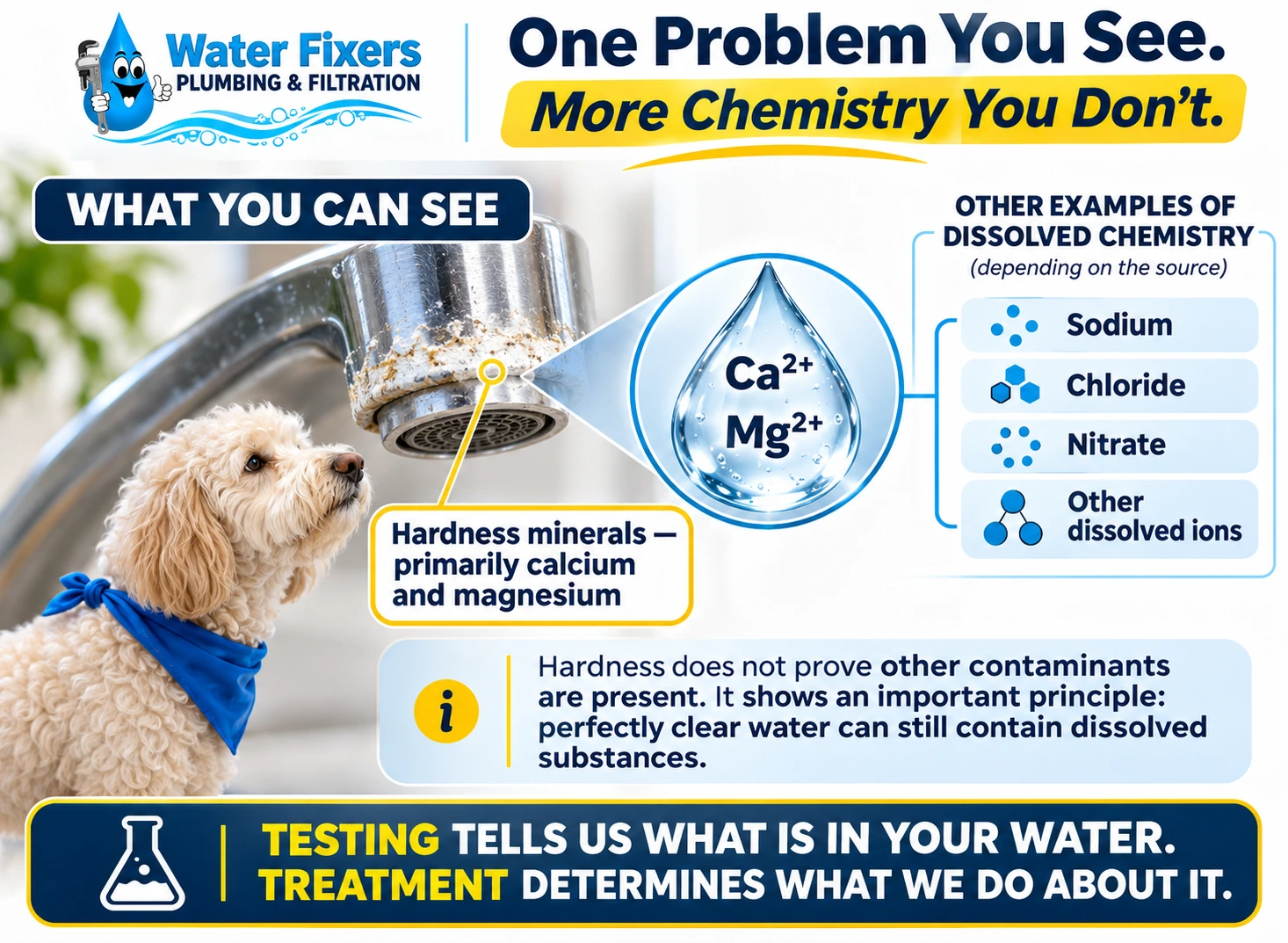
Hardness Is the Visible Clue—not the Whole Water Story
Hard-water scale does not prove that lead, nitrate, arsenic, or any other specific contaminant is present. That would require appropriate testing.
What hardness does demonstrate very well is that water can carry dissolved chemistry that is invisible while the water is in the glass.
Calcium and magnesium happen to become obvious because they can leave scale behind. Other dissolved substances may not leave such an obvious visual clue.
That is why Water Fixers prefers a simple principle:
Testing tells us what is in the water. Treatment determines what we should do about it.
For a deeper technical explanation of hardness itself, see our Hard Water water-quality guide. If you are not sure what your water actually needs, start with Water Fixers water testing before choosing equipment.
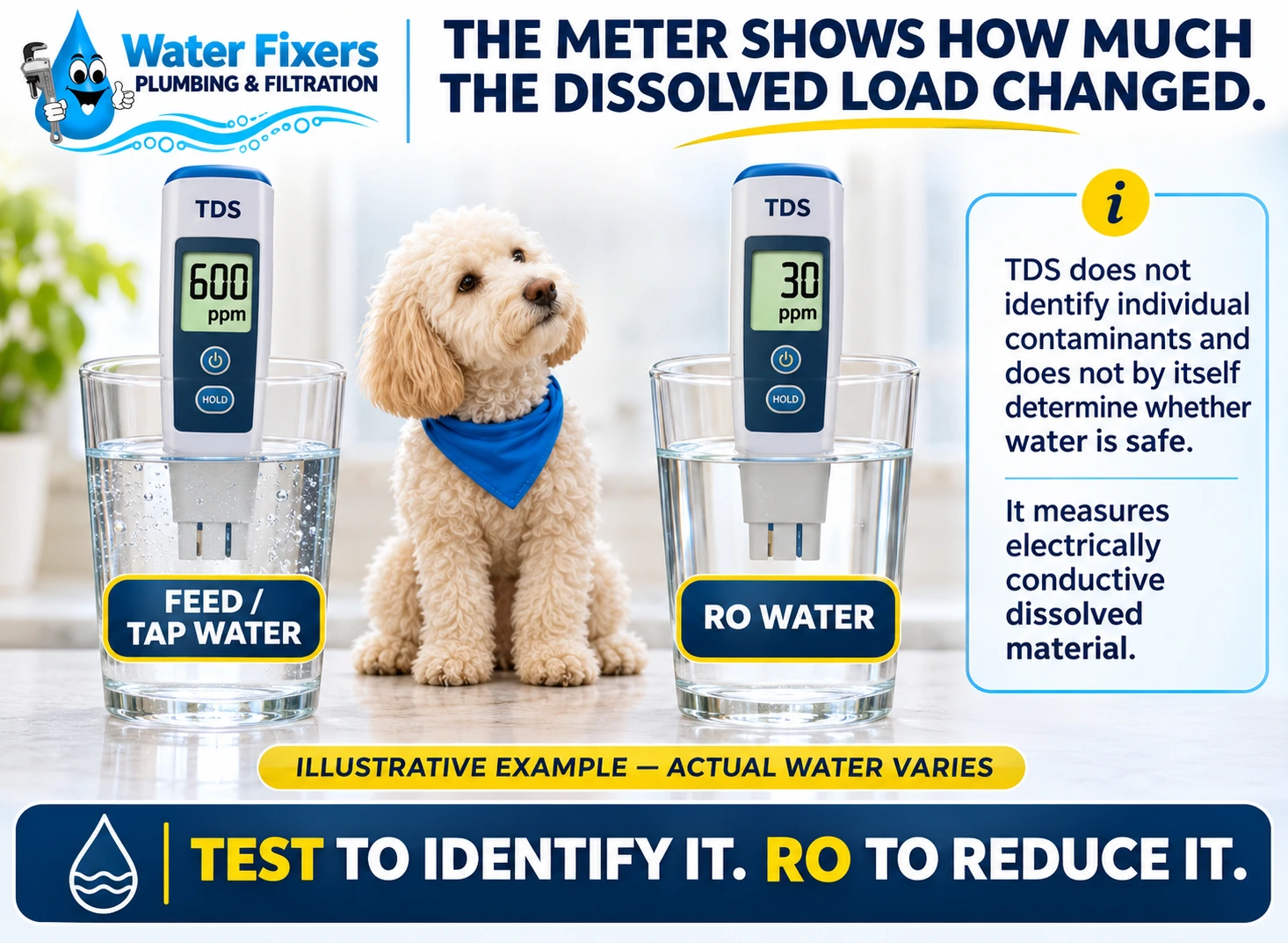
What Does a TDS Meter Actually Tell You?
Total Dissolved Solids, or TDS, is often used as a quick way to demonstrate how much electrically conductive dissolved material is present in water. A large difference between feed-water TDS and RO-water TDS can visually demonstrate that the membrane is substantially changing the dissolved-solids content.
But a TDS meter is not a contaminant-identification device. A higher TDS number does not automatically mean the water is dangerous, and a low TDS number does not identify whether a specific contaminant is absent.
Use TDS for what it is good at: showing the overall change in dissolved ionic content before and after treatment. Use proper testing when you need to know what substances are actually present.
The Cost of Treating the Wrong Problem
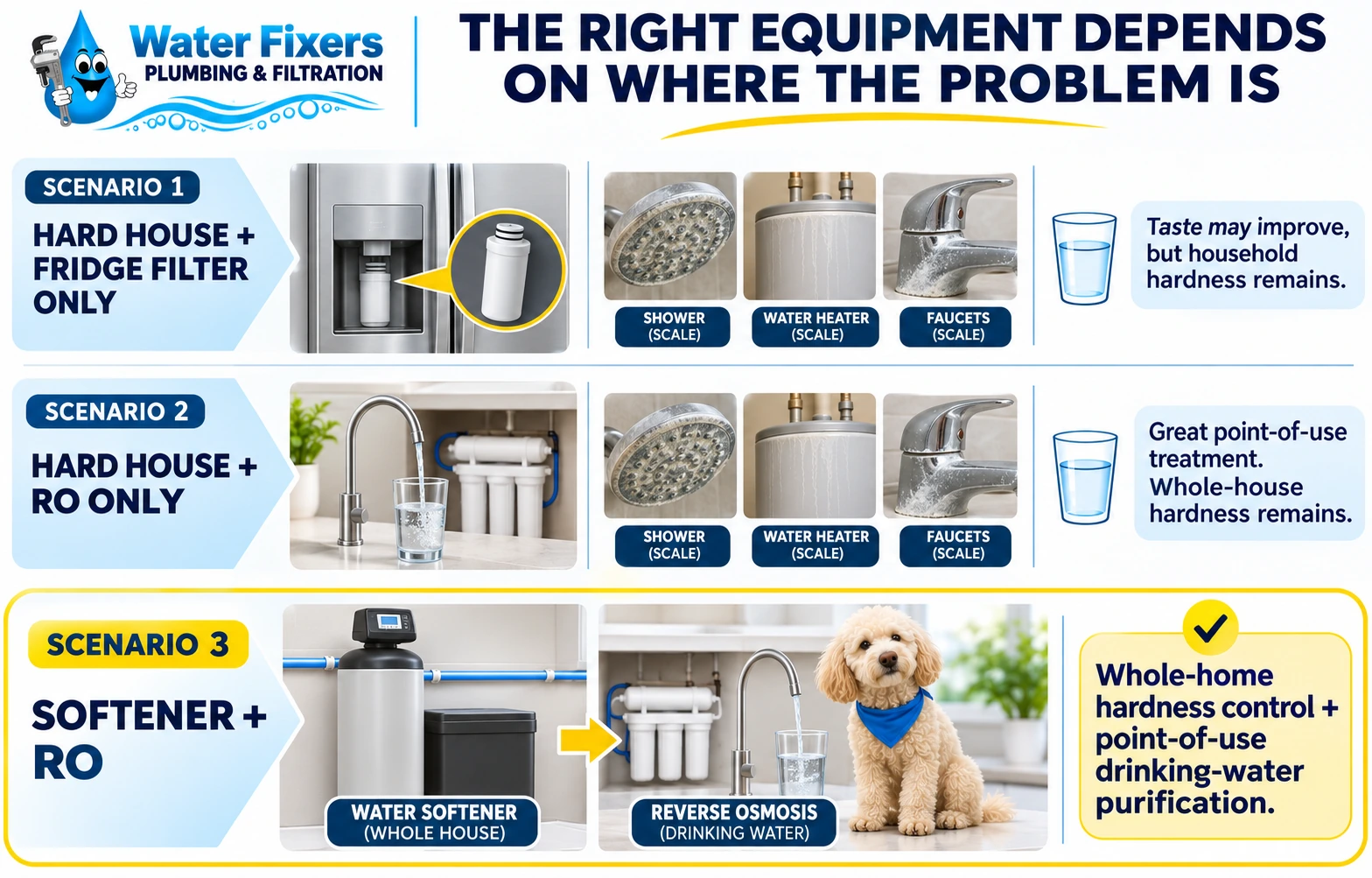
A lot of disappointing water-treatment experiences come from using a good product for the wrong job.
A refrigerator filter may help taste but leave hardness throughout the house. A kitchen RO may provide excellent drinking water while scale continues building on shower glass and household fixtures. A softener may solve the hardness problem but still leave a homeowner wanting a different drinking-water experience.
This is why Water Fixers treats the location of the problem as seriously as the problem itself.
Hard Water, Softeners & RO: Common Myths
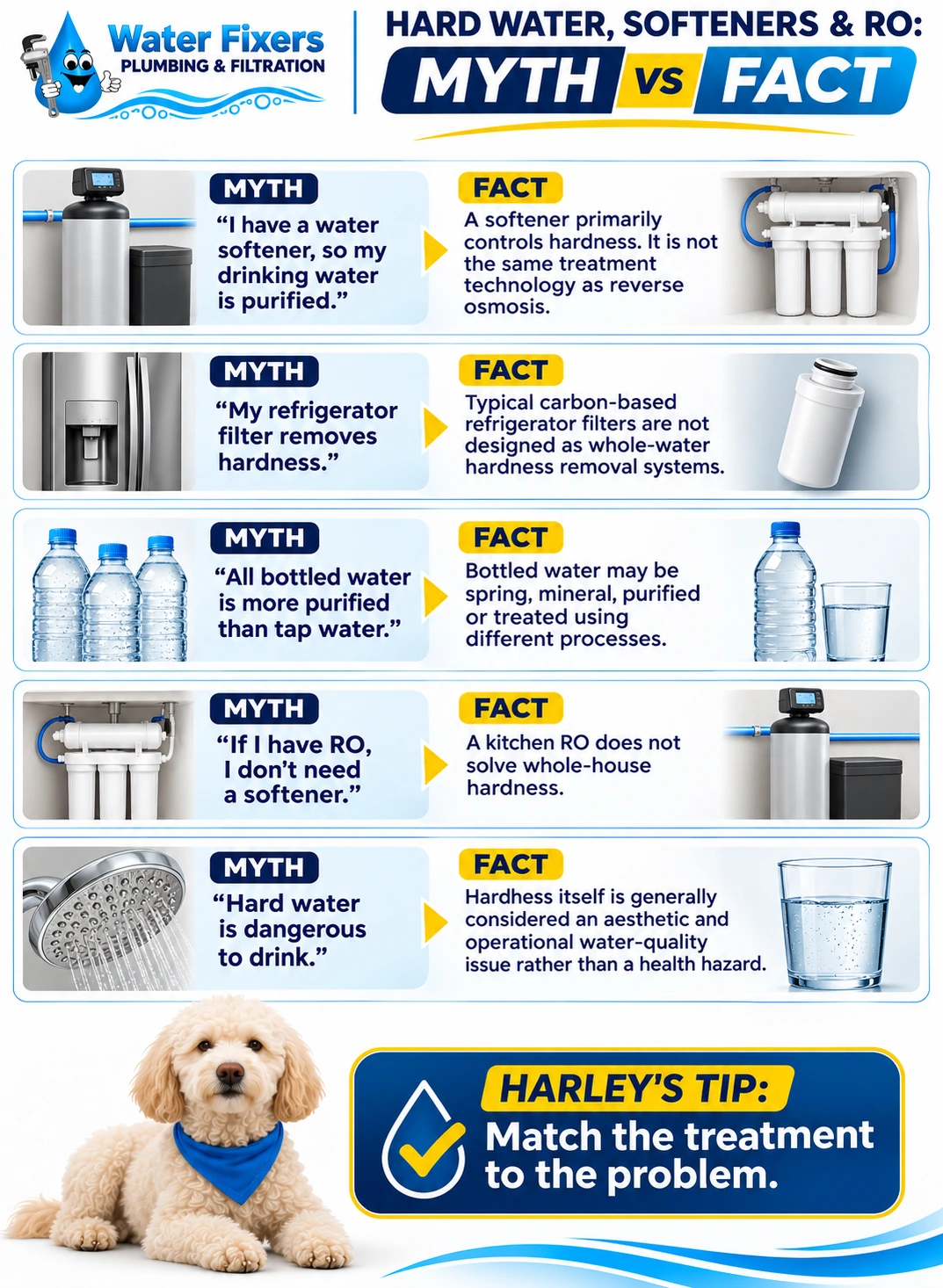
“I have a softener, so my drinking water is purified.”
A softener is designed primarily for hardness control. That is different from RO membrane treatment.
“My refrigerator filter removes hardness.”
A typical carbon-based refrigerator filter is not a whole-home hardness-removal system.
“All bottled water is more purified than tap water.”
Bottled water can come from different sources and use different treatment processes. Read the label and treatment description.
“If I have RO, I don’t need a softener.”
An under-sink RO does not protect the shower, water heater, laundry equipment, dishwasher, or every other fixture from whole-home hardness.
“Hard water is dangerous to drink.”
Hardness itself is generally treated as an aesthetic and operational water-quality issue rather than a health hazard. The stronger reason to address hardness is what it does throughout the home—and the opportunity it gives us to understand dissolved water chemistry correctly.
Think of Water Treatment as a Ladder
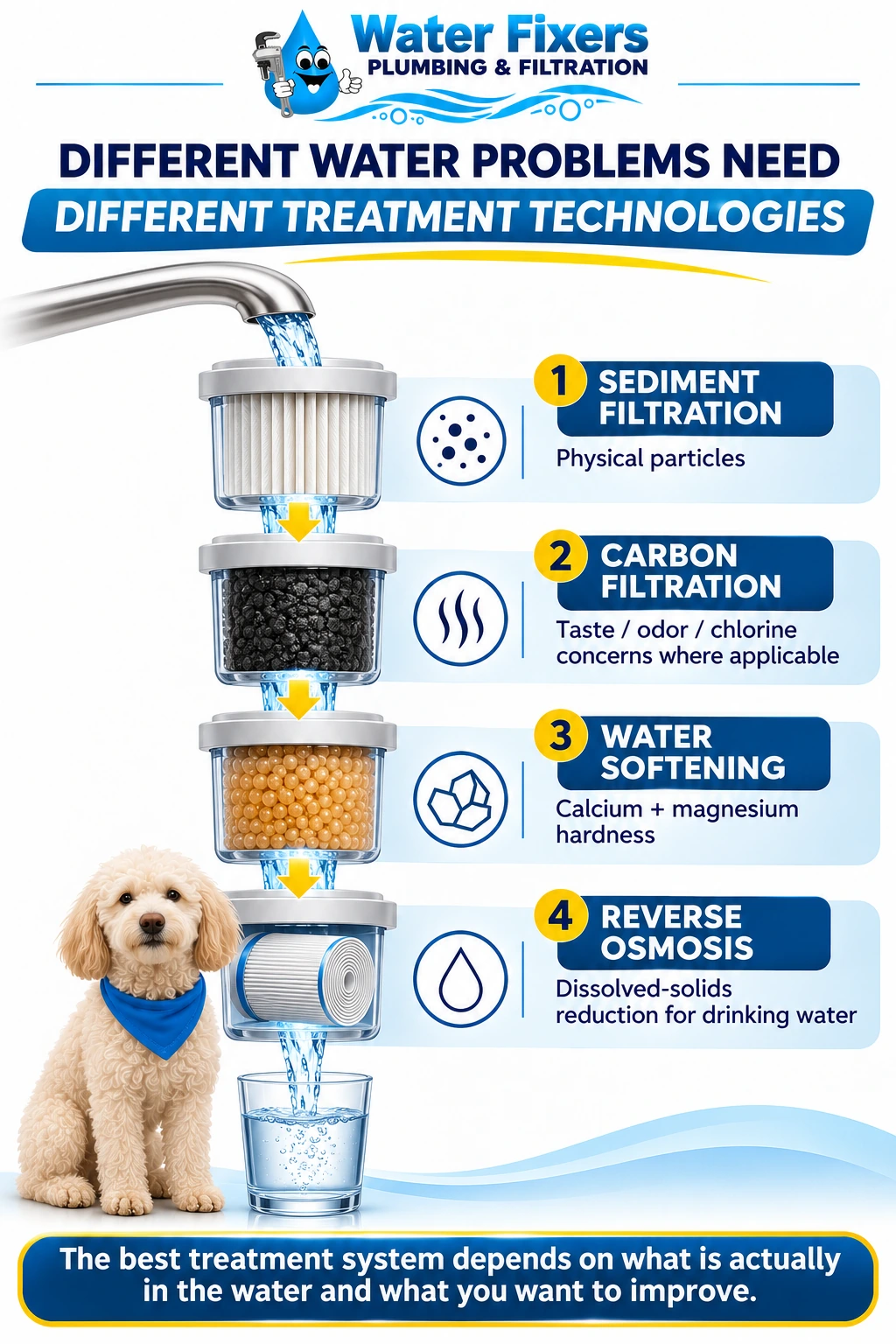
Instead of looking for one piece of equipment that supposedly fixes everything, it is better to match each treatment technology to the job it was designed to do.
- Sediment treatment — physical particles and suspended material.
- Carbon treatment — targeted taste, odor, chlorine, and other concerns depending on the media.
- Water softening — calcium and magnesium hardness throughout the home.
- Reverse osmosis — broad dissolved-solids reduction for drinking water.
The ideal system may use one of these technologies or several of them together. That depends on the source water, water test results, household demand, hardness level, and what the homeowner actually wants to improve.
So What Is the Best Setup for a Hard-Water Home?
For many homes with significant hardness, the most complete approach is straightforward:
1. Control hardness throughout the home.
Use a properly sized water softener to address calcium and magnesium before hard water reaches the fixtures, water heater, laundry equipment, dishwasher, and other plumbing.
2. Treat the water you actually drink.
Use reverse osmosis at the kitchen to substantially reduce dissolved solids for drinking, cooking, refrigerator water, and ice where the installation allows.
3. Start with the actual water.
Water chemistry varies. Testing and a proper system evaluation are more useful than choosing equipment based on a generic sales pitch.
Water Fixers services residential and commercial water-treatment systems throughout California’s Central Coast. We can help determine whether the real problem is hardness, drinking-water quality, another water-quality issue—or a combination.
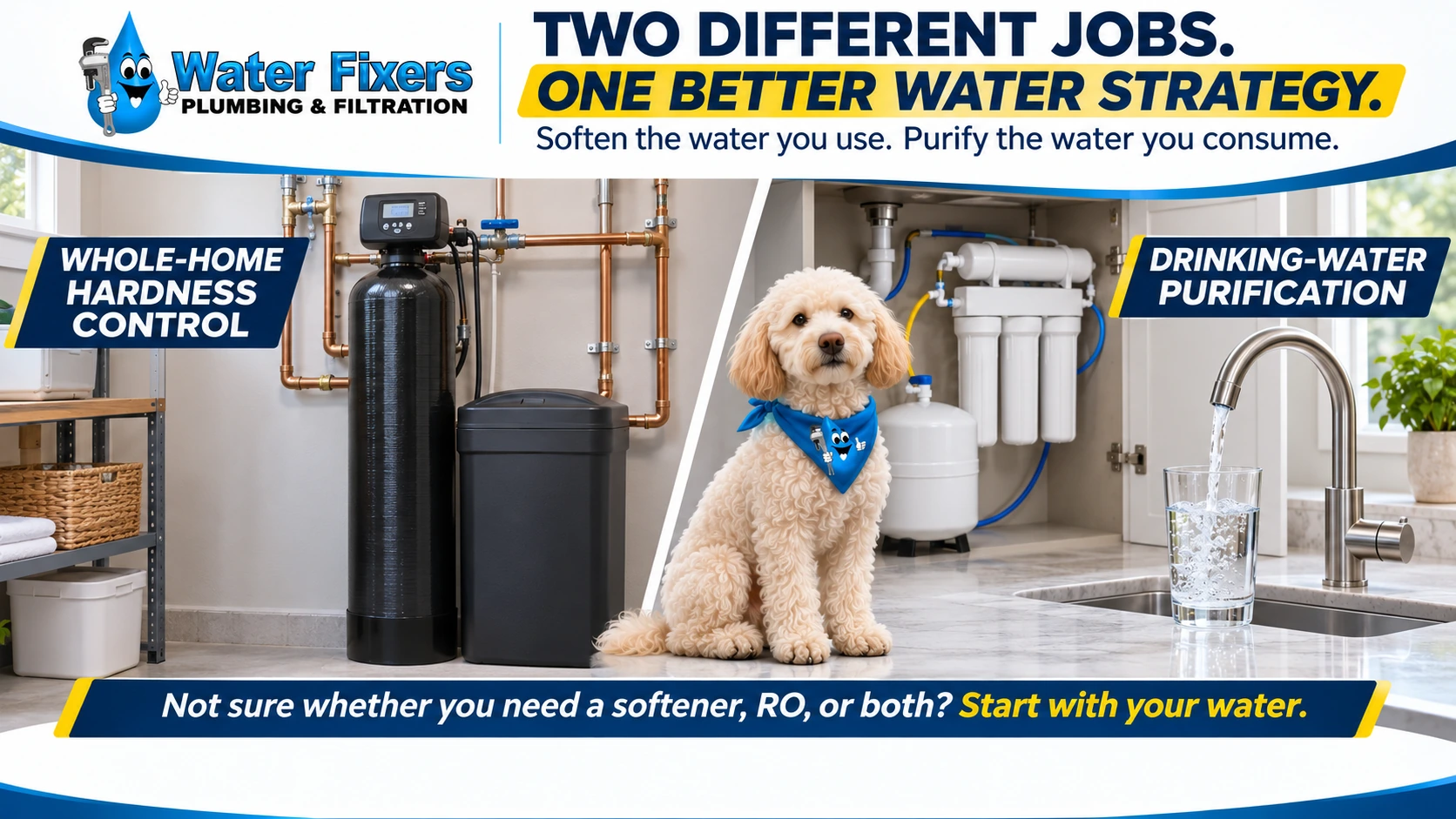
Not Sure Whether You Need a Softener, RO, or Both?
Start with your water and the problem you’re trying to solve. Water Fixers can help you build the right treatment strategy instead of trying to make one piece of equipment do every job.
Start With Water Testing
Explore Water Softeners
Compare RO Systems
Call 805-928-6444
Water Fixers Plumbing & Filtration • California License #719792
Frequently Asked Questions About Hard Water, Softeners, and RO
Does reverse osmosis remove hardness?
RO can substantially reduce calcium and magnesium at the drinking-water point, but it is not a whole-home hardness solution. If scale is affecting showers, fixtures, appliances, or the water heater, a properly sized water softener is the more appropriate whole-house treatment.
Does a water softener purify drinking water?
No. A water softener primarily controls hardness. It exchanges calcium and magnesium ions but is not designed to perform the same broad dissolved-solids reduction as reverse osmosis.
Is softened water the same as RO water?
No. Softened water has had hardness minerals exchanged; RO water has passed through a membrane designed to reduce a much broader dissolved-solids load.
Why put RO after a water softener?
The softener handles the high-volume hardness problem first, while RO treats the smaller volume used for drinking and cooking. This gives the home whole-house hardness control plus point-of-use drinking-water treatment.
Can hard water damage an RO membrane?
Very hard or scale-forming feed water can increase scaling stress on an RO membrane. Pretreatment may be appropriate depending on hardness, water chemistry, system design, and manufacturer requirements.
Is hard water unhealthy?
Hardness itself is generally considered an aesthetic and operational water-quality issue rather than a health hazard. Calcium and magnesium are common hardness minerals. If you are concerned about a specific contaminant, test for that contaminant rather than using hardness or TDS as a substitute.
Should I test my water before buying a softener or RO?
Yes when treatment decisions depend on the actual water chemistry. Hardness testing helps size a softener correctly, and targeted water testing helps determine whether an RO or another treatment method matches a specific water-quality concern.
About This Water Fixers Guide
Water Fixers Plumbing & Filtration serves homes and businesses across California’s Central Coast, including communities in Santa Barbara and San Luis Obispo counties. Our work includes water testing, water softeners, reverse osmosis, whole-house filtration, plumbing, installation, maintenance, and repair.
California Contractor License #719792 • View Water Fixers service areas • Contact Water Fixers
Related Water Fixers Guides
Central Coast Hard Water
Local hardness testing and whole-home treatment planning.
Sources & Further Reading
- U.S. Geological Survey — Hardness of Water: calcium, magnesium, hardness classifications, scale, and household effects.
- CDC — About Home Water Treatment Systems: water softeners, reverse osmosis, and what each treatment method is designed to reduce.
- U.S. EPA WaterSense — Guide to Selecting Water Treatment Systems: activated carbon, dissolved minerals, RO treatment, and system-selection considerations.
- NSF — Bottled Water: spring, mineral, and purified bottled-water categories and treatment methods.
- NSF/ANSI 58 — Reverse Osmosis Drinking Water Treatment Systems: RO performance and TDS-reduction testing requirements.
Water-treatment note: Actual reduction performance depends on system design, membrane condition, feed-water chemistry, pressure, temperature, maintenance, and the specific performance claims or certifications of the installed equipment. Water testing is the appropriate way to determine whether a specific contaminant is present.