










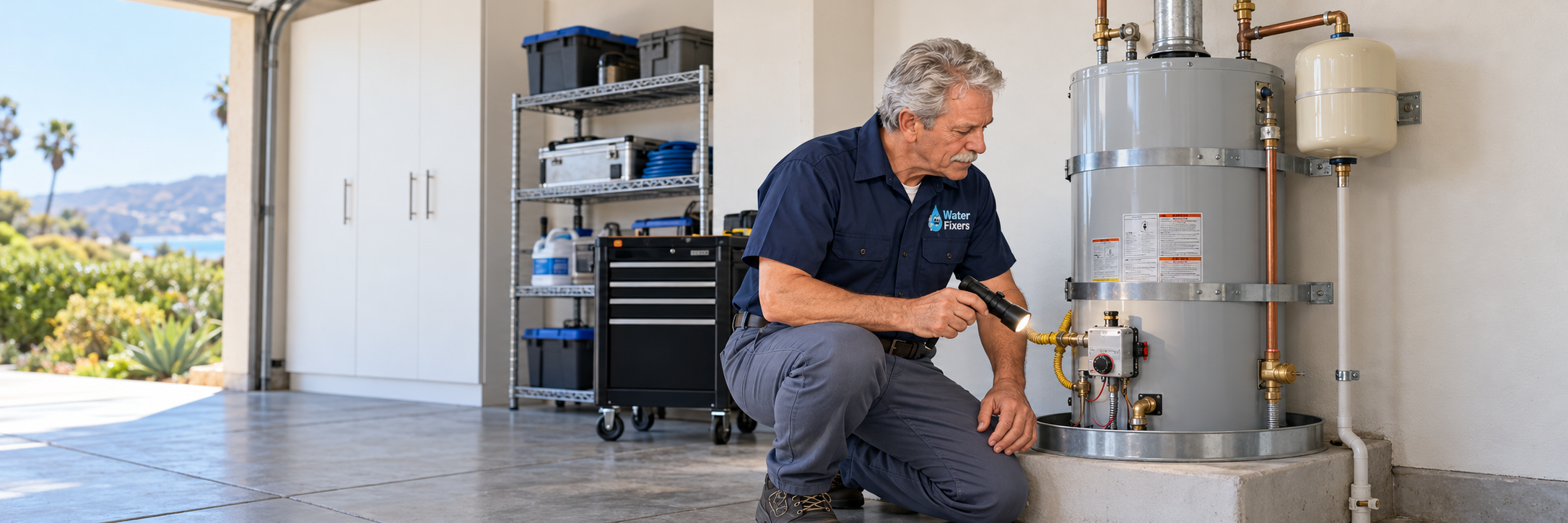



TIPS FROM HARLEY • WATER QUALITY GUIDE
Orange stains, rusty-looking water, metallic taste, sediment, or water that looks clear at first and turns orange later can all be consistent with iron—but they do not tell you what form of iron is present or where it came from. There is no single “iron filter” that is right for every home.
Quick Answer: What Removes Iron From Water?
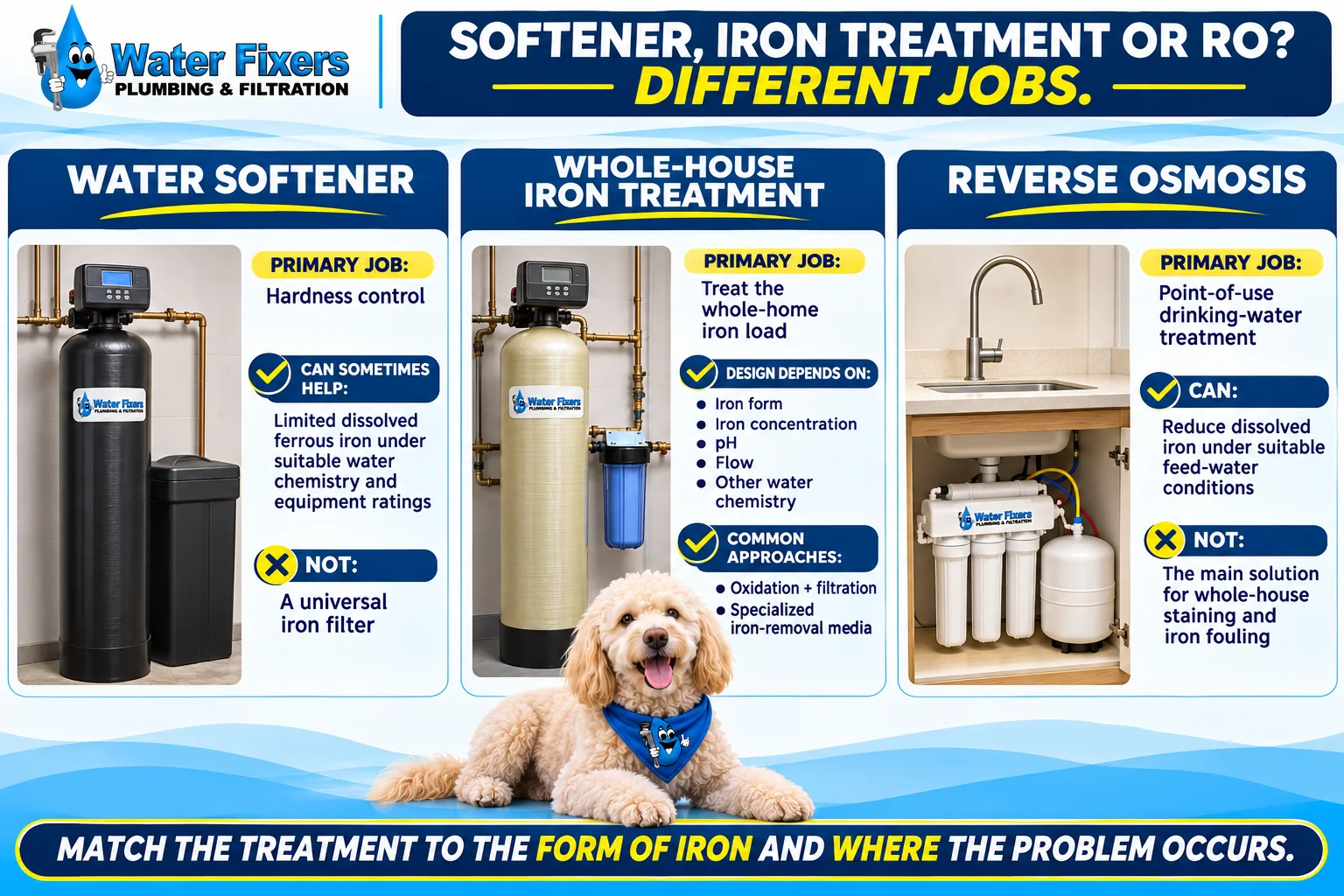
A water softener may help with limited dissolved ferrous iron. Whole-house iron treatment is often a better fit for significant dissolved or oxidized iron loads. Reverse osmosis belongs mainly at the drinking-water point—not as the main fix for whole-house staining and fouling.
Harley’s rule: Don’t buy a tank because of a stain. Find out what made the stain first.
Start With Water Testing
Explore Well-Water Treatment
Ask Water Fixers
| What the water shows | Likely treatment role | Why testing matters |
|---|---|---|
| Limited dissolved ferrous iron + hardness | Properly rated water softener may help | Iron level, pH, hardness and equipment limits matter |
| Significant dissolved or oxidized iron | Whole-house iron treatment | Oxidation/filtration or specialty media may fit |
| Iron bacteria / slime | Cleaning, disinfection and broader well treatment | A filter alone may not solve the biological source |
| Drinking-water polishing after upstream treatment | Reverse osmosis | RO is point-of-use, not a whole-house iron fix |

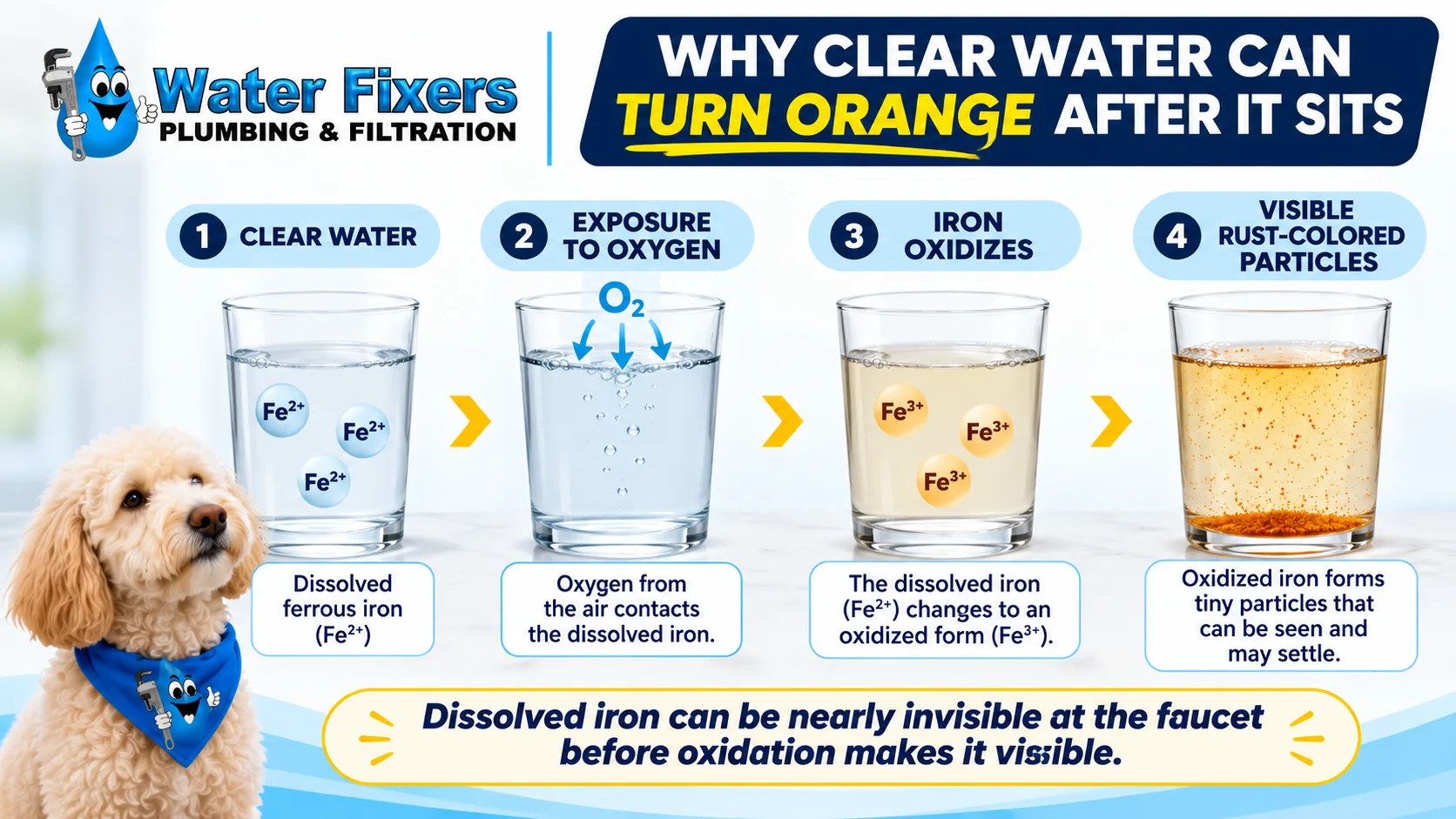
Why Can Clear Water Turn Orange After It Sits?
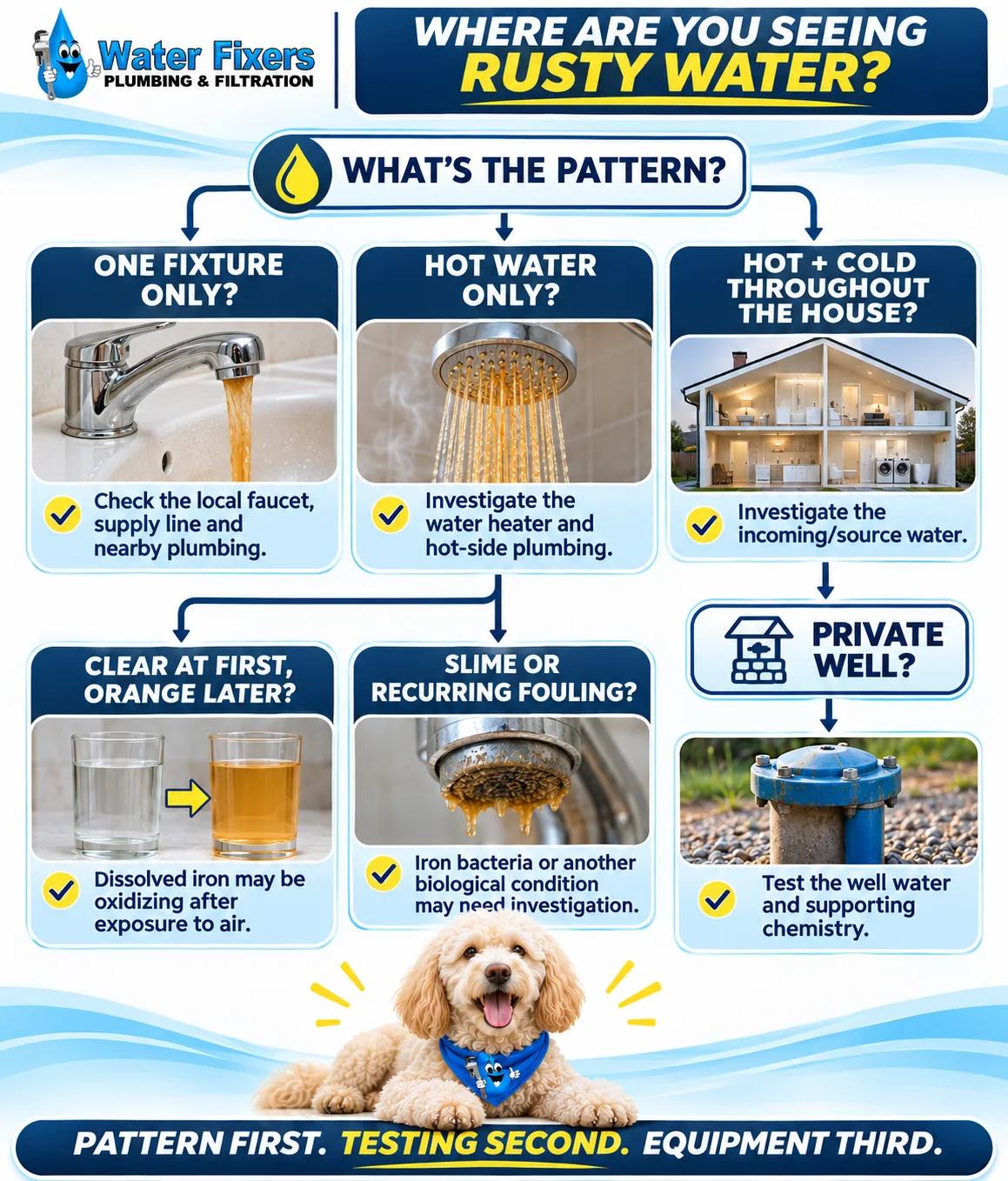
Dissolved ferrous iron can be nearly invisible when water first leaves the faucet. After the water is exposed to oxygen, that dissolved iron can oxidize into a visible yellow-orange, reddish-brown, or rust-like form. That is why a glass can look clear when it is first filled and change after standing.
This is an important clue, but it is still not a complete diagnosis. Corrosion products, manganese, sediment, and mixed water-quality problems can create overlapping symptoms. The goal is to identify the source and form before choosing treatment.
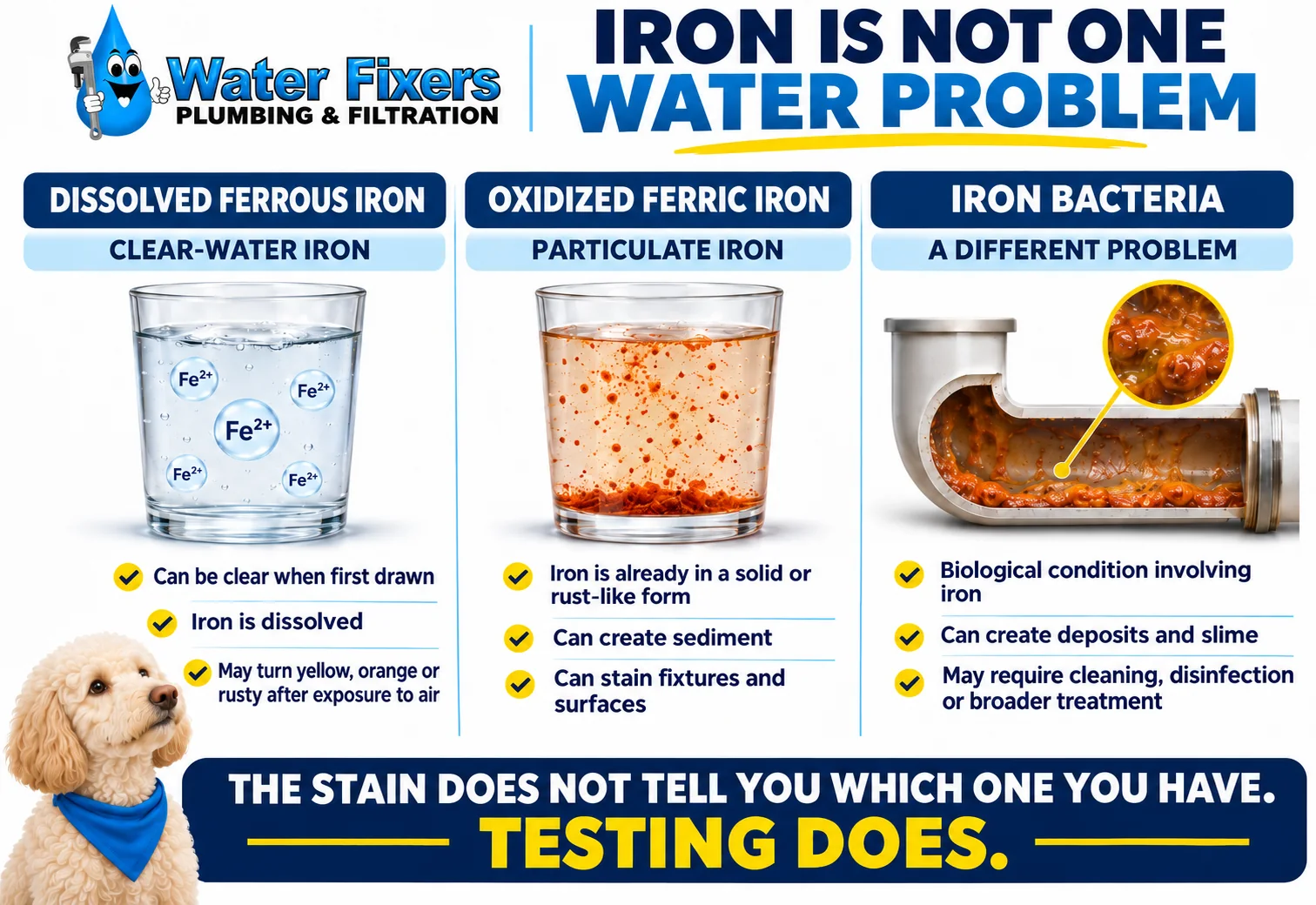
Iron Is Not One Water Problem
The word “iron” can describe several very different treatment situations:
- Dissolved ferrous iron: iron remains dissolved and water may appear clear when first drawn.
- Oxidized ferric iron: iron has already become particles that may look orange, red-brown, or rust-like.
- Iron bacteria: a biological condition in wells or plumbing that can create rusty deposits, slime, fouling, and recurring maintenance problems.
Those forms behave differently in softeners, sediment filters, oxidation systems, and membranes. A treatment system selected from stain color alone can easily be the wrong tool.
Want the technical contaminant details? The Water Fixers Iron in Water guide covers forms, testing, standards, and treatment limitations in more depth.
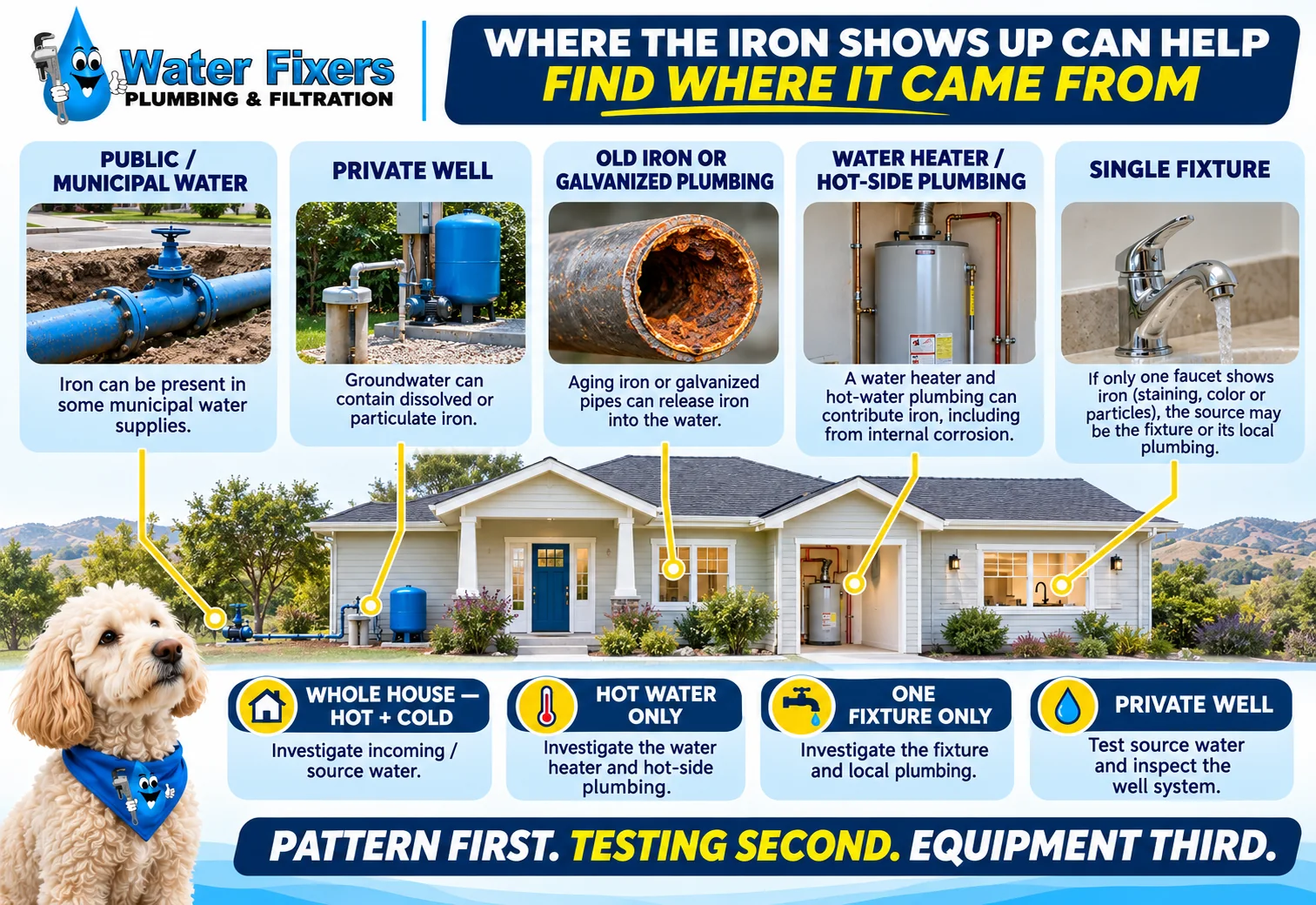
Where Is the Iron Coming From?
Iron can originate in groundwater, a well system, corroding iron or steel components, a water heater, older galvanized plumbing, or a single fixture. The pattern inside the home can narrow the investigation.
Does a Water Softener Remove Iron?
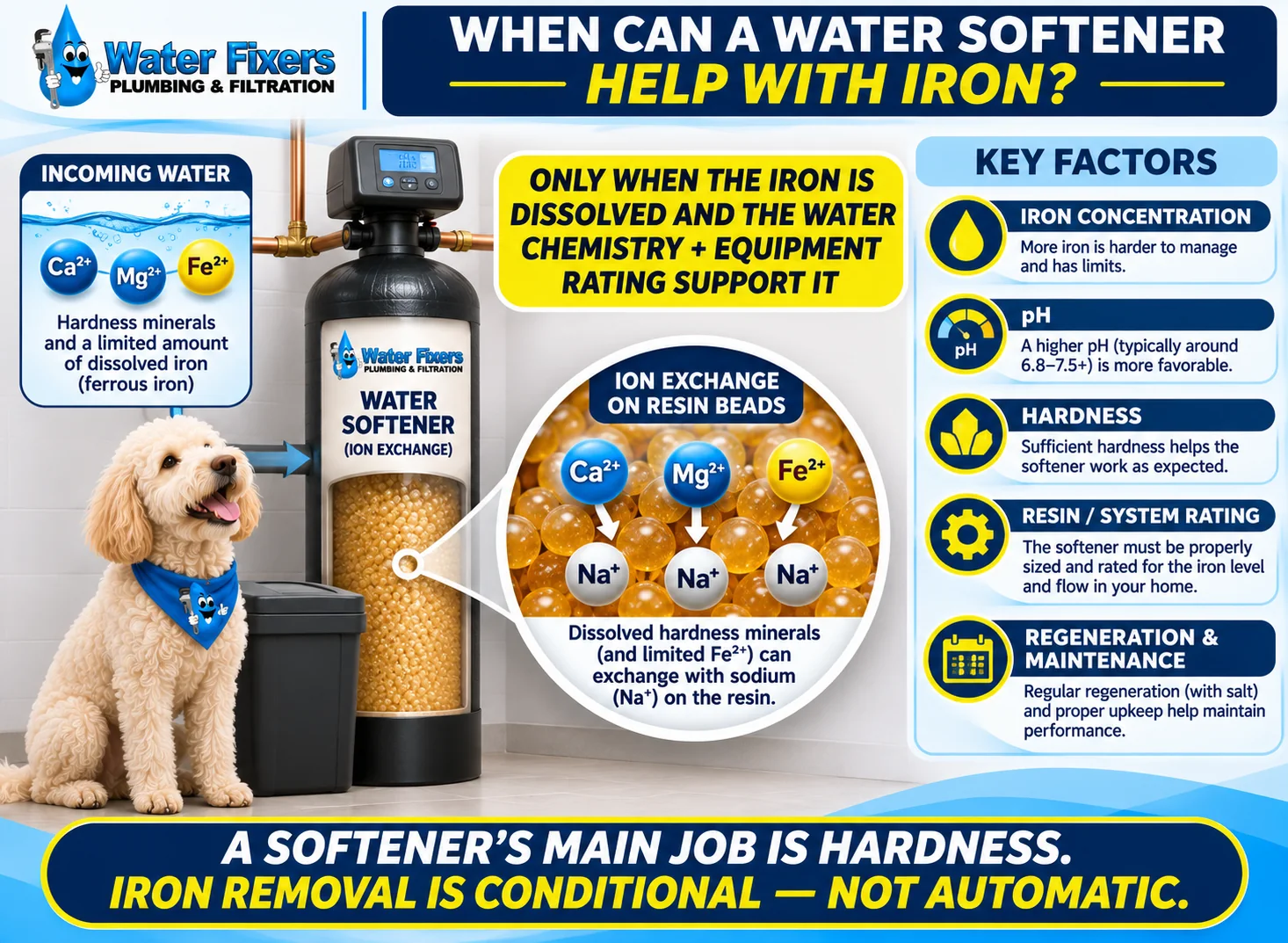
Sometimes—but that does not make a water softener a universal iron filter. Ion-exchange softeners are designed primarily to remove calcium and magnesium hardness. Under suitable conditions, a properly rated softener may also reduce limited amounts of dissolved ferrous iron.
Whether that is appropriate depends on the iron concentration, pH, hardness, resin and equipment rating, regeneration settings, maintenance, and what else is in the water. A manufacturer’s documented limits matter.
When a Softener Can Be the Wrong Tool
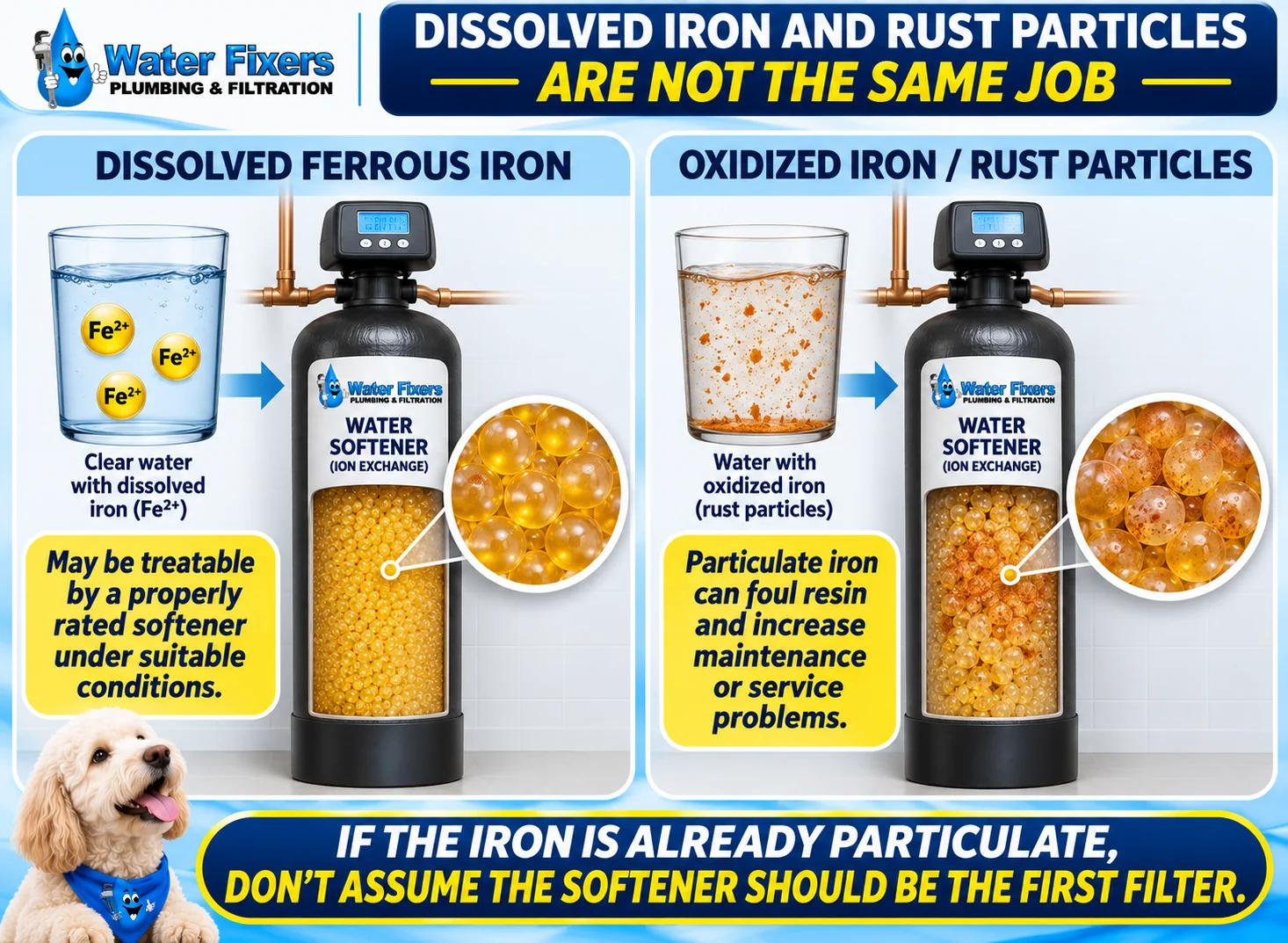
Oxidized iron is already a particle. Sending a significant particulate iron load into softener resin can contribute to fouling and service problems. Iron-bacteria problems can also foul equipment and require a different approach.
That is why the question is not simply, “Will a softener remove iron?” It is, “What form of iron is present, and is this softener actually rated for that water?”
When Do You Need Whole-House Iron Treatment?
When iron affects fixtures, toilets, showers, laundry, appliances, plumbing, or treatment equipment throughout the house, point-of-entry treatment usually makes more sense than asking a small drinking-water device to handle the entire problem.
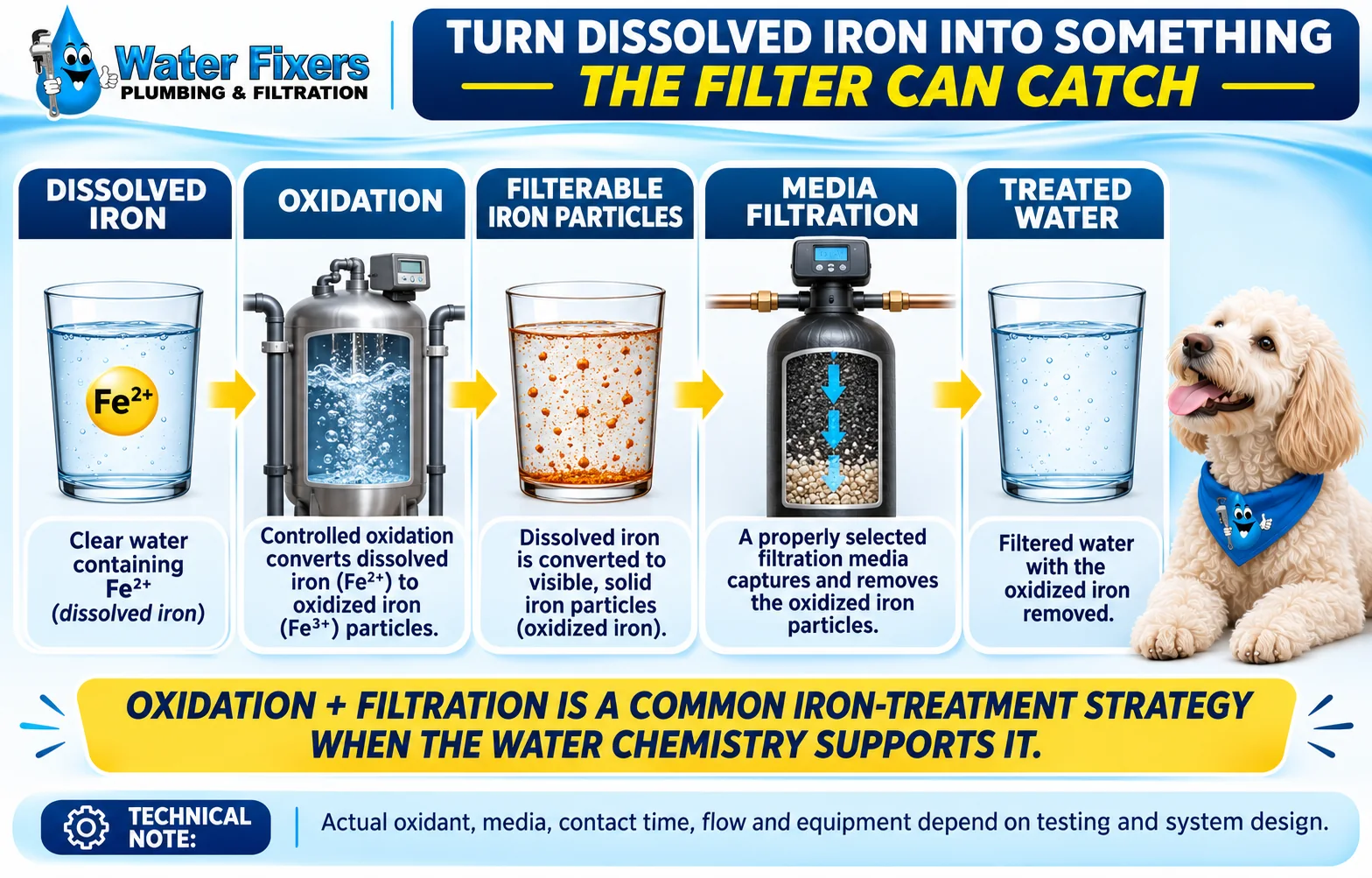
A common treatment concept is oxidation followed by filtration. Dissolved iron is converted into a filterable form, and an appropriately selected media/filter captures the resulting particles. The actual oxidation method, media, contact time, flow rate, backwash requirement, and system size depend on testing and the equipment design.
Where Does Reverse Osmosis Fit?
Reverse osmosis is best thought of as a drinking-water treatment step, not the main solution for orange stains throughout a house. An RO membrane can reduce many dissolved inorganic constituents under suitable feed-water conditions, including dissolved iron, but a significant iron load can contribute to fouling and increased maintenance.
If iron is staining toilets, showers, sinks, laundry, or plumbing, solve the larger whole-house problem upstream. Then let RO do the drinking-water job it is designed to do.
Iron + Hard Water: Can You Need Both an Iron System and a Softener?
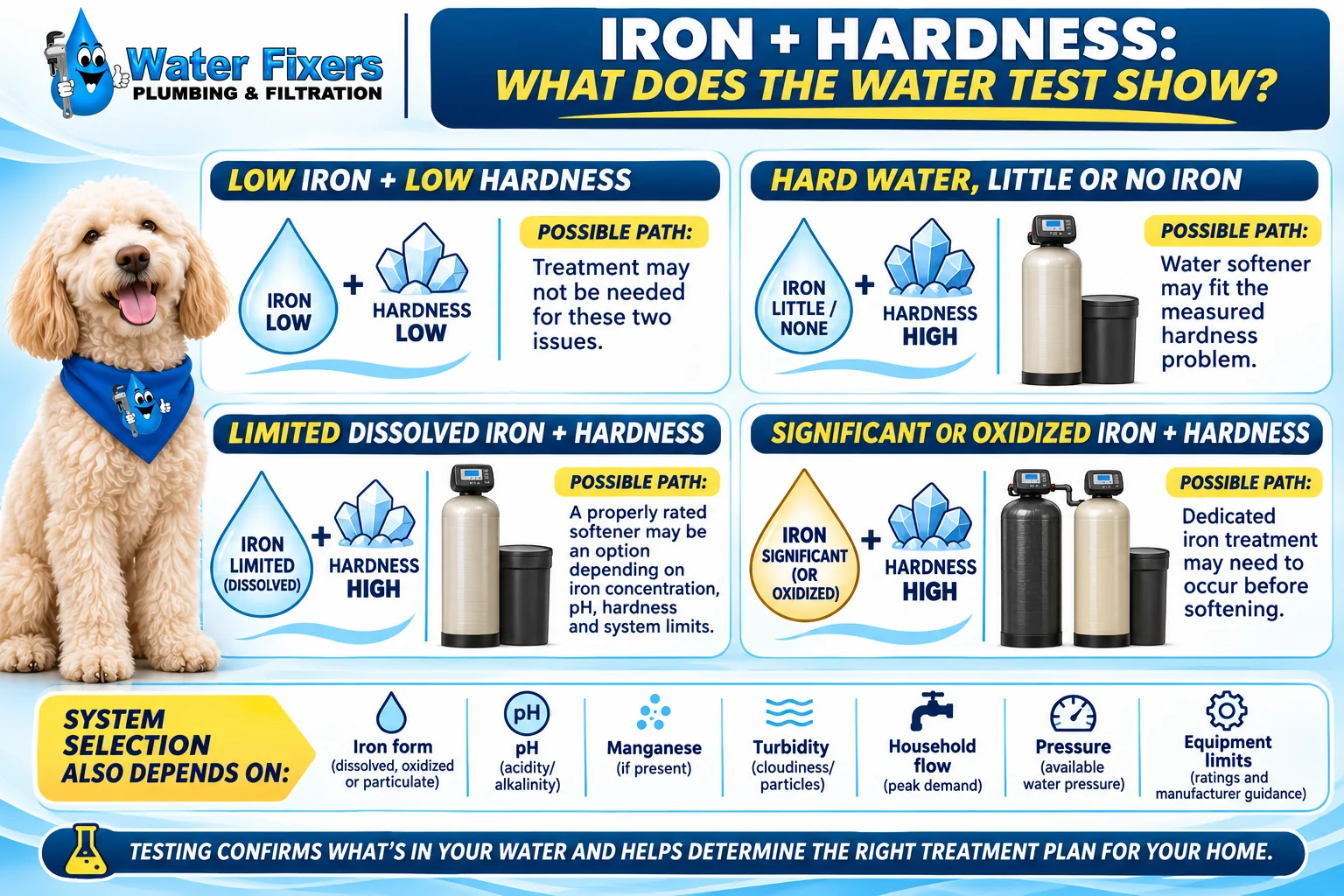
Yes. Iron and hardness can occur together, especially in groundwater. But they are not the same condition.
If testing shows hard water with little or no iron, a softener may be the main treatment. If the water contains limited dissolved iron and hardness, a properly rated softener may be able to address both under the right conditions. If the iron load is significant, oxidized, or otherwise outside the softener’s limits, dedicated iron treatment may need to come first.
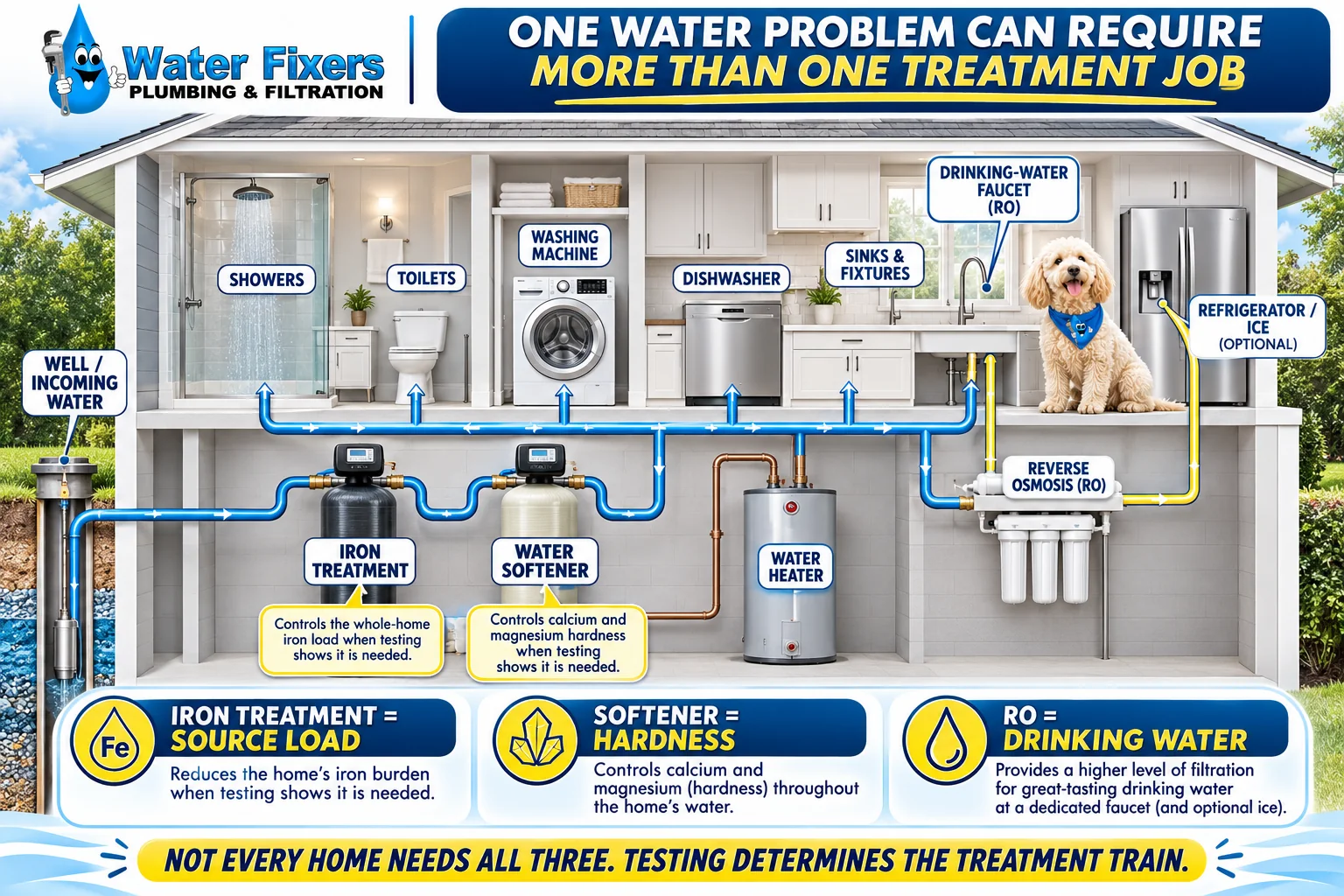
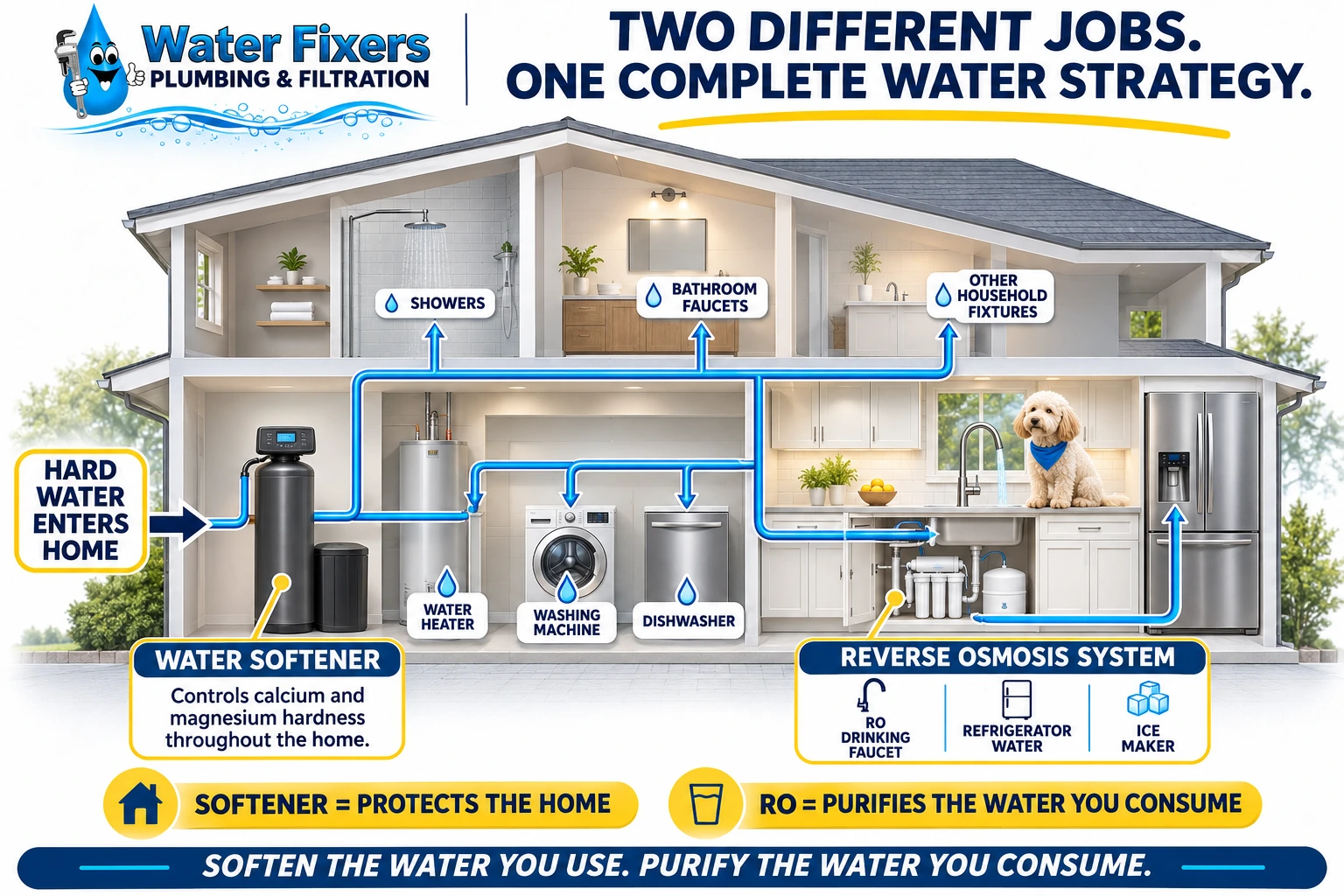
Can a Home Need Iron Treatment + a Softener + RO?
It can—but only when the water test justifies all three.
- Iron treatment handles the whole-home iron load.
- Water softening handles calcium and magnesium hardness.
- Reverse osmosis treats drinking water at the point of use.
This is why Water Fixers approaches treatment as a system-design problem instead of assuming one tank should do every job.
Iron Bacteria Are a Different Problem
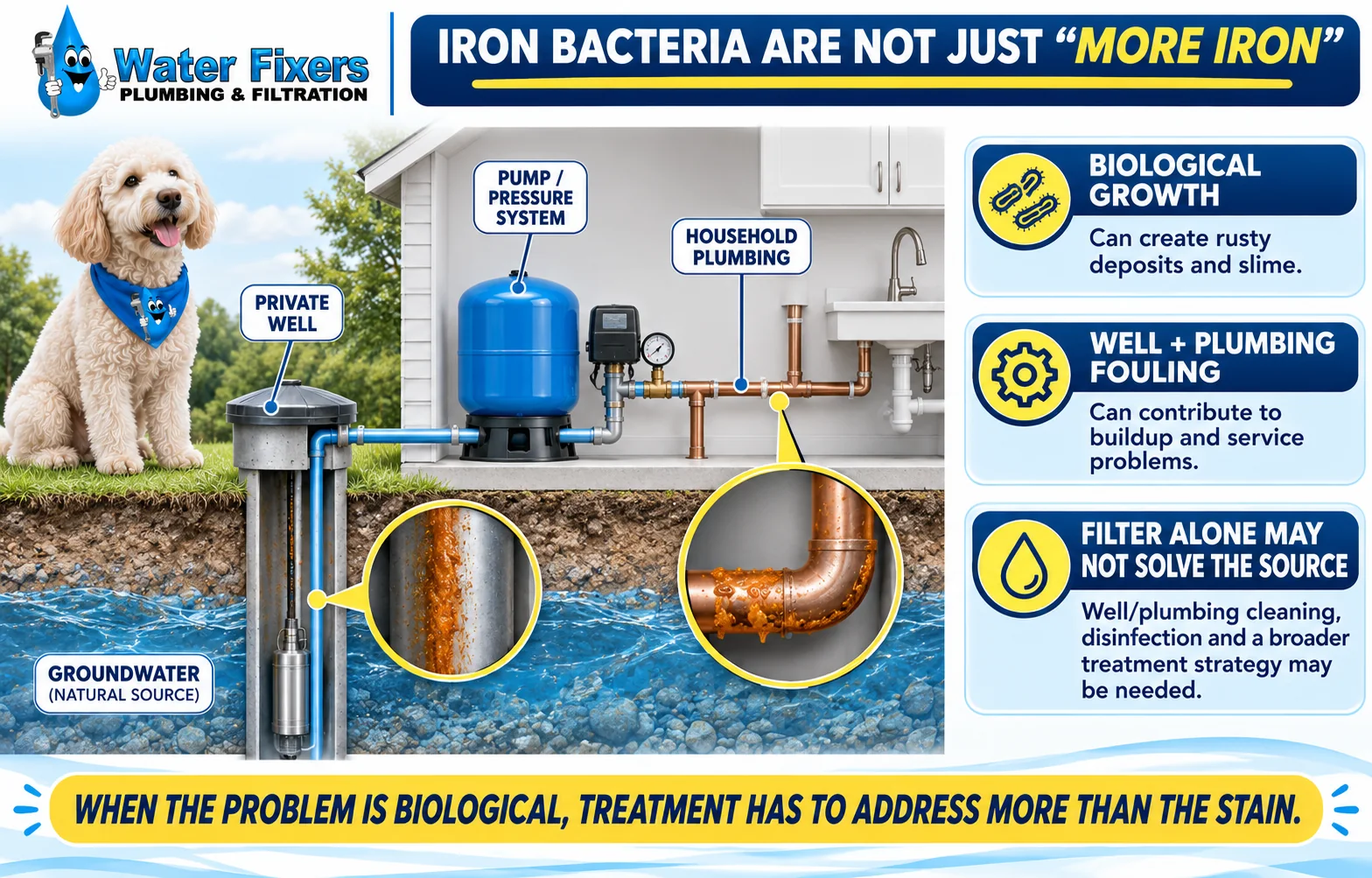
Iron bacteria are microorganisms that interact with iron and can create rusty deposits, slime, and recurring fouling in wells and plumbing. A homeowner may describe the condition as “really bad iron,” but a biological problem changes the treatment plan.
Filtration alone may not solve the source. Depending on the situation, well or plumbing cleaning, disinfection, source correction, and a broader treatment plan may be necessary. If the water comes from a private well and slime or recurring fouling is present, testing and well-system evaluation become especially important.
Iron vs. Manganese vs. Hard-Water Scale
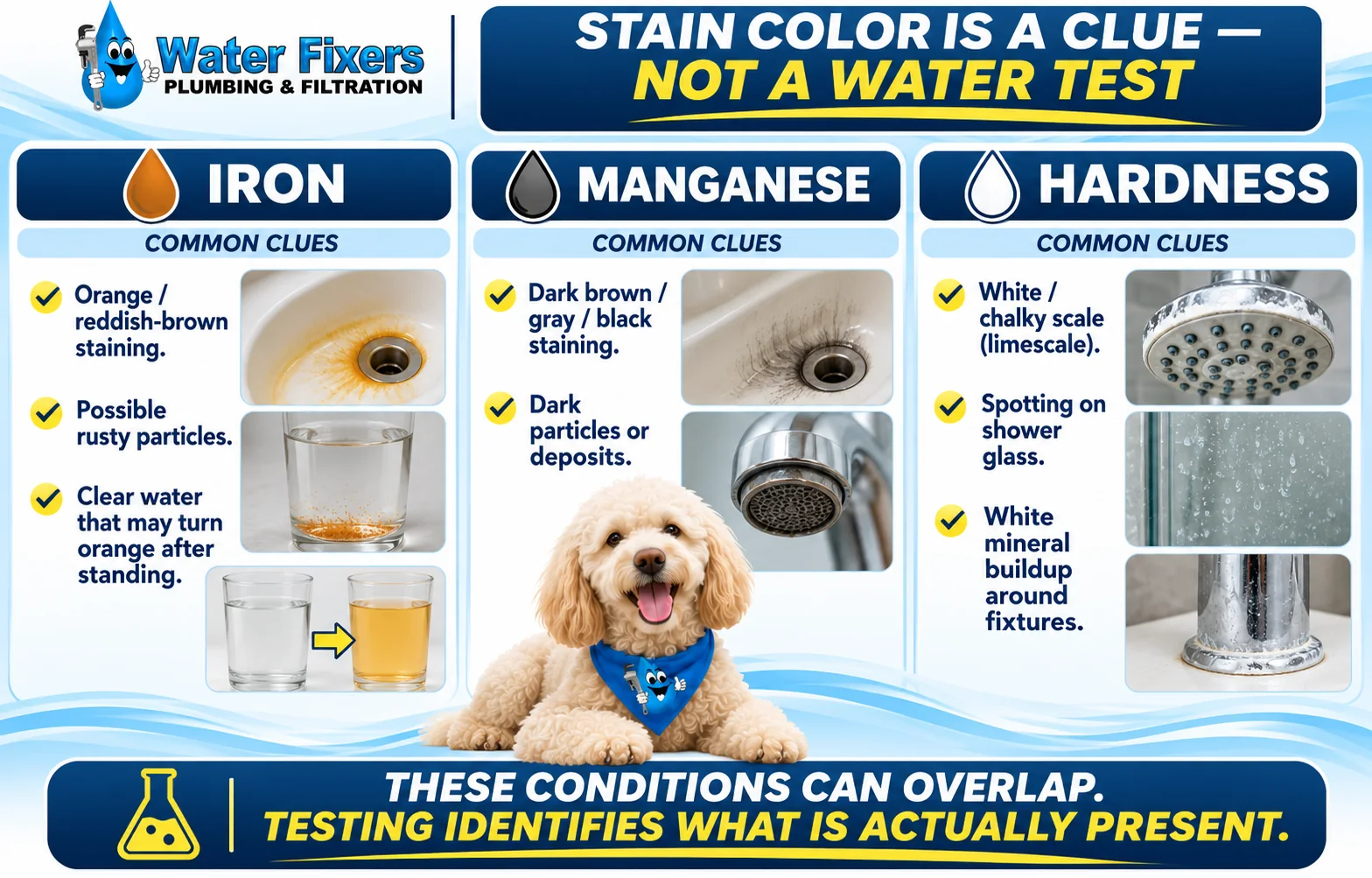
Orange or reddish-brown staining can be consistent with iron. Dark brown, gray, or black staining can be consistent with manganese. White or chalky scale is more consistent with hardness. But these conditions can overlap, and appearance alone cannot tell you the concentration or treatment requirements.
If staining is unexplained, it often makes sense to test manganese along with iron and hardness rather than diagnosing from color alone.
Where Is the Rust Showing Up?
The location of the symptom is one of the most useful pieces of information a homeowner can provide. A problem limited to one faucet points in a different direction than rusty water on both hot and cold sides throughout the house.
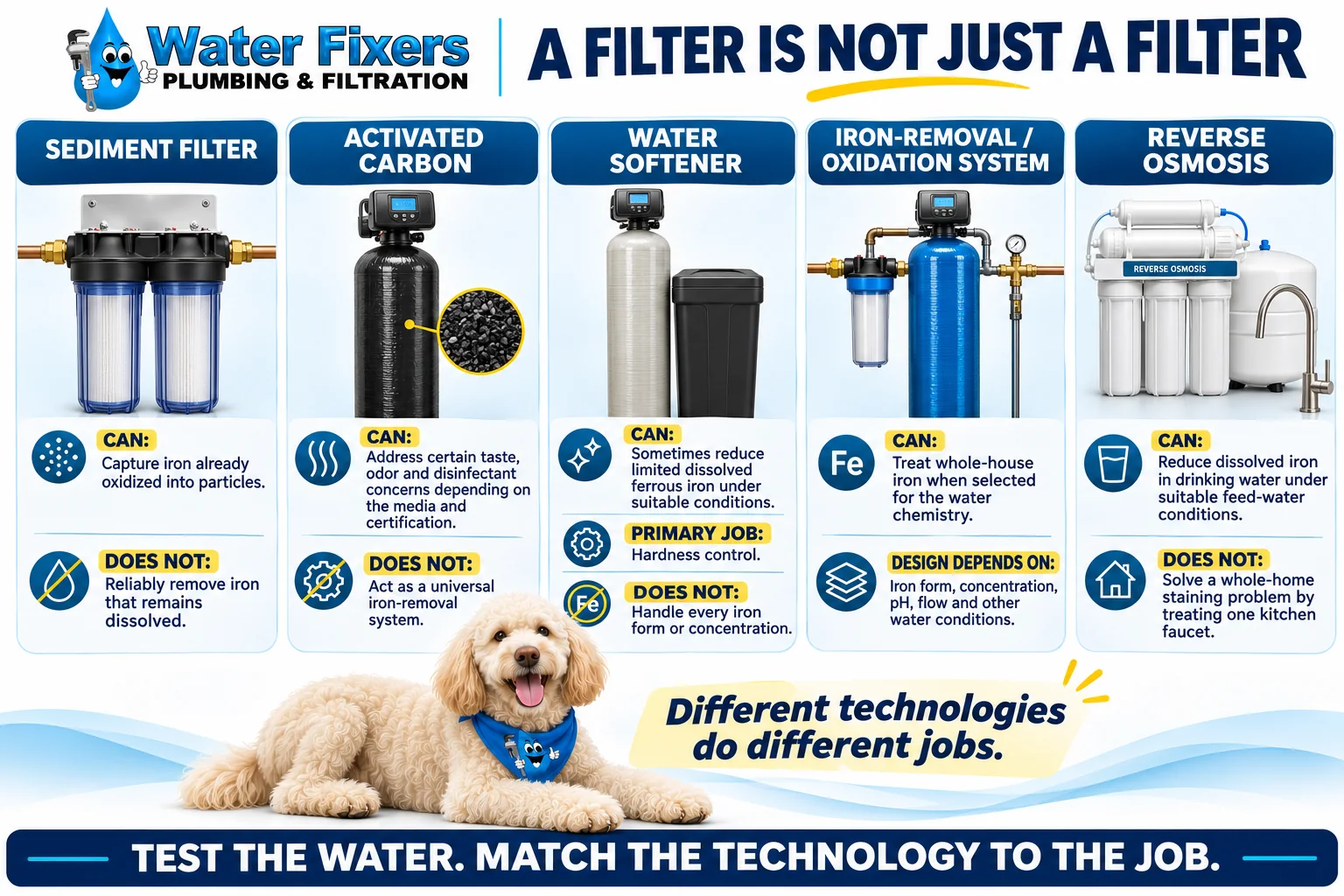
What Do Common Water Filters Actually Do With Iron?
“Filter” is a broad word. Different technologies solve different jobs:
- Sediment filtration: can capture iron that is already oxidized into particles, but dissolved iron can pass through.
- Activated carbon: can be useful for certain taste, odor, and disinfectant concerns, but ordinary carbon is not a universal iron-removal medium.
- Water softening: may reduce limited dissolved ferrous iron under appropriate conditions; its primary job is hardness.
- Iron-removal media / oxidation systems: can be designed around whole-house iron chemistry and loading.
- Reverse osmosis: can reduce dissolved iron at a drinking-water point but does not solve a whole-house staining problem by treating one faucet.
What About Iron in Water on California’s Central Coast?
Iron is especially relevant to discuss locally because the Water Fixers service area includes municipal systems, groundwater-heavy systems, mixed-source systems, and private wells. The important point is not that a particular city “has bad iron.” The important point is that source water and property conditions vary.
Santa Maria Valley: Santa Maria uses a blend of imported State Water and groundwater. In Santa Maria, Orcutt, Guadalupe, and nearby areas, a rusty-water complaint still needs property-level diagnosis because source water, premise plumbing, water heaters, and fixtures can all play a role.
Nipomo and South County: Nipomo, Arroyo Grande, Grover Beach, Pismo Beach, and nearby areas include public systems, mixed-source supplies, and private-well properties. The water source matters more than the city name.
San Luis Obispo / Coastal: San Luis Obispo relies largely on treated surface-water sources, while nearby communities and private properties can have different source profiles. Los Osos is a useful local example: its system uses groundwater wells, and some wells have filtration specifically for naturally occurring iron and manganese.
North County: Paso Robles, Atascadero, and Templeton have strong groundwater relevance. Iron should be considered together with hardness, manganese, pH, and the rest of the measured chemistry rather than treated as an isolated stain problem.
Lompoc / Vandenberg: Lompoc is groundwater-based and treats its municipal water before distribution, including processes that address iron, manganese, and hardness. A household complaint can still originate in premise plumbing or equipment downstream.
Santa Ynez Valley / Los Alamos: Private wells and smaller systems can vary substantially from one property to the next. A neighboring well result is not a substitute for testing the actual property.
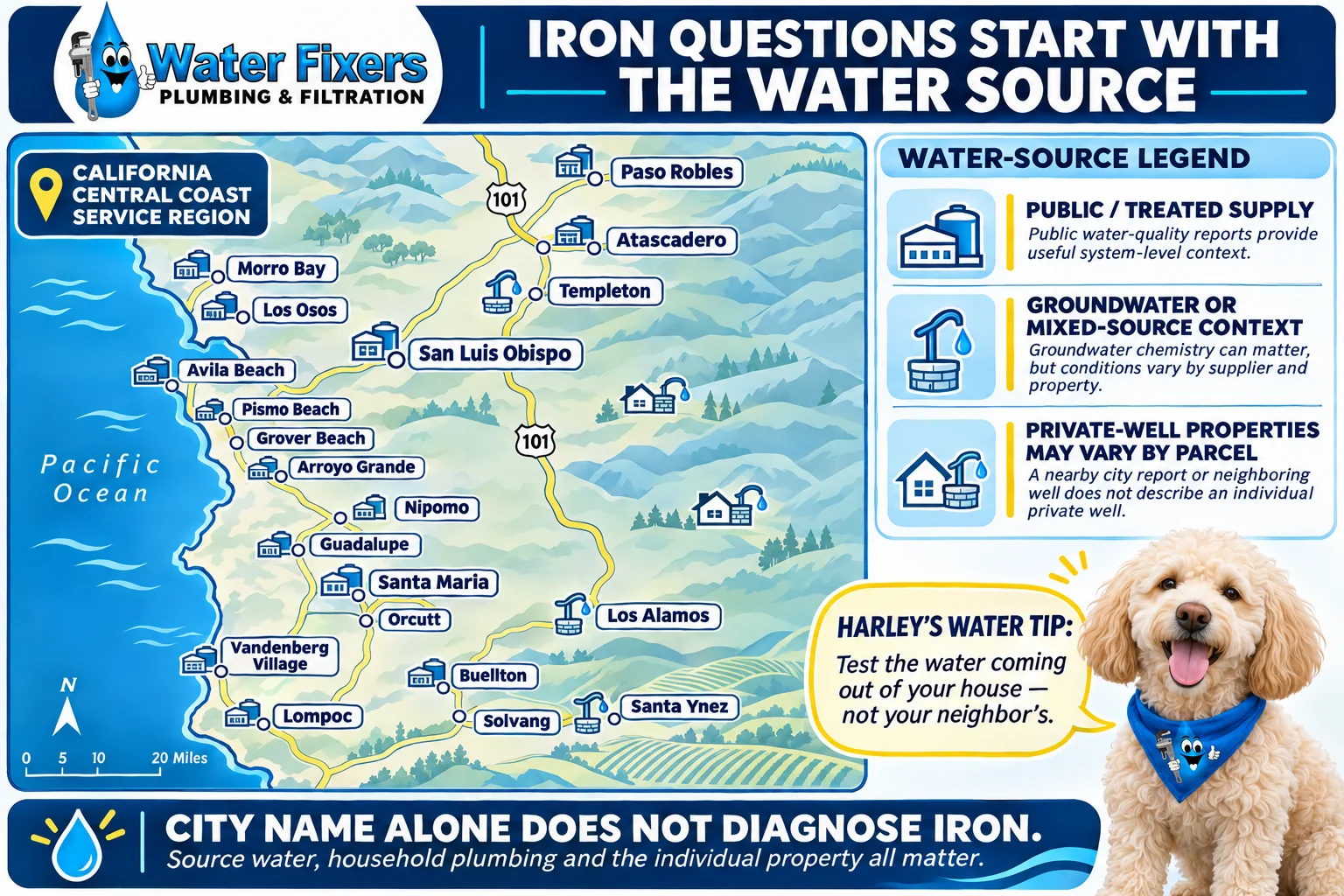
Harley’s Local Water Rule
Test the water coming out of your house—not your neighbor’s. City name alone does not diagnose iron. Source water, plumbing, and the individual property matter.
What Should Be Tested Before Choosing Iron Treatment?
A useful iron-treatment test plan usually looks beyond one number. Depending on the property and symptom, Water Fixers may need to consider:
- total iron and, when useful, dissolved iron;
- manganese;
- pH;
- hardness;
- turbidity or suspended solids;
- TDS / conductivity as supporting context;
- water source: municipal, shared, or private well;
- whether the symptom is hot-only, cold-only, fixture-specific, or whole-home;
- iron-bacteria indicators when slime, odor, or recurring fouling suggests a biological issue;
- household flow and pressure for whole-house equipment sizing.
If you do not know what form of iron you have, test before you shop for equipment.
Common Iron-in-Water Myths
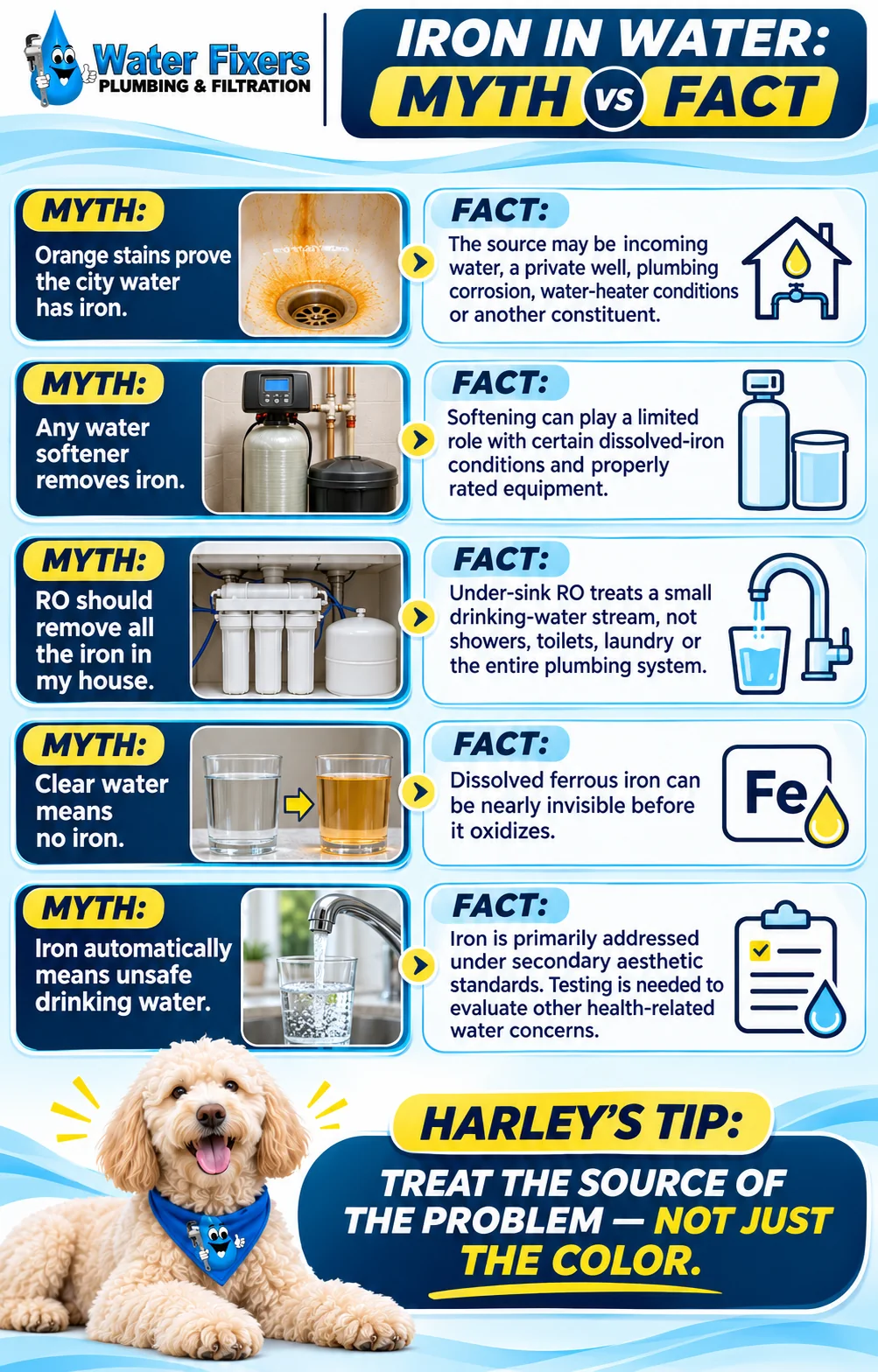
Frequently Asked Questions
Does a water softener remove iron?
A water softener can sometimes reduce limited amounts of dissolved ferrous iron when the iron level, pH, hardness, resin, regeneration, and manufacturer rating support it. Oxidized iron and iron-bacteria problems may require a different treatment approach.
Does reverse osmosis remove iron?
Reverse osmosis can reduce dissolved iron at a drinking-water faucet under suitable feed-water conditions. It is not the primary treatment for a whole-house iron problem affecting showers, toilets, laundry, fixtures, and plumbing.
What is the best way to remove iron from well water?
The best method depends on the iron form and concentration plus pH, hardness, manganese, turbidity, flow, and other source-water conditions. Dissolved iron, oxidized iron, and iron-bacteria problems can require different treatment plans.
Why does my clear water turn orange after sitting?
Dissolved ferrous iron can be nearly invisible when freshly drawn. Exposure to oxygen can convert it into visible oxidized iron particles that look yellow, orange, or reddish-brown.
Why is only my hot water rusty?
If cold water is normal but hot water is rusty, investigate the water heater and hot-side plumbing before assuming the incoming water supply is the source.
Why is only one faucet rusty?
A problem limited to one fixture may originate in that faucet, its supply line, or nearby plumbing rather than in the whole-house water supply.
Is iron in drinking water dangerous?
EPA and California list iron at 0.3 mg/L under secondary drinking-water standards associated with consumer-acceptance concerns such as color, sediment, metallic taste, and staining. That does not mean an iron result proves the water is otherwise safe. Private wells and changing water conditions may call for broader testing.
Will a sediment filter remove iron?
A sediment filter can capture iron that is already oxidized into particles. It does not reliably remove iron that remains dissolved in the water.
Can iron foul an RO system?
Iron can contribute to membrane or cartridge fouling and increased maintenance, especially when the incoming iron load is significant. Whole-house iron should generally be addressed upstream when it is affecting the home broadly.
Should iron treatment come before a water softener?
It may. Significant or oxidized iron may need dedicated treatment before softening. Limited dissolved iron may sometimes be handled by a properly rated softener when the water chemistry supports it.
Can a house need an iron filter, water softener, and RO?
Yes, but only when testing justifies all three. Iron treatment addresses the iron load, softening addresses hardness, and RO addresses drinking-water quality at the point of use.
Related Water Fixers Guides
Keep going based on the question your water is actually raising.
Iron in Water
Technical guide to iron forms, standards, testing and treatment limits.
Manganese in Water
Compare dark staining and overlapping groundwater treatment concerns.
Well Water Treatment
Plan treatment when the problem begins in groundwater or the well system.
Whole-House Filtration
Point-of-entry treatment when staining or fouling affects the home broadly.
Softener or RO?
Compare hardness control, drinking-water treatment and serviceable equipment.
Also see: Bacteria in Well Water when slime, recurring fouling or a biological well-water concern is part of the picture.
Sources & Further Reading
This guide is grounded in federal, California and local water-quality guidance.
- U.S. EPA — Secondary Drinking Water Standards
- California State Water Resources Control Board — Secondary Drinking Water Standards
- Minnesota Department of Health — Iron in Well Water
- City of Santa Maria — Water Services
- Los Osos Community Services District — Water Quality
- City of Lompoc — Water Quality
- San Luis Obispo County — Private Well Owner Resources
Treatment note: Water-treatment performance depends on measured chemistry, equipment rating, flow conditions, installation and maintenance. This guide is educational and does not replace property-specific water testing or public-health guidance.
About This Water Fixers Guide
Water Fixers Plumbing & Filtration serves homes and businesses across California’s Central Coast, including Santa Barbara and San Luis Obispo counties. Our work includes water testing, well-water treatment, whole-house filtration, water softeners, reverse osmosis, plumbing, installation, maintenance and repair.
California Contractor License #719792 • View Service Areas • Contact Water Fixers

Stop Treating the Stain. Find the Source.
Water Fixers can help test the water, identify what the iron result means for treatment, and design a system around the water you actually have.
Start With Water Testing
Ask Water Fixers
Call 805-928-6444
Water Fixers Plumbing & Filtration • California License #719792