WATER QUALITY KNOWLEDGE CENTER • PRIVATE WELL SAFETY
Quick answer: The standard starting point is a properly collected laboratory sample for total coliform bacteria, with E. coli interpretation where applicable. If harmful germs are found, do not keep drinking the water while guessing at a filter. Use a safe water source, follow local public-health guidance, correct the contamination pathway, use appropriate disinfection when needed, and retest before returning the water to normal drinking use.
Water Fixers Plumbing & Filtration • California License #719792 • Central Coast private-well guidance
READ THE LAB RESULT CORRECTLY
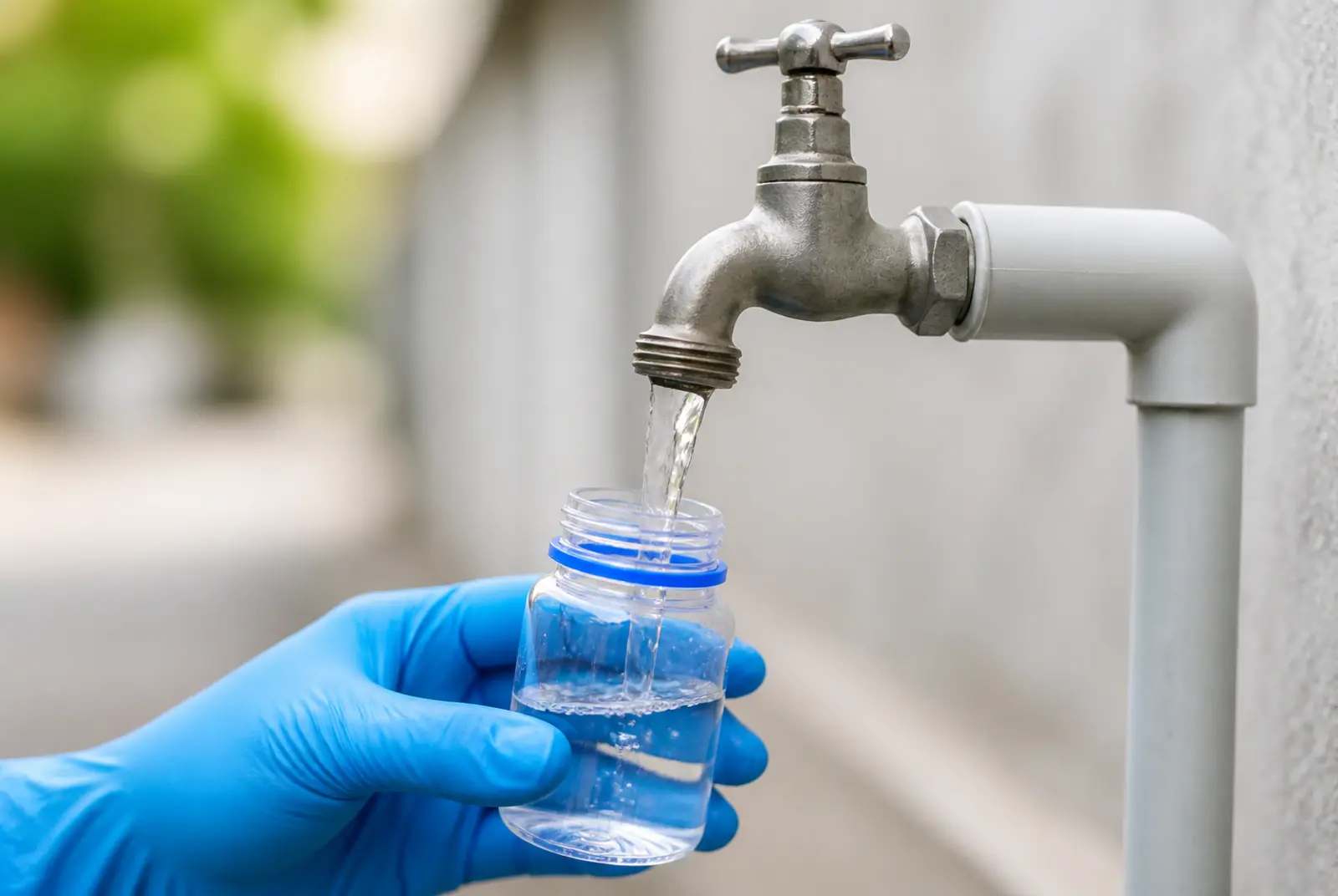
Microbiological testing is designed to answer a specific question with a controlled sample. The result is more useful than color, taste, odor, cloudiness or a guess about where contamination came from.
INDICATOR TEST
Total coliform bacteria are commonly used as an indicator that a well or water system may have a contamination pathway. A positive result deserves follow-up; it does not identify the exact source by itself.
STRONGER WARNING
Detection of E. coli is stronger evidence that fecal contamination may have entered the water. Treat that as a drinking-water safety issue and follow the laboratory and health-department response guidance.
ONE SAMPLE
A negative sample means the target organisms were not detected by that test in that sample. It does not guarantee a private well will stay free of contamination indefinitely, which is why routine testing still matters.
WHEN SHOULD A PRIVATE WELL BE TESTED?
ROUTINE
CDC and California well-owner guidance recommend routine annual bacteria testing for private wells. Your laboratory or local health department may recommend additional tests for the property.
AFTER AN EVENT
Test after flooding, well-system repairs or other conditions that could create a new pathway into the water. Do not assume the water is safe because it looks unchanged.
WHEN CONDITIONS CHANGE
A noticeable water-quality change, a nearby contamination concern or other unusual condition is a reason to ask whether additional testing is appropriate.
A POSITIVE TEST STARTS A SOURCE INVESTIGATION
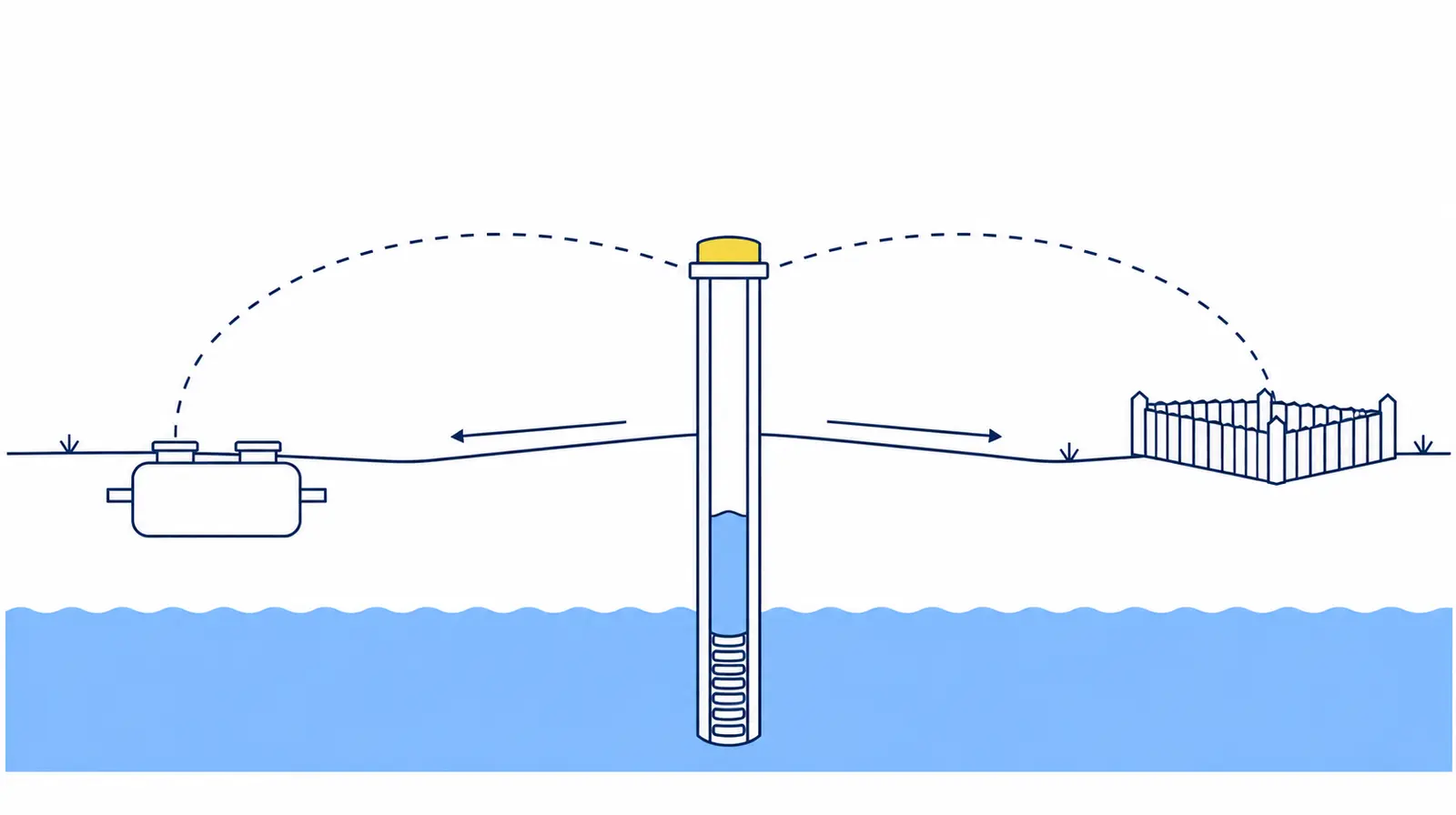
Possible pathways include surface runoff or flooding, damaged or poorly sealed well components, nearby septic or animal-waste pathways, work performed on the well system, and other site-specific conditions. Sampling contamination is also possible when collection instructions are not followed.
Important: a positive total-coliform result does not prove which pathway caused it. Correcting the actual source is more durable than treating the symptom alone.
THE SAMPLE HAS TO BE TRUSTWORTHY
Microbiology samples are easy to compromise. Use the bottle supplied or approved by the laboratory, protect the inside of the cap and bottle from contact, follow the lab’s sampling-point instructions, and meet its required handling and delivery window.
For a drinking-water safety question, use an appropriate certified laboratory rather than relying on a general-purpose home strip as the final answer.
IF THE RESULT IS POSITIVE OR UNSAFE
CDC guidance says that if a well is contaminated with harmful germs, do not drink the well water until the problem is addressed. Use bottled water or another safe source and contact the local health department for specific instructions. If no safe source is available and the concern is germs rather than chemicals, follow current public-health boil-water guidance rather than improvising your own treatment steps.
Do not use boiling as a response to chemical contamination. Different contaminants require different actions.
TREATMENT COMES AFTER THE TEST
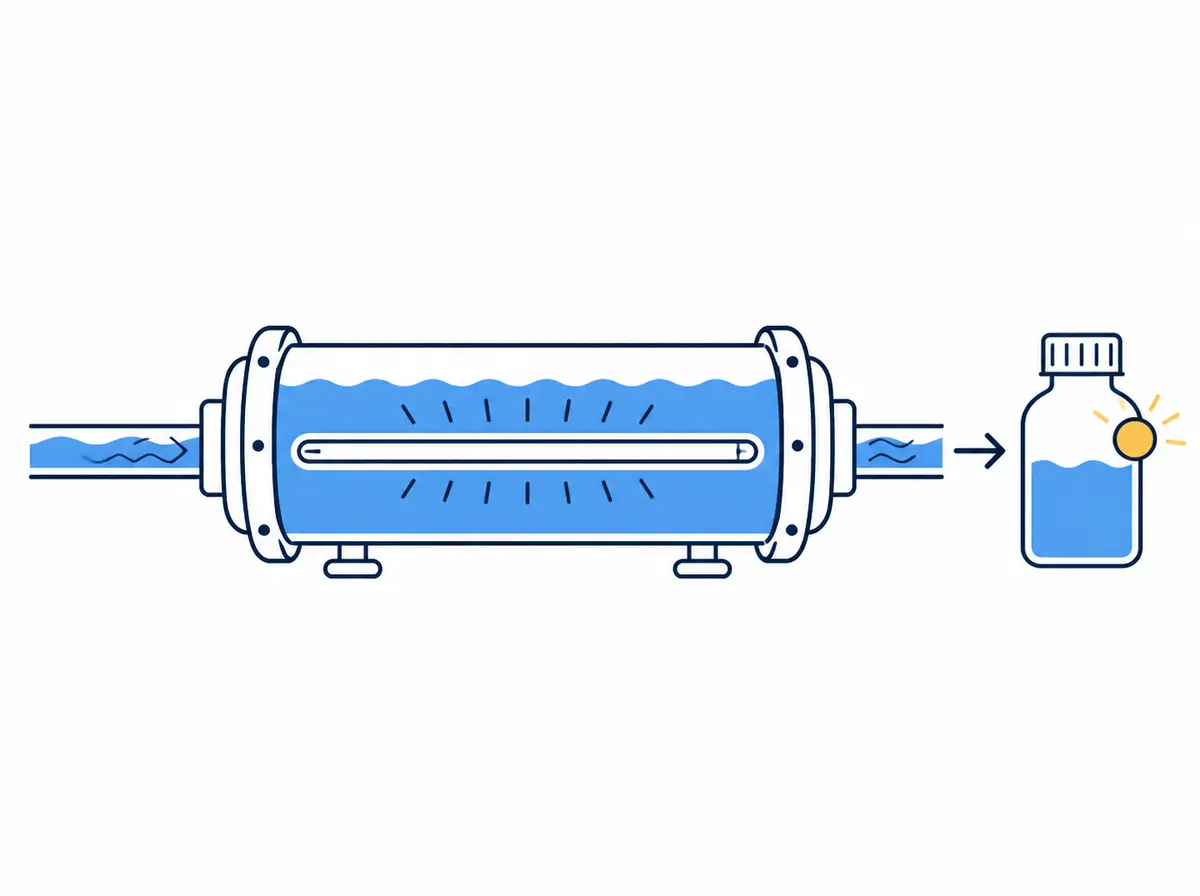
A treatment plan may include correcting well or plumbing defects, professional shock disinfection in appropriate circumstances, and ongoing point-of-entry disinfection such as a properly designed ultraviolet system.
UV can be useful for microorganisms, but it has operating conditions: pretreatment, flow, UV transmission through the water, lamp output, sleeve condition and maintenance all matter. UV does not remove dissolved chemicals.
TREATMENT LIMITS MATTER
CDC notes that UV works better when water is filtered before UV, while UV itself does not remove chemicals. For private-well bacteria, the important question is not “Do I have a filter?” but “Is the treatment train designed, maintained and verified for this problem?”
NOT DISINFECTION
These can be useful pretreatment stages and can improve water characteristics, but ordinary filtration by itself is not a substitute for a validated disinfection step when the problem is microbiological.
NOT DISINFECTION
A softener is designed primarily for hardness minerals. Do not use a softener as the bacteria-safety strategy.
NOT A STANDALONE SAFETY PLAN
Do not assume a standard household RO system alone makes bacteriologically contaminated source water safe. Address the source and use an appropriately designed disinfection plan.
THE JOB IS NOT FINISHED AT DISINFECTION
After correction or disinfection, follow the laboratory or health department’s instructions for when and how to collect the confirmation sample. A treatment step without verification leaves the original safety question unanswered.
If bacteria results keep returning, look beyond repeated disinfection. Recurring positives can justify a closer investigation of the well, surrounding drainage, seals, storage, plumbing and treatment system.
1. Confirm the result with the lab/health authority as directed.
2. Protect drinking-water use while the issue is unresolved.
3. Investigate and correct the likely pathway.
4. Disinfect or install validated treatment when appropriate.
5. Retest under the recommended protocol.
6. Maintain and recheck the system over time.
RELATED WATER FIXERS GUIDANCE
START HERE
Use the water source, the question and the lab method to choose the correct test rather than guessing from symptoms.
PRIVATE WELL
Plan treatment around test results, well condition and the actual contaminant or performance problem.
DO NOT CONFUSE ODOR WITH BACTERIA
Rotten-egg odor can have more than one source. Odor by itself does not diagnose bacteria in well water.
OFFICIAL WELL-WATER RESOURCES
Water Fixers can help with testing coordination, plumbing, treatment equipment and service, but drinking-water safety decisions should stay grounded in the certified laboratory result and current public-health guidance.
Annual total-coliform testing, certified-laboratory guidance, and reasons to test after changes or well-system events.
Conservative guidance for unsafe results, safe alternate water, treatment and confirmation testing.
California guidance for annual well-water testing and use of appropriate laboratory testing for bacteria and other constituents.
Local private-well testing and maintenance resources for one of Water Fixers’ Central Coast service counties.
Central Coast note: San Luis Obispo County Public Health Laboratory currently lists drinking-water total-coliform and E. coli testing among its services. Availability, fees and collection requirements can change, so check the current county or laboratory instructions before collecting a sample.
DIRECT ANSWERS
Water Fixers can help route private-well testing, interpret the practical treatment question, service filtration and plumbing components, and plan appropriate disinfection or pretreatment without pretending one device solves every well-water problem.
Water Fixers Plumbing & Filtration • California License #719792
CALL NOW! Se Habla Español!