EXISTING WATER SOFTENER HELP

Big-Box Water Softener Repair or Replacement

Before you replace it, find out what actually failed.

If a Rheem, A.O. Smith, Whirlpool, GE, Kenmore/Sears, Aquasure, Morton, WaterBoss or another retail water softener has stopped working, start with the exact model and symptom. Water Fixers can evaluate many existing systems and explain whether maintenance, a targeted repair or replacement is the practical next step.

Water Fixers Plumbing & Filtration • California License #719792

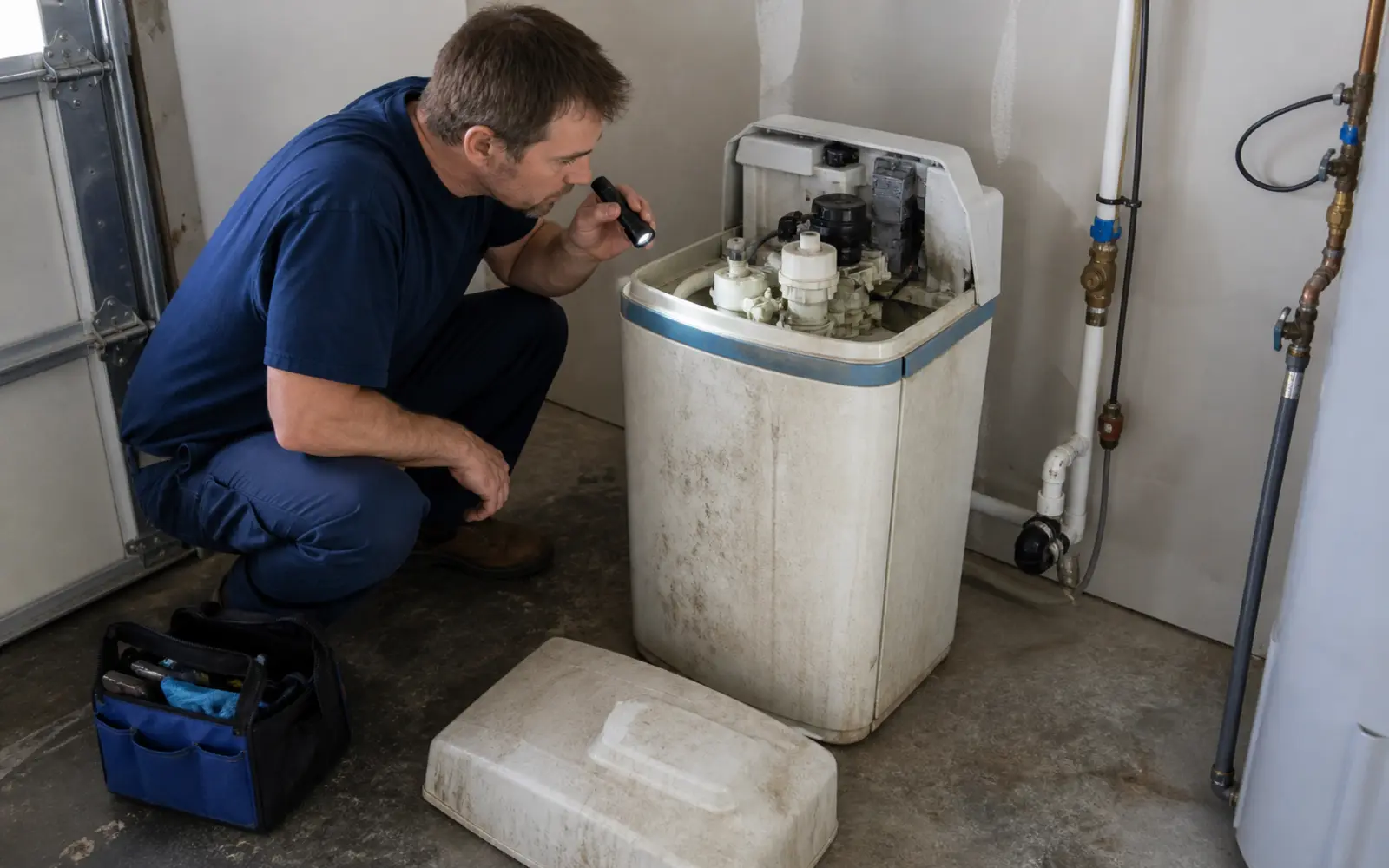
Older cabinet-style water softener

Do not order by appearance alone. Record the full model/serial or SKU label before buying parts.

START WITH THE SYMPTOM

Four Quick Checks Before You Assume the Softener Is Done

These are non-invasive checks, not a remote diagnosis. Retail softeners from different manufacturers can show the same symptom for different reasons, which is why the exact model matters.

Active Leak

If water is escaping from the cabinet, bypass, fittings or drain connection, protect the surrounding area and shut off or bypass the unit only if you can do so safely. Then request service.

Hard Water Returned

Check whether the unit has power, the bypass is in service position and salt is present. Hard water can also come from brine, programming, valve or resin problems.

Salt Level Never Drops

A salt bridge can make the tank look full while brine is not being made correctly. Brine draw, injector/nozzle and drain problems can create similar symptoms.

Continuous Drain or Repeated Cycling

A unit that keeps sending water to drain or repeatedly regenerates should be evaluated promptly. Settings, controls, metering and valve operation can all matter.

BEFORE YOU CALL

Six Things That Make a Repair Evaluation Faster

Manufacturers publish model-specific manuals, troubleshooting steps and parts information. Bringing the exact equipment information keeps a service decision tied to the unit you actually own instead of a generic brand assumption.

Model / serial / SKU

Photograph the full label instead of copying only the brand name.

Display and error code

Take a clear photo before resetting or unplugging anything.

Salt and brine condition

Show the salt level, any crust or bridge and visible water level.

Leak or drain area

Photograph where water is appearing and the nearby drain hose routing.

Bypass and plumbing

Include the bypass, inlet/outlet, nearby shutoffs and visible connections.

Symptom history

Note when the problem started, whether a manual regeneration changed anything and any recent service.

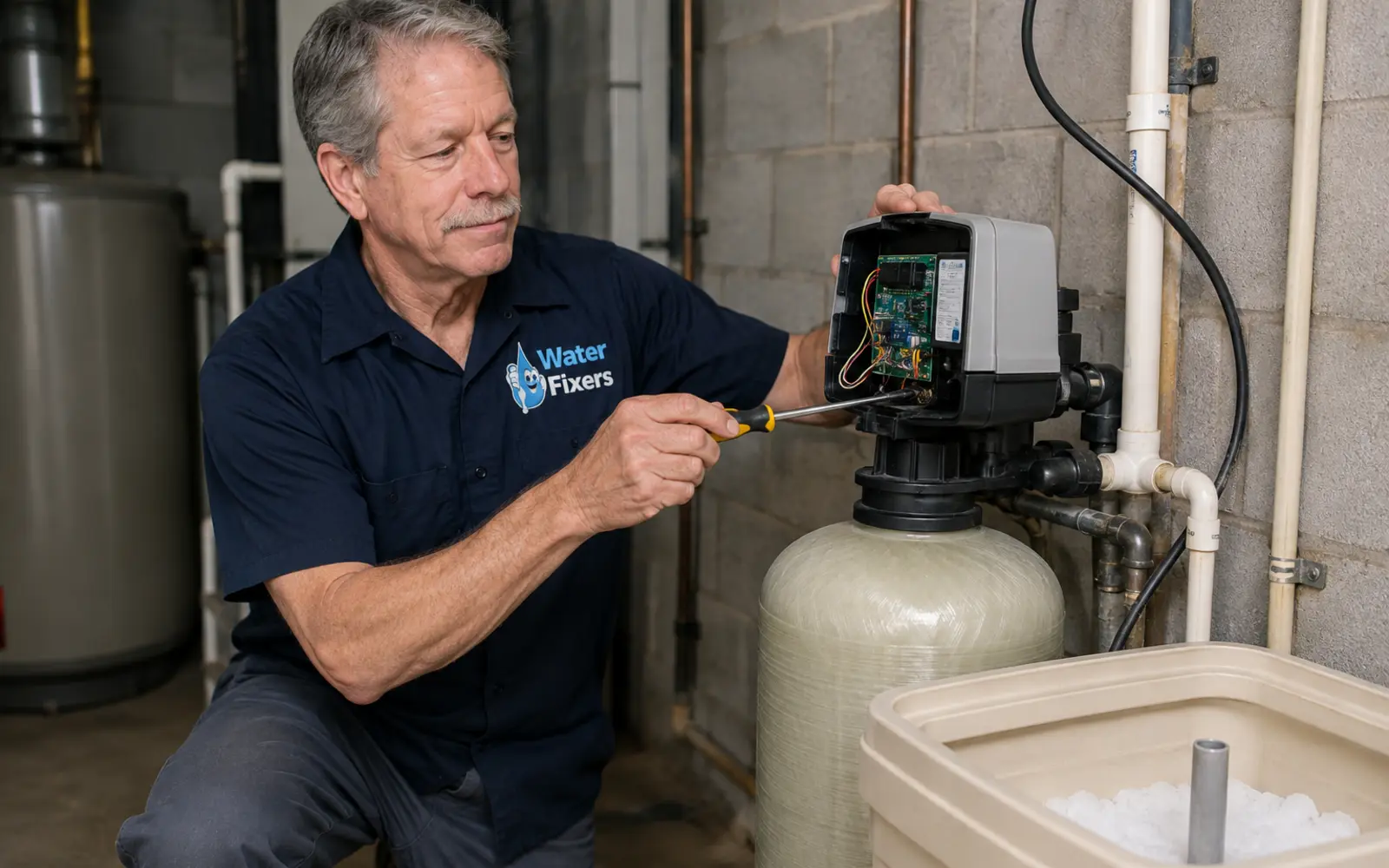
Water Fixers technician servicing a residential water softener

DIAGNOSIS BEFORE PARTS

What a Useful Big-Box Softener Evaluation Actually Checks

The goal is not to prove that every retail softener should be replaced. The goal is to determine what failed, whether the system is still worth keeping and whether a practical repair path exists for that exact model.

  • Power, settings and programming: confirm the control is powered and configured for the water and household.
  • Bypass and flow path: verify untreated water is not bypassing the softener.
  • Salt and brine: look for bridging, unusual brine level, draw/refill problems and visible restrictions.
  • Regeneration: determine whether the valve can move through a complete cycle and whether water is draining when expected.
  • Valve, motor and controls: identify whether a mechanical or electronic fault is preventing normal operation.
  • Resin performance: compare the equipment condition with the treated-water result rather than assuming the media is good or bad by age alone.
  • Plumbing and pressure: check inlet/outlet, fittings, drain, pressure and installation conditions around the unit.
  • Parts path: confirm the exact model and whether the needed part can realistically be identified, obtained and installed.

BRAND-SPECIFIC ROUTES

Start With the Brand Page When the Model Family Matters

Brand pages help keep model, warranty and ownership research separate from this repair-or-replace action guide. Water Fixers is independent of these manufacturers; brand names belong to their respective owners.

GE

Dedicated repair and troubleshooting route for GE cabinet softeners.

Kenmore / Sears

Dedicated repair route for older Kenmore and Sears softeners.

Rheem

Ownership and comparison guide for Rheem retail softeners.

A.O. Smith

Ownership and comparison guide for A.O. Smith softeners.

Whirlpool

Ownership and comparison guide for Whirlpool softeners.

Aquasure

Ownership and comparison guide for Aquasure systems.

Morton

Ownership and comparison guide for Morton softeners.

WaterBoss

Ownership and comparison guide for WaterBoss systems.

REPAIR OR REPLACE?

Use Condition and Repair Economics—Not the Retailer Name

There is no universal age at which a retail softener automatically becomes a replacement. The stronger decision uses the exact failure, tank and valve condition, resin performance, parts path, sizing and the cost of restoring dependable operation.

Repair Is More Attractive When

  • the failure is identifiable and isolated
  • the pressure/brine tanks and valve body are in usable condition
  • the needed part has a practical model-specific path
  • resin performance is still reasonable or the media work is limited
  • the unit is correctly sized for current demand
  • the repair cost restores a useful service life

Replacement Becomes More Practical When

  • the tank or major assembly is unsafe, leaking or badly deteriorated
  • core parts are unavailable or the correct repair path is uncertain
  • major valve work and exhausted resin stack together
  • the unit has repeated failures after prior repairs
  • the existing system is poorly sized for current household flow or hardness
  • the total repair scope approaches the value of a properly sized supported replacement

For the deeper theory behind this decision, use Repairable vs. Replaceable Water Softeners. For parts, warranty and serviceability questions, use Water Softener Parts & Repairability.

IF REPLACEMENT WINS

Move to the Five-Model Water Fixers Comparison—Not Another Sales Pitch Here

This page should stay focused on the softener you already own. If the existing unit no longer has a sensible repair path, the Water Fixers softener hub compares SoftFlo-C, SoftFlo-S, SoftFlo-SE, SoftFlo-SEC and SmartSoft in one place. Final selection should still use measured hardness, household demand, flow, plumbing and installation space.

KEEP THE TOPICS SEPARATE

Related Water Softener Guides

Parts & Repairability

Parts availability, model identification, warranty structure and practical serviceability.

Repairable vs. Replaceable

Broader decision guide for whether an aging softener is still worth repairing.

Water Fixers vs. Big-Box

Pre-purchase comparison of ownership models, installation and long-term support.

Water Softener Maintenance

Salt, brine, settings, regeneration and routine care for existing systems.

Water Softener Service & Repair

General multi-brand troubleshooting and repair route.

Service Areas

Check Water Fixers coverage across the Central Coast.

DIRECT ANSWERS

Big-Box Water Softener Repair & Replacement FAQs

Quick answers for homeowners deciding whether an existing retail water softener needs maintenance, repair or replacement.

Water Fixers can evaluate many existing residential water softeners, including retail and older systems. Whether a specific repair is practical depends on the exact model, symptom, condition and parts path.
No. Hard water can return because of bypass position, salt or brine problems, incorrect settings, regeneration trouble, valve faults, exhausted resin or poor sizing. The cause should be identified before replacement is recommended.
No. A salt bridge can prevent brine from forming correctly even though salt is visible in the tank. Several manufacturers describe salt bridging in their troubleshooting material, but a persistent no-soft-water problem can have other causes too.
If possible, provide the full model/serial or SKU label, a photo of the display or error code, the salt and brine condition, the leak or drain area if relevant, and a short history of what changed.
Usually it is better to identify the exact model and failed component first. Similar-looking valves, motors, boards, injectors and seals are not automatically interchangeable, and the wrong part does not solve the underlying failure.
Replacement becomes more practical when major assemblies are deteriorated, core parts are unavailable, repeated failures continue, resin and valve work stack together, the unit is poorly sized, or the total repair scope no longer restores good long-term value.
No. A correctly sized, installed, programmed and maintained retail softener can soften water. This page is about diagnosing an existing system and comparing the real repair path before spending money.
No. Water Fixers Plumbing & Filtration is an independent plumbing and water-treatment contractor. Brand names and trademarks belong to their respective owners.

Have the Model Number? Tell Us What the Softener Is Doing.

Water Fixers can evaluate many existing softeners across the Central Coast. Start with the symptom and exact model. We will explain whether the next step is maintenance, a targeted repair, more testing or replacement.

Water Fixers Plumbing & Filtration • 2893 Industrial Pkwy, Santa Maria, CA 93455 • License #719792