







TIPS FROM HARLEY • TIP #1 • HOME WATER SHUTOFF
Know Where Your Main Water Shutoff Valve Is Before You Need It
A burst pipe, failed supply line or leaking appliance is a lousy time for a scavenger hunt. Knowing which valve controls the water to your home—and whether you can safely reach it—can help limit damage while you get the problem repaired.
Harley says: You know where the treats are. You should know where the water shutoff is too.
HARLEY’S QUICK TAKE
Five Things to Know Before There Is Water on the Floor
1
Find It Now
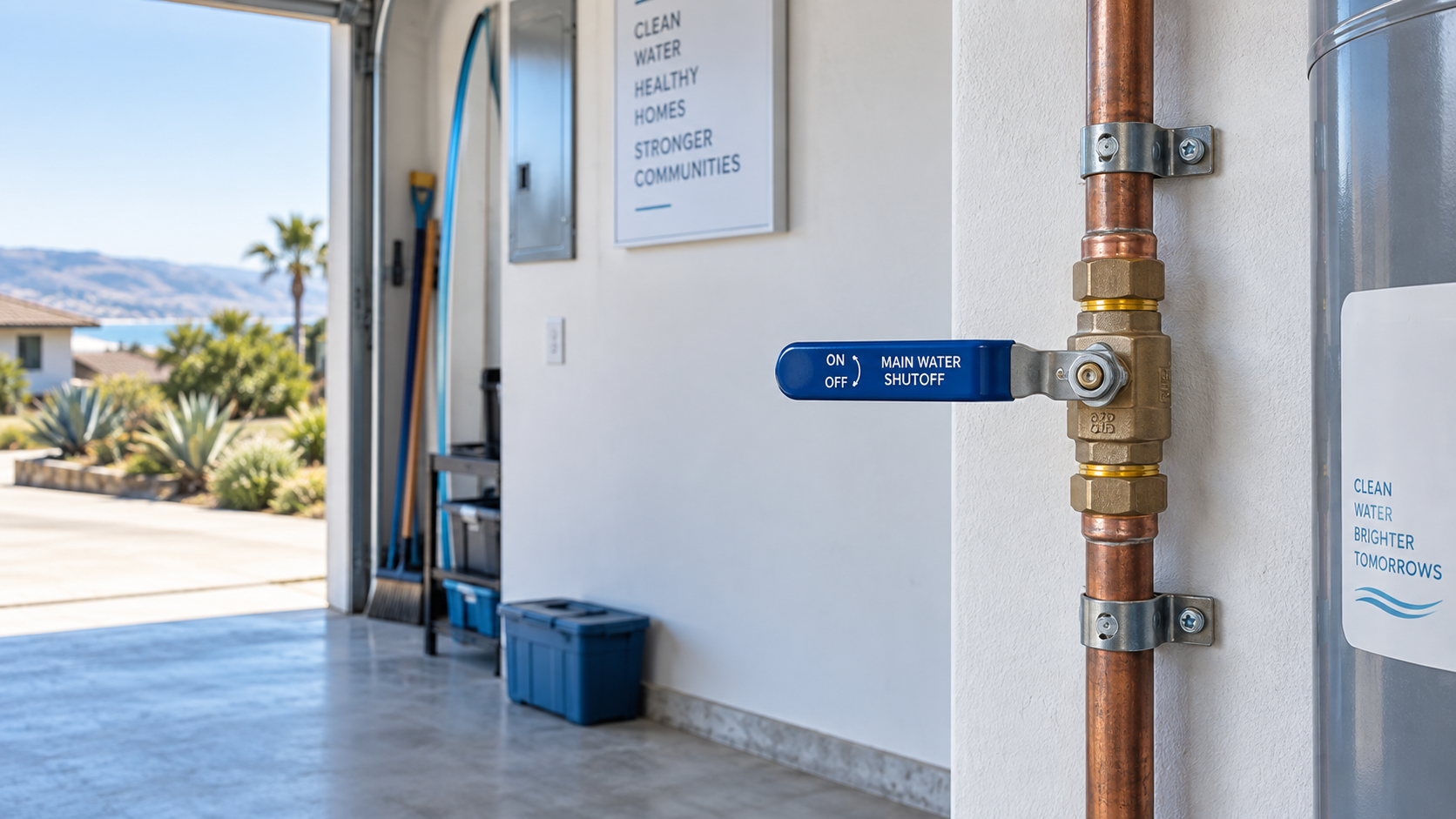
Locate the house-side main shutoff before an emergency and keep the area around it accessible.
2
Know What It Is
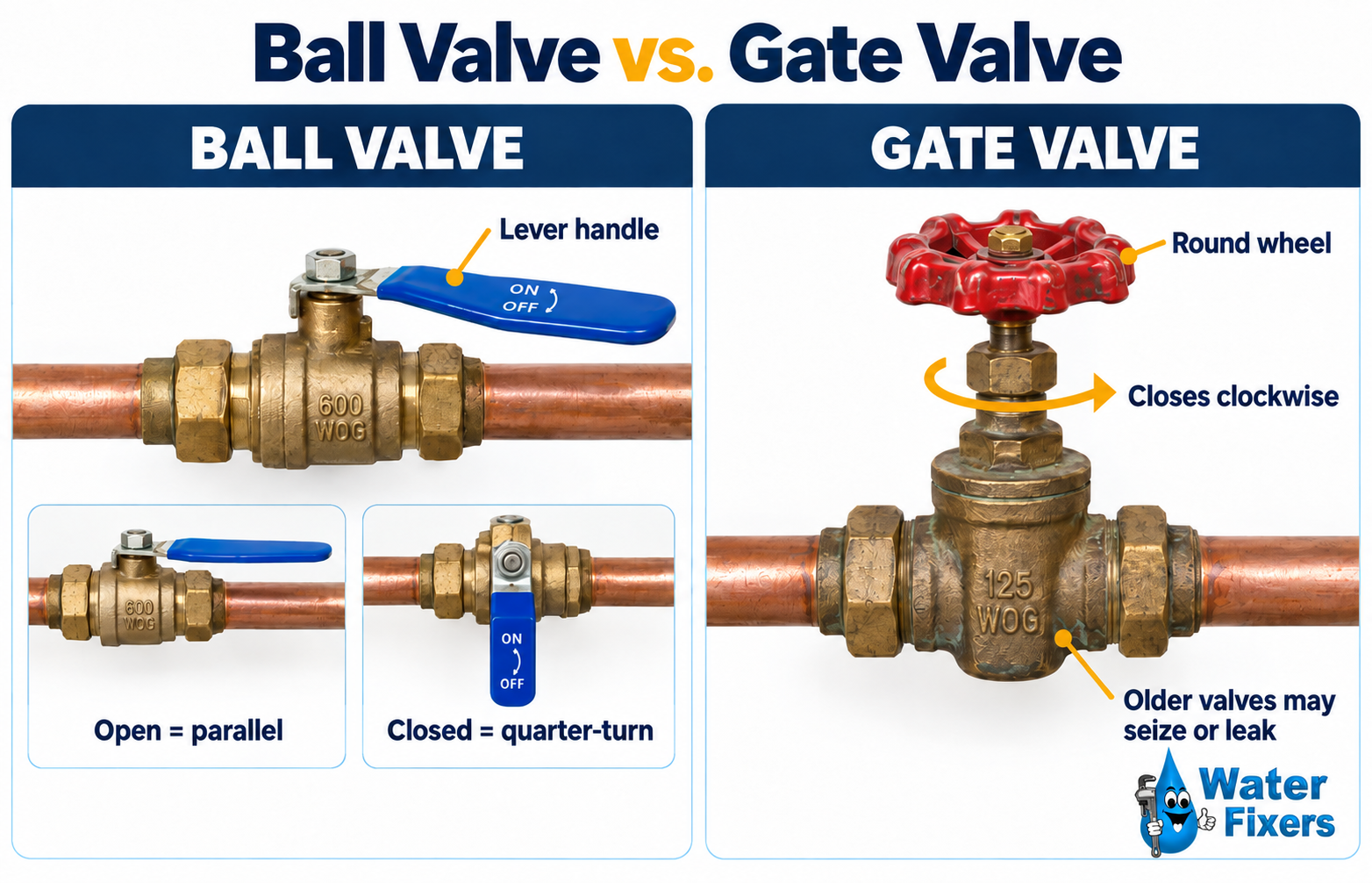
A lever-style ball valve and a wheel-style gate valve operate differently. Learn which one you have.
3
Do Not Force It
If the valve is badly corroded, leaking, frozen or unusually hard to move, do not attack it with tools.
4
Know the Boundary
A homeowner shutoff is not always the same thing as utility-owned meter or curb-stop equipment.
5
Use the Smallest Shutoff
For an isolated fixture leak, a working fixture shutoff may control the problem without shutting down the whole home.
🐾
Call the Humans
If you cannot identify the right valve or it will not operate safely, Water Fixers can locate, inspect or replace it.
START WITH THE BASICS
What Does the Main Water Shutoff Valve Actually Control?
The main water shutoff valve controls the incoming water supply to most or all of the home’s domestic plumbing. When it is closed, water from the supply side should stop feeding fixtures, appliance connections, toilets, faucets and other branches downstream of that valve.
That makes it one of the most useful controls in a plumbing emergency. It does not repair the leak, diagnose its source or remove water already stored in pipes and equipment—but it can stop additional supply water from feeding the problem.
Main shutoff vs. fixture shutoff
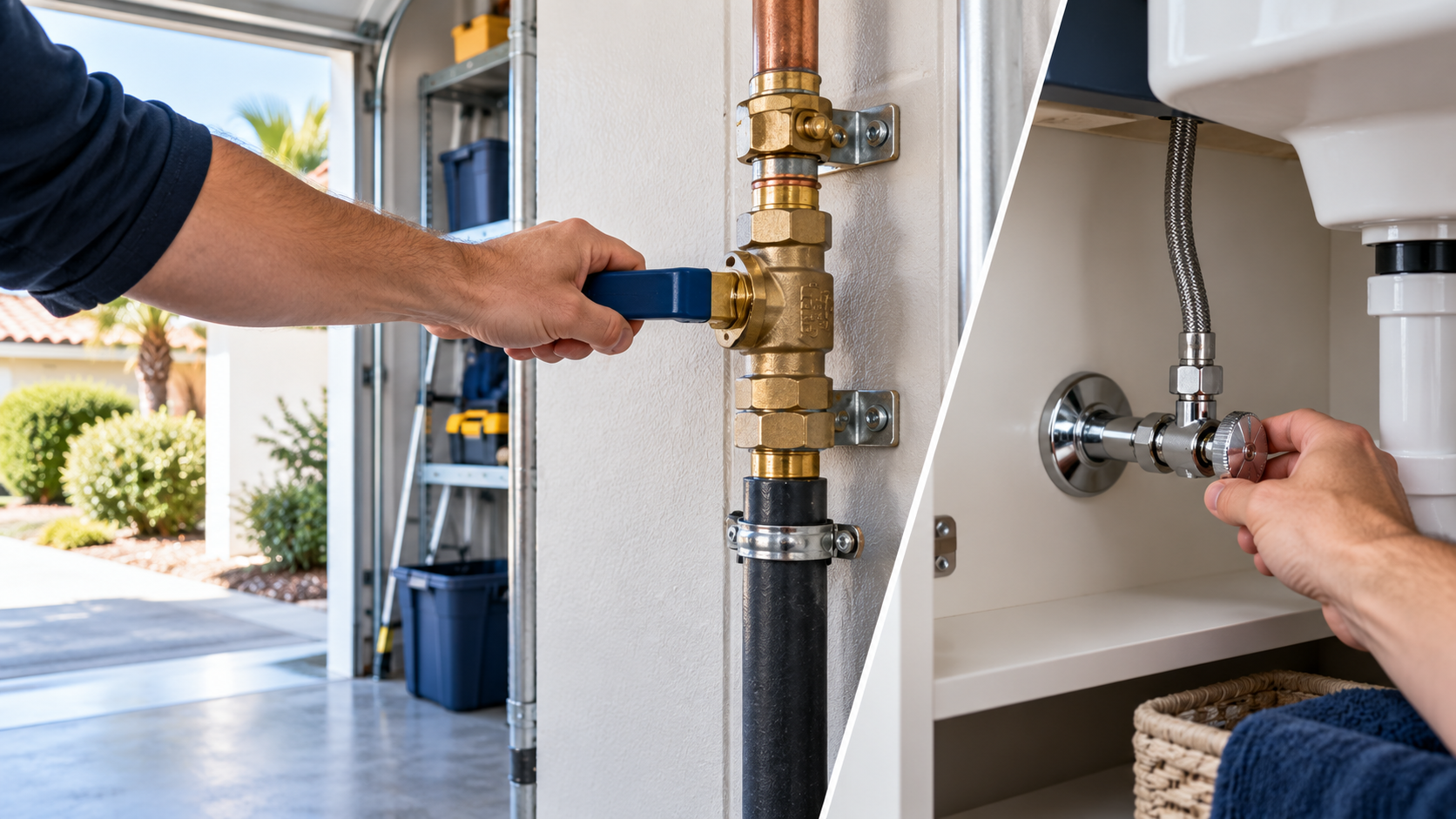
A sink, toilet, washing machine or other fixture may have its own local shutoff. If the leak is isolated and that valve is easy to identify and operate, using the local shutoff can leave the rest of the home in service. If the local valve fails—or the leak is on piping that does not have a local control—the main shutoff becomes the next important control point.
Situations where the main shutoff can matter
- Burst or split water-supply piping
- Failed faucet or toilet supply line
- Leaking water heater or appliance connection
- Broken fixture or valve that will not stop flowing
- Water-line or plumbing repair where the home supply must be isolated
WHERE TO LOOK
Where Is the Main Water Shutoff in a Santa Maria-Area Home?
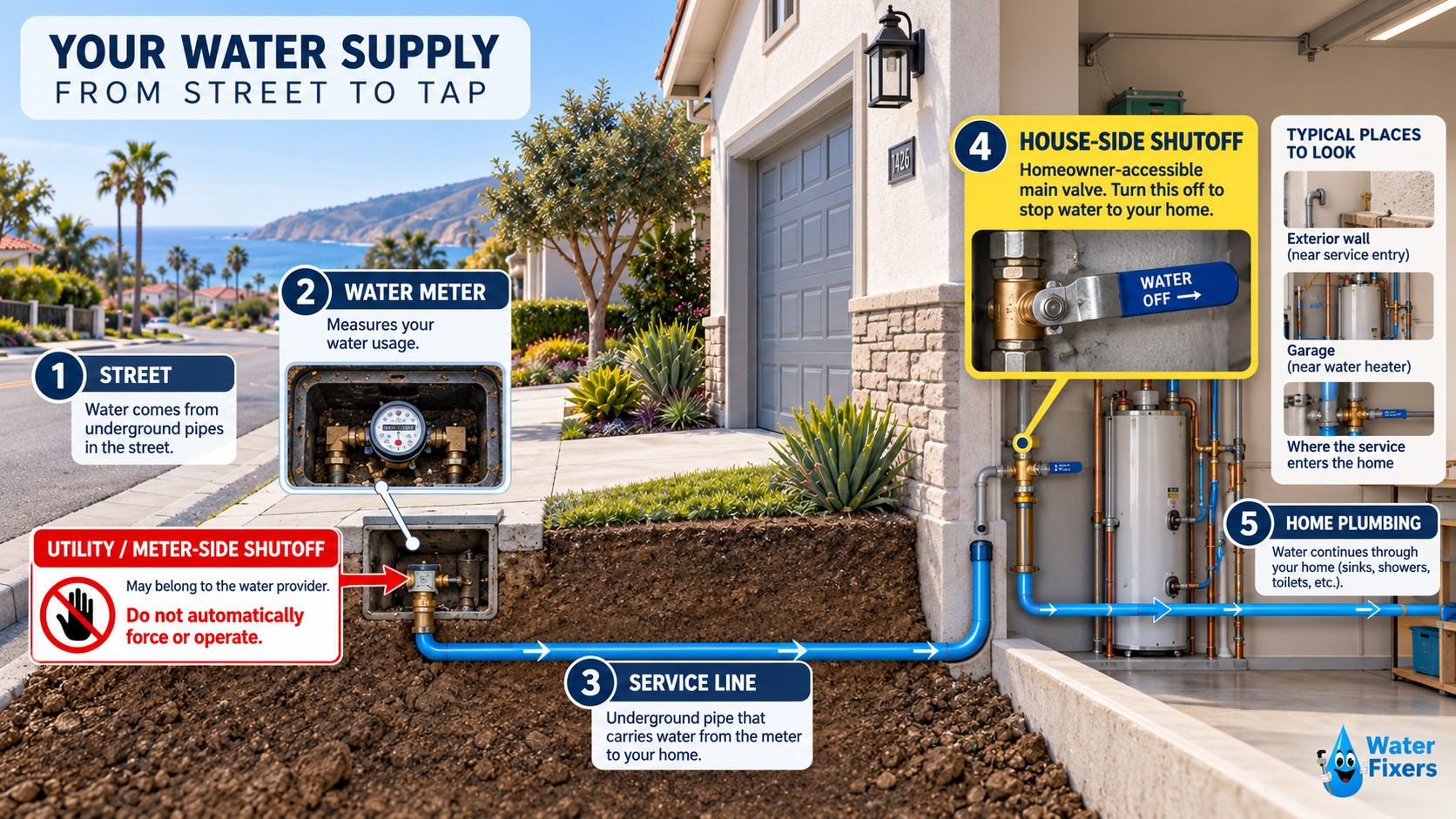
The exact location depends on the age and layout of the property. Start by identifying where the water service approaches the house, then look for an accessible valve on the house side of that service.
Common locations can include:
- an exterior wall near where the water service enters the home;
- a garage or utility area;
- an accessible plumbing area near the front or side of the home; or
- near the water meter—but not necessarily the utility-owned valve inside the meter box.
Landscaping, remodels, older construction and previous plumbing work can make a shutoff harder to spot. If you cannot positively identify it, do not guess.
IMPORTANT: HOUSE-SIDE SHUTOFF ≠ AUTOMATICALLY THE METER VALVE
Do Not Assume Every Valve in the Meter Box Is Yours to Operate
Water-provider equipment, meter valves and curb-stop arrangements vary. If the only shutoff you can find is inside or adjacent to the utility meter box, or it requires a special tool, stop before forcing or modifying it. Contact the water provider or a qualified plumber if you are unsure which valve is intended for homeowner use.
Harley’s rule: if you need a mystery wrench and a lot of confidence, this is probably a “call the humans” situation.
IDENTIFY YOUR VALVE
Ball Valve vs. Gate Valve: What Are You Looking At?
The two common shutoff styles homeowners may encounter look and operate differently. Knowing which one you have helps you understand how it should move—and when something is not normal.
LEVER HANDLE
Ball Valve
A ball valve uses a lever handle. On a typical installation, the handle is generally parallel with the pipe when open and turns about one-quarter turn until it is perpendicular with the pipe when closed.
WHEEL HANDLE
Gate Valve
A gate valve uses a round wheel handle and typically closes by turning clockwise. Older gate valves can become stiff, corroded, unreliable or begin leaking around the stem.
Do not use pliers, a pipe wrench, a hammer or extra leverage to force a badly stuck household shutoff. A valve that breaks while you are testing it can turn a preparedness exercise into the emergency you were trying to avoid.
WHEN WATER IS LEAKING
How to Shut Off the Water Safely
If there is an active plumbing leak and it is safe to approach the plumbing, use the smallest reliable shutoff that controls the problem.
- Identify the source if you safely can. If the leak is clearly at one toilet, sink or appliance and its local shutoff works, start there.
- Use the main shutoff when the leak is not isolated or a local shutoff will not control it.
- Operate the correct valve gently. A ball valve normally needs a quarter turn. A gate valve generally turns clockwise to close. Stop if the valve binds, cracks, leaks or requires excessive force.
- Relieve downstream pressure. After shutting off the main, opening a cold-water faucet can help release remaining pressure and gives you a quick check that incoming flow has stopped.
- Get the failed plumbing repaired before restoring water. Turning the water back on can restart the leak.
Water + electricity = stop
If water is reaching electrical equipment, outlets, appliances, an electrical panel or another unsafe area, do not wade into the water or reach through a hazardous area just to get to a valve. Keep people away and contact the appropriate emergency/professional help.
BEFORE YOU NEED IT
A Shutoff Is Only Helpful If You Can Find It and It Still Works
At least once a year, make sure you still know where the main shutoff is and that access has not been blocked by storage, landscaping or remodeling. A visual inspection can reveal corrosion, mineral buildup, leakage, damage or an obviously deteriorated valve.
If the valve looks old, corroded, wet, damaged or unusually difficult to operate, do not wait for a burst pipe to find out whether it can still isolate the home. Have it evaluated and replaced when needed.
READY
Good Sign
The valve is easy to find, dry, accessible, clearly part of the house plumbing and appears to be in sound condition.
ATTENTION
Plan Service
The valve is corroded, leaking, buried, blocked, missing a usable handle, difficult to identify or hard to move.
HARLEY SAYS
Do Not Force It
A valve that feels frozen or looks fragile should not become a strength test. Schedule service before an emergency.
AN EXTRA LAYER OF PROTECTION
Smart Monitoring Can Help—but It Does Not Replace Knowing the Manual Shutoff
Smart water devices can add useful monitoring and alerts, but they do different jobs. Knowing the basic plumbing controls still matters.
MONITOR + SHUTOFF
Moen Flo Smart Water Shutoff
Installed inline on the main water line. It monitors water activity and can automatically close its internal valve during qualifying events. It can add automatic shutoff protection when you are away or asleep.
MONITOR + ALERT
Flume Smart Water Monitor
Attaches to many compatible residential water meters and monitors water-use patterns. It can alert you to unusual or continuous flow, but it does not mechanically shut off the home’s water.
🐾 WHEN HARLEY SAYS: CALL THE HUMANS
Stop Guessing and Get Plumbing Help If…
- you cannot find or positively identify the house shutoff;
- the valve is stuck, badly corroded, leaking or damaged;
- the handle breaks, the stem leaks or the valve will not fully close;
- water continues flowing after the valve should be closed;
- the only available control appears to be utility or meter equipment;
- you suspect a hidden leak and do not know where the water is coming from; or
- water is entering an area where electrical or other hazards make access unsafe.
Harley is very confident. Plumbing diagnosis should be a little less based on confidence.
HOW WATER FIXERS CAN HELP
From “Where Is My Shutoff?” to a Valve You Can Rely On
Water Fixers can help identify the home’s plumbing control points, evaluate a questionable main shutoff, replace old or unreliable shutoff valves, investigate active or hidden leaks, and install smart leak-protection equipment when it fits the property.
Shutoff Valve & PRV Service
For main shutoffs, fixture shutoffs, pressure-control valves and plumbing that should work before an emergency.
Emergency Plumbing
For active plumbing failures that need the water controlled and the immediate problem repaired.
Leak Detection
For unexplained water use, hidden moisture, meter movement, warm floors or a suspected leak with no obvious source.
Water Line Repair
For supply-line leaks, wet areas, pressure loss or problems involving the incoming water line and related shutoff plumbing.
SHUTOFF PROBLEM • ACTIVE LEAK • NOT SURE WHAT YOU’RE LOOKING AT?
Tell Water Fixers What Is Happening at the Property
You do not need to diagnose the problem first. Tell us what you are seeing and we can help route you toward the right plumbing next step.
Water Fixers Plumbing & Filtration • Santa Maria & California Central Coast • CA License #719792 • Se Habla Español

🐾 MORE TIPS FROM HARLEY
Apparently One Tip Wasn’t Enough
Head back to Tips From Harley for practical plumbing and water advice, questionable dog jokes, and guidance checked by the Water Fixers team.