
SANTA MARIA, CA • REPIPING • PIPE REPLACEMENT
Water Fixers evaluates repiping projects in Santa Maria by looking at the pattern of failures, visible pipe condition, flow, pressure, access and prior repairs. One isolated fitting should not be treated the same as repeated problems across separate interior branches.
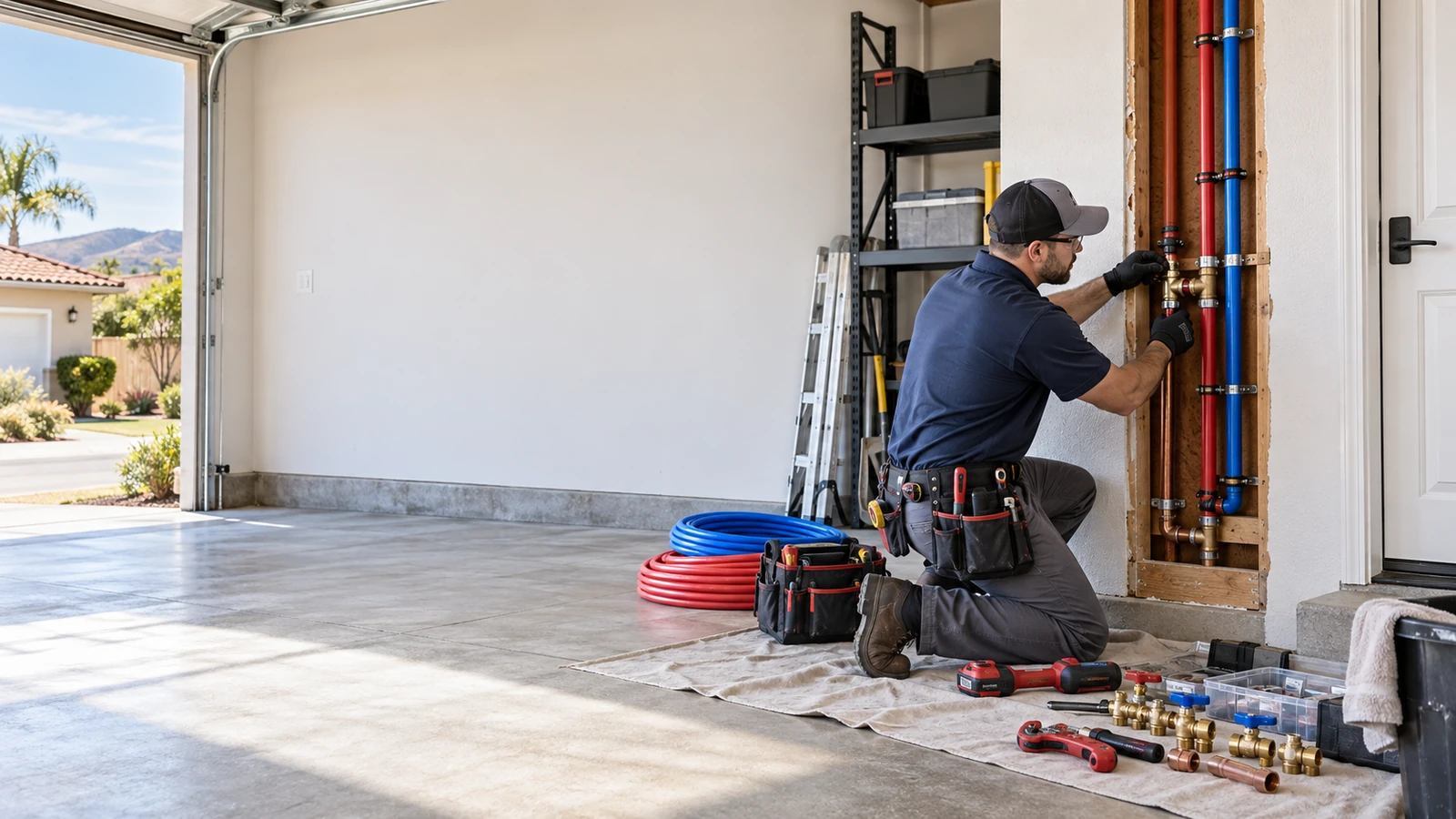
START WITH THE FAILURE PATTERN
If one fitting failed once, a focused repair may be enough. If separate branches have leaked, accessible piping shows broader deterioration, or flow is restricted across several fixtures, map the pattern before choosing a partial or whole-house repipe.
A pattern across separate branches is stronger evidence for repiping than one isolated fitting failure. Document where prior repairs occurred and whether the same pipe material or condition is involved before widening the project scope.
Poor flow at several fixtures can involve interior piping, but incoming pressure, valves, treatment equipment and localized fixture restrictions should be separated first. Pressure-only problems stay on the pressure/PRV path.
When a defect is limited to one accessible pipe or fitting and the surrounding system is serviceable, keep the first repair focused instead of turning it into a repipe.
SANTA MARIA WATER + PLUMBING CONTEXT
Current City supply context: Santa Maria identifies local groundwater and imported State Water as its two supply sources and blends them before distribution.
That source mix can change hardness and mineral conditions, but water chemistry alone does not diagnose a repipe. Repiping decisions should come from the actual pipe condition, leak history, restriction pattern, pressure, access and repair history at the property.
Hardness, mineral content and treatment equipment can affect scale or equipment performance. Use the dedicated Santa Maria water guide or testing path when the question is water quality rather than pipe condition.
Stronger repiping evidence includes recurring failures in separate areas, confirmed deterioration across accessible piping, broad restriction tied to the distribution piping, or repeated repairs that no longer make practical sense as isolated work.
MAP THE REPAIR HISTORY
When repair history shows failures in separate interior branches, compare the locations, materials and timing before treating them as unrelated calls. If the same deteriorated piping condition appears in several areas, a broader repipe may be worth evaluating. If weak flow improves after a fixture aerator is cleaned or treatment equipment is bypassed for diagnosis, that symptom belongs outside the repipe scope. The useful estimate separates confirmed piping problems from nearby symptoms that have a different owner.
Have prior leak locations and approximate repair dates available, note visible pipe materials where they can be observed safely, and share any measured pressure information or treatment equipment that sits upstream of the affected fixtures.
Keep drain/sewer work, water-quality treatment, private-well equipment, a fixture-only restriction, a buried service-line problem and an unknown leak source on their own service paths unless diagnosis ties them directly to the interior piping project.
CHOOSE THE SCOPE THAT MATCHES THE EVIDENCE
Choose the smallest scope that matches the evidence. A focused repair fits an isolated defect; a sectional repipe fits a defined branch or zone; whole-home repiping belongs in the conversation only when the condition is widespread enough to justify it.
Useful when one branch, remodel zone, repeated-problem area or material transition is the part that actually needs replacement.
Appropriate when the defect is isolated and the surrounding piping remains serviceable. Keep the work narrow when the evidence stays narrow.
Consider when failures, deterioration or distribution restrictions are broad enough that repeated spot repairs are no longer the practical scope.
PLAN THE PROJECT AROUND THE PROPERTY
PEX and copper can both be appropriate when the design, existing plumbing, access, pressure, water conditions, local requirements and project goals support them. A repipe is also a practical time to review shutoffs, pressure regulation, fixture supplies and equipment tie-ins.
Permit planning: Santa Maria’s Building Division currently lists the 2025 California Plumbing Code among its adopted codes and reviews permit plans for code and local-ordinance compliance. Confirm the requirements for the actual address and scope before permit-dependent work begins. Water Fixers also maintains a homeowner plumbing permit guide.
PEX can reduce some routing constraints, but correct sizing, supports, transitions, heat clearances, valves and workmanship remain essential.
Copper remains appropriate on many projects when the water conditions, layout, access, budget and installation details support it.
Measure incoming pressure and review shutoffs or pressure regulation before new piping is connected. A pressure-only problem should be diagnosed on the PRV/pressure-system path rather than used as proof that the house needs repiping.
USE THE SERVICE THAT MATCHES THE ACTUAL PROBLEM
If moisture is visible but the source is uncertain, start with Leak Detection in Santa Maria before deciding which piping should be replaced.
An active leak needs damage control first. Use the Santa Maria Emergency Plumber path when water cannot be safely contained.
A known localized pipe, valve or connection problem can stay on general plumbing service when the surrounding interior piping remains serviceable.
Scale, taste, odor and sediment are water-quality questions. Evaluate them separately before assuming replacement pipe is the treatment.
KEEP INTERIOR REPIPING SEPARATE FROM ADJACENT SERVICES
Use the repiping family when the evidence points to broader interior domestic-water distribution piping rather than one fixture or buried service line.
A confirmed or suspected buried meter-to-building service-line problem belongs on Santa Maria Water-Line Repair & Replacement—not on an interior repiping page.
A faucet, toilet, fixture supply or localized connection can stay on the fixture/plumbing path when the broader piping system is not the problem.
Use the broad Santa Maria plumber page when the symptom has not yet been narrowed to repiping, leak detection, water-line work, pressure service or another specialty.
COMMON REPIPING QUESTIONS
Not necessarily. One isolated failure can often be repaired. A larger project becomes more reasonable when failures repeat in separate locations, pipe condition is deteriorating or flow is broadly restricted.
No. Santa Maria water conditions are one planning input, not a material-selection shortcut. The City currently blends local groundwater and imported State Water, while the property’s existing piping, access, pressure, code requirements, project goals and budget also matter. Water chemistry alone does not prove that a repipe is needed or that one material is automatically preferred.
Yes. A branch, remodel zone, addition or repeated-problem section can be repiped while serviceable piping elsewhere remains in place.
Requirements depend on the address and project scope. Santa Maria’s Building Division currently enforces the 2025 California Plumbing Code and reviews permit plans for code and local-ordinance compliance, so confirm the current permit and inspection path for the planned work before construction begins.
Use this page for repiping decisions at a Santa Maria property. For broader plumbing and water-treatment help, use the local Santa Maria service page or the Santa Maria Valley regional hub.
REPEATED FAILURES DESERVE A SYSTEM-LEVEL LOOK
Tell Water Fixers where leaks have occurred, how many repairs the property has had, whether flow or pressure changed, and what pipe materials are visible. We can help determine whether repair, partial repiping or broader replacement fits the evidence.
CALL NOW! Se Habla Español!