
PISMO BEACH • SEWER & MAIN DRAIN
Sewer and main drain service in Pismo Beach starts by comparing which fixtures are affected, whether the problem keeps returning, and what the property-side drain system is doing. Several fixtures reacting during the same event can point farther downstream than one isolated clog, so the pattern—not the room where wastewater first appears—guides the next step.

Before choosing a machine or cleaning method, compare the affected fixtures, whether the problem has happened before, and what can be observed at an accessible cleanout. Those details help separate a local fixture or branch restriction from a larger shared-line problem.
If only one fixture is slow or clogged while the rest of the home drains normally, start with that fixture or branch drain rather than assuming the main line is involved.
When drains in different rooms react during the same event, the shared building drain or sewer lateral becomes more relevant than any one fixture. That pattern is a reason to evaluate farther downstream.
If the same restriction returns after prior clearing, the next step should focus on why it keeps recurring rather than automatically repeating the same service.
Fixtures that depend on a sewage ejector basin and pump belong on the pumped-wastewater path. Gravity-drain clearing does not diagnose pump controls, basin conditions or discharge-piping problems.
A single fixture may only need local clearing, while a shared restriction can show up as several drains reacting together, cross-fixture gurgling, or wastewater appearing at a lower fixture. Those observations help narrow where the restriction may be.
The goal is to determine how far downstream the evidence points before recommending a larger service. If the pattern stays isolated, drain cleaning is usually the more focused starting point; if several fixtures are involved, main-drain diagnosis becomes more relevant.
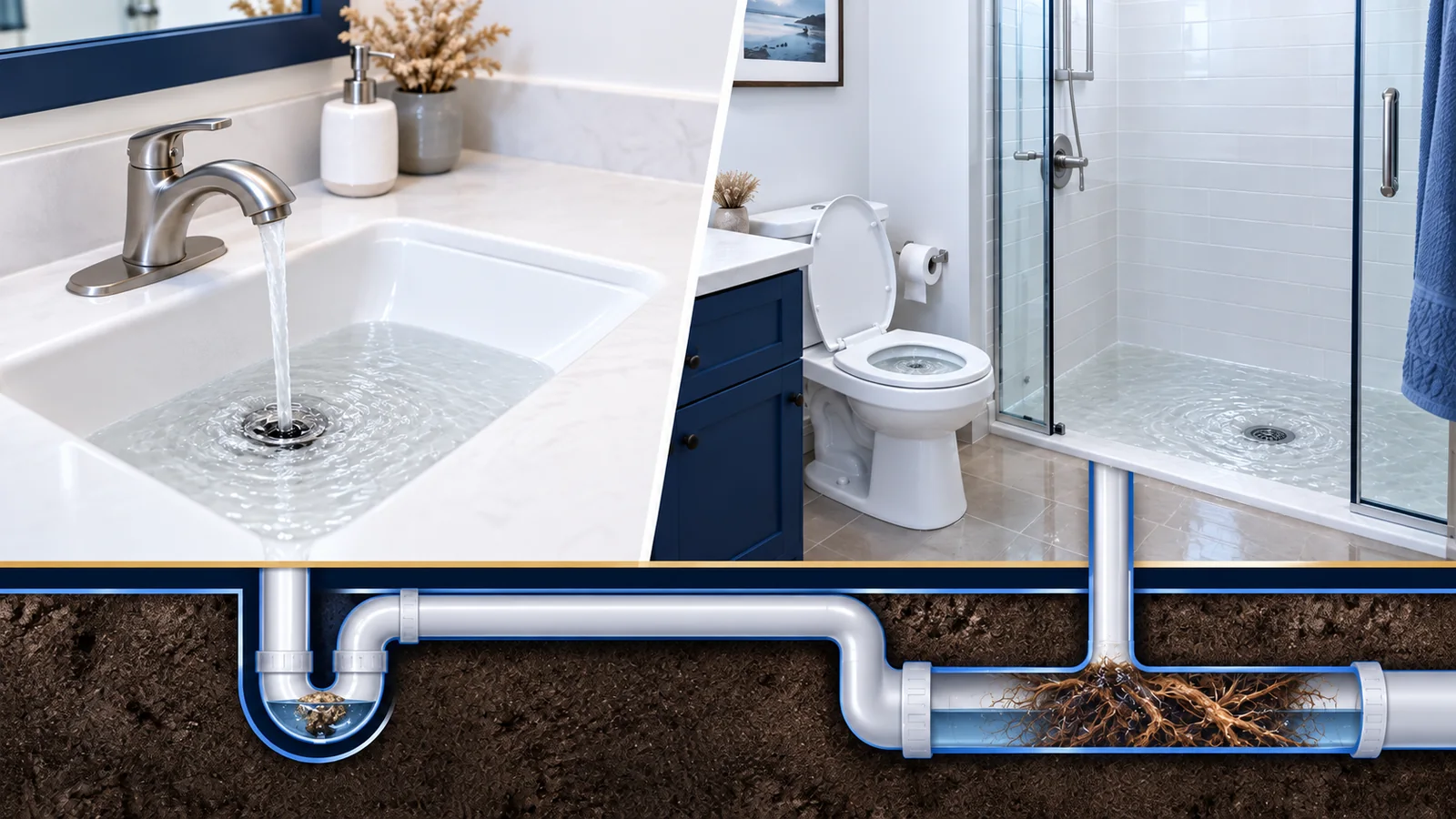
The right method depends on what the line is actually doing, not on treating every backup with the most aggressive option. We compare the symptom pattern, recurrence, access and any evidence that justifies a closer look at the shared drain or lateral.
Which fixtures are slow, backing up, gurgling or affecting one another?
Did this happen once, or does the same drainage problem return after prior clearing?
Is there a usable exterior cleanout, and what happens at that point when the system backs up?
Do the symptoms justify a closer look for buildup, roots, offset joints, damage or another restriction?

Recurring symptoms can justify a sewer camera inspection when seeing the pipe would change the next decision. A camera may help identify a visible obstruction, joint issue, damage or another condition that repeated clearing alone cannot explain.
A camera is not required for every simple clog. The inspection should have a clear diagnostic purpose and be used when the result can help choose between clearing, additional cleaning, repair or another next step.

Mechanical clearing can restore flow when a reachable blockage is the main problem and the line is otherwise suitable for that approach.
Hydro jetting is a more intensive cleaning option for suitable pipe when recurring deposits or buildup justify high-pressure water cleaning. It is a method to choose from evidence, not the default answer to every backup.
If inspection identifies a damaged or failed section of pipe, repair should address the verified defect instead of repeatedly treating the symptom as though it were only buildup.
The City of Pismo Beach says it is responsible for the sewer main, while the customer is responsible for the sewer lateral from the building to the main. If a reported sewer problem may involve the public main, the City says staff can investigate whether City infrastructure is involved. See the City Public Works sewer FAQ.
For a service decision, fixture patterns, recurrence, cleanout behavior and accessible property-side conditions can help determine whether the problem appears to be on the private drainage path or whether City investigation makes sense. A single symptom by itself does not establish responsibility.
A multi-fixture backup, repeated shared-line symptom or concerning cleanout condition is a good reason to schedule a sewer/main-drain evaluation before choosing a cleaning or repair method.
Use the emergency plumbing path when wastewater is actively entering occupied areas, creating an immediate sanitation concern, or cannot be controlled by stopping fixture use. Avoid using affected plumbing until the situation is evaluated.
For an isolated fixture clog, use drain cleaning. Hydro jetting is a separate intensive-cleaning method when the pipe and buildup justify it. Sewage ejector pump service covers pumped below-grade wastewater systems, while broader plumbing concerns belong on the Pismo Beach plumbing page.
Looking across the Five Cities? See Five Cities plumbing and water treatment services, or browse all Water Fixers service areas.
If several fixtures in different rooms react during the same event, or the same shared-line problem keeps returning, a sewer/main-drain evaluation can be more appropriate than treating one fixture in isolation.
We compare which fixtures are affected, recurrence, accessible cleanout behavior and other observable clues. Those details can narrow the likely section of the drainage system before a method is chosen.
No. Hydro jetting is an intensive cleaning method for suitable pipe when deposits or buildup justify it. A different clearing method, inspection or repair may be more appropriate depending on the evidence.
A camera can be useful when recurring symptoms or other evidence make it important to see the pipe before deciding what to do next. It is not required for every simple clog.
The City says it is responsible for the sewer main, while the customer is responsible for the sewer lateral from the building to the main. The City also says it can investigate a reported sewer problem to determine whether its main is involved.
Share which fixtures are affected, whether the problem has happened before, any active wastewater overflow, and whether you can identify an accessible sewer cleanout. Those details make the first evaluation more focused.
When you request service, share which fixtures are affected, whether the problem has happened before, any active overflow, and whether you can identify an accessible sewer cleanout. Those details help determine whether the problem appears isolated, involves a shared property-side line, or may need City investigation.
CALL NOW! Se Habla Español!