
Water Fixers Plumbing & Filtration serves Buellton, Santa Barbara County, California with plumbing and water-treatment support. Buellton is a blend story: imported treated water can be much softer than the City’s groundwater. The 2024-period CCR reports groundwater averaging 433 mg/L hardness as CaCO3, so a home’s experience can depend strongly on source blending.
Water provider: City of Buellton. Water supply: treated Central Coast Water Authority/State Water plus groundwater. Source context: Santa Ynez Valley groundwater and State Water.
Here is the local context that matters: 2024-period CCR: groundwater hardness 420-460 mg/L as CaCO3 (avg 433), groundwater TDS 300-1000 mg/L; arsenic and nitrate reported below MCLs in cited data. These are not all health violations: hardness, TDS, taste, odor and scale are often aesthetic or equipment concerns, while regulated contaminants must be interpreted against current drinking-water standards and the provider’s compliance reporting.
Buellton customers are associated with City of Buellton. The supply is treated Central Coast Water Authority/State Water plus groundwater, tied to Santa Ynez Valley groundwater and State Water. Homes on private wells or a different purveyor can have materially different chemistry, so confirm the actual water account or well before applying citywide conclusions.
What the local information means: 2024-period CCR: groundwater hardness 420-460 mg/L as CaCO3 (avg 433), groundwater TDS 300-1000 mg/L; arsenic and nitrate reported below MCLs in cited data. Water conditions can change over time, so check the linked authority for the latest report.
Mineral hardness can leave white spots on faucets and shower glass, reduce soap lather and form scale on heating surfaces. Dissolved solids can affect taste and increase the load on reverse-osmosis membranes. Disinfectants can affect taste and odor. Sediment can shorten cartridge life. Plumbing age, pressure and water-heater condition can amplify symptoms that are not caused by the water source alone.
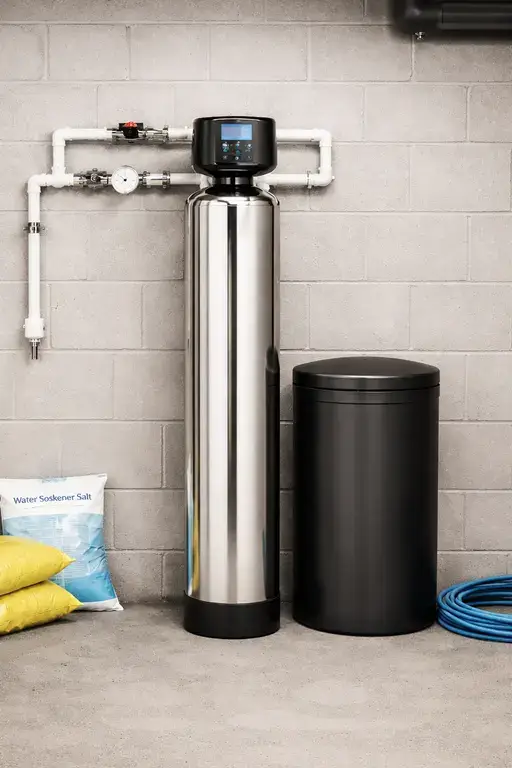
No single system is right for every property. Water Fixers can start with water testing and the symptom, then consider a softener for hardness, reverse osmosis for point-of-use drinking water, carbon for applicable taste/odor/disinfectant goals, sediment filtration for particulate loading, whole-house filtration where the target warrants it, and well-water or specialty treatment only when testing supports it. Plumbing repair, heater maintenance, leak detection, pressure work and smart leak protection may be the correct solution when the problem is mechanical rather than chemical.
Softener: targets calcium/magnesium hardness and scale; it is not a general contaminant filter. RO: is a point-of-use option for reducing many dissolved constituents and improving drinking-water taste, but membrane performance depends on feed-water quality and maintenance. Whole-house filtration: should be selected for a defined target such as sediment or an applicable disinfectant/taste issue. In Buellton, start with the provider/source above and test results.
Yes—documented local data and/or source conditions support treating hardness as a meaningful household issue.
The relevant local supply is treated Central Coast Water Authority/State Water plus groundwater, associated with City of Buellton and Santa Ynez Valley groundwater and State Water.
Use the current report from City of Buellton for regulatory compliance. Hardness, taste, odor, or scale alone do not prove that water is unsafe.
White spots are commonly associated with mineral residue after water evaporates. Confirm hardness at the property before choosing a softener.
Not automatically. A softener is appropriate when hardness is confirmed and the homeowner wants to reduce scale; system sizing should follow testing and household demand.
RO can be useful for point-of-use drinking water when the treatment goal matches what RO reduces. Test first and maintain filters and membrane on schedule.
There is no universal best filter. Choose media and configuration for the measured problem—sediment, taste/odor, dissolved constituents, hardness, or a well-specific issue.
Private-well owners should use a certified laboratory and select analytes based on well location, history and local risk factors; common starting categories include bacteria, nitrate, minerals/TDS, iron/manganese and any locally indicated constituents.
Water reports and monitoring data change over time. Check the linked provider or agency for the latest information.
For drinking and cooking water specifically, many Buellton homeowners choose an under-sink system — see our Buellton reverse osmosis page.
Water Fixers Plumbing & Filtration can help connect the water-quality question to the plumbing system instead of guessing at equipment. Call 805-928-6444 or request service online. California contractor license #719792.
CALL NOW! Se Habla Español!