
VANDENBERG VILLAGE, CA • REPIPING • PIPE REPLACEMENT
Water Fixers evaluates repiping projects in Vandenberg Village by looking at pipe material, where failures have occurred, measured pressure, flow, access, previous repairs and the rest of the property’s plumbing. For addresses served by Vandenberg Village Community Services District, elevation can affect utility pressure, but the repipe decision still comes from the customer-owned piping and measurements at the property.
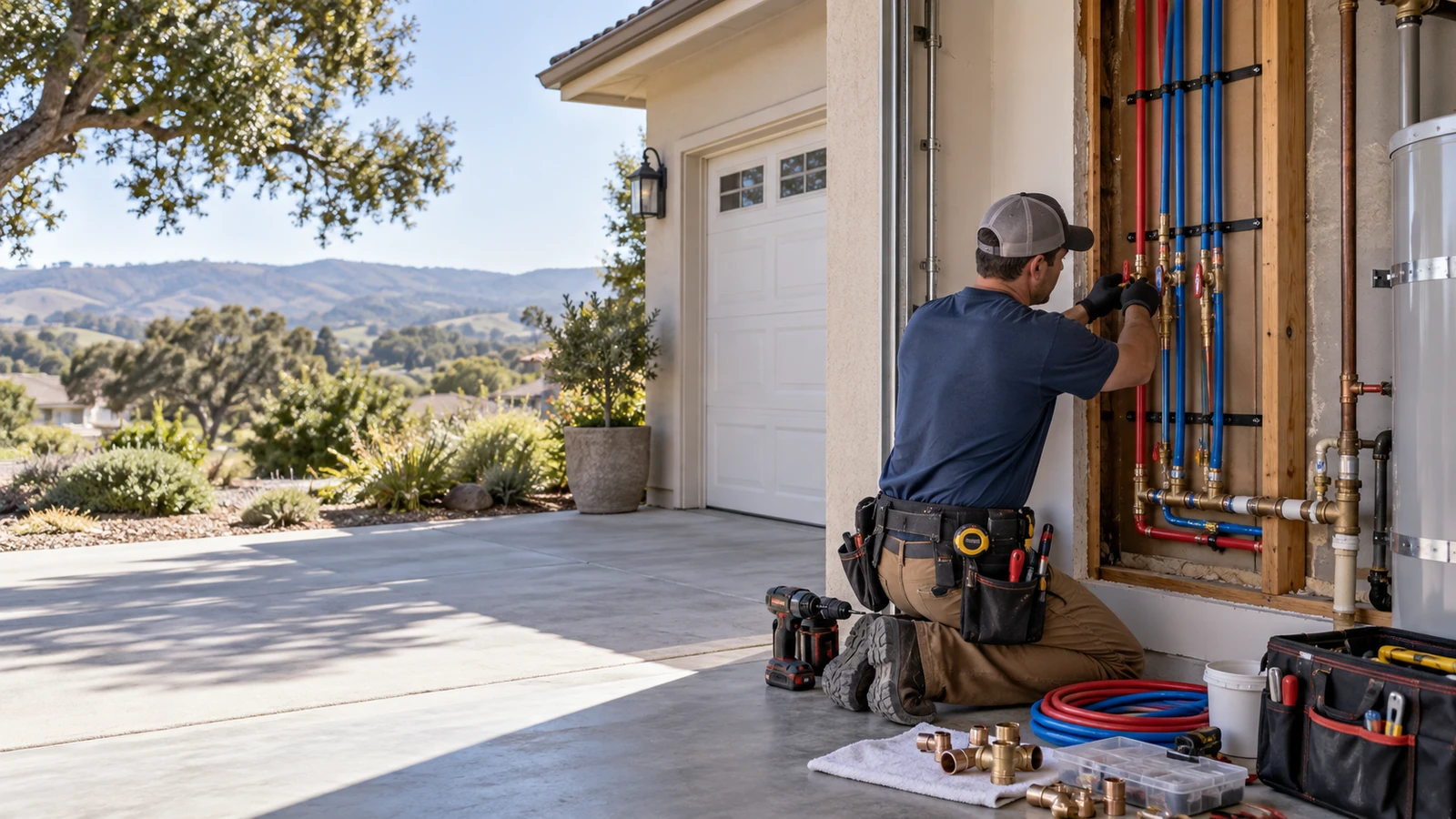
START WITH THE FAILURE PATTERN
For a VVCSD-served property, pressure can vary with elevation, so measure static pressure rather than assuming. Pressure regulation may be part of the project when actual readings are excessive; the repipe scope still depends on the condition and failure pattern of the customer-owned piping.
A pattern across separate branches is stronger evidence for repiping than one isolated fitting failure. Document where earlier repairs occurred and, when known, whether the same pipe material or failure type is recurring.
Do not use low flow alone as a repipe diagnosis. First determine whether the loss occurs at the service, pressure regulator, treatment equipment, one branch, a fixture restriction or throughout the distribution piping.
If one component has clearly failed and the surrounding piping is otherwise serviceable, a targeted plumbing-service call is often the more proportionate starting point.
VANDENBERG VILLAGE WATER + PLUMBING CONTEXT
For addresses served by Vandenberg Village Community Services District: VVCSD says its system is gravity-pressurized from two one-million-gallon tanks and reports average Village pressures of about 45 to 115 psi depending on elevation. Those are system-level figures, not the pressure at a specific home. Measure pressure at the property and inspect the customer-owned plumbing before tying pressure to a repipe.
Source water and treatment equipment can affect scale, maintenance and small passages. Pipe replacement is a separate decision based on failures, restriction, material condition and project scope.
Repiping becomes more defensible when the same piping problem recurs in multiple areas, several branches remain restricted after local causes are ruled out, or inspection shows enough deterioration or incompatible material that continued spot repair is no longer practical.
USE THE SERVICE THAT MATCHES THE ACTUAL PROBLEM
Not every pipe problem needs a repipe. A known isolated defect can remain a standard plumbing-service call when the surrounding distribution system is otherwise serviceable.
If moisture or water use suggests a leak but the source is still uncertain, start with Water Fixers Leak Detection before deciding which piping should be opened or replaced.
If the primary concern is hardness, taste, odor, sediment or another water-quality symptom, start with water testing or treatment diagnosis instead of widening the plumbing scope without evidence.
If water is actively uncontrolled, spreading or cannot be safely isolated, use the Vandenberg Village Emergency Plumber path first. Keep water away from electrical hazards and do not force a damaged or unfamiliar valve.
A LOCAL DECISION EXAMPLE
For VVCSD-served addresses, the District’s published pressure range makes an actual pressure reading especially useful before new domestic lines are installed. Lower-elevation properties can see higher utility pressure than higher-elevation properties, but elevation alone should not set the design. Measure static pressure, evaluate the PRV if present and inspect the customer-owned piping. The repipe scope still depends on leaks, material, restriction and condition.
Record static pressure, locate the PRV if present, list repeated leak locations, identify visible pipe materials and transitions, and note whether weak flow occurs throughout the house or only after a particular valve, fixture or treatment device.
Keep unrelated drain and sewer work, water-treatment choices, utility-side infrastructure, private-well equipment, a single fixture restriction and an unlocated leak outside the repipe scope until diagnosis shows a direct connection to the customer-owned distribution piping.
PLAN THE PROJECT AROUND THE PROPERTY
New piping should be designed around the actual building rather than a preferred material alone. Evaluate routing, supports, transitions, pressure control, service valves, heaters, treatment and fixture connections as one coordinated plumbing project.
Permit planning: Vandenberg Village is an unincorporated Santa Barbara County community. The Water Fixers permit guide identifies Santa Barbara County Building & Safety as the county-jurisdiction starting point for Village residential permit questions. Requirements depend on the exact property and work, so verify the address and scope before permit-dependent work begins. Review the plumbing permit guide.
PEX can be a practical repiping option for many layouts when sizing, supports, transitions, heat clearances, protection and workmanship are planned correctly.
Copper can also be appropriate when water conditions, fittings, supports, access, transition details and the building layout support the design. Material choice should follow the property and project—not a location-wide assumption.
Measure pressure and verify the main shutoff during planning. If pressure is excessive or the shutoff or PRV is unreliable, address that condition so new piping is not left with the same avoidable stress or control problem.
CHOOSE THE SCOPE THAT MATCHES THE EVIDENCE
Start with the smallest scope the evidence supports. A targeted repair fits one isolated defect. A partial repipe fits a problem concentrated in one branch or zone. Whole-house repiping becomes more relevant when repeated failures, restriction or deterioration are widespread enough that continued spot work is no longer practical. VVCSD pressure context can inform the evaluation, but actual pressure must be measured at the property.
Consider whole-house repiping when failures, deterioration or restriction are widespread enough that repeated spot repairs stop being practical and inspection supports a system-level replacement plan.
Useful when the evidence is concentrated in one branch, remodel area, repeated-problem zone or material transition rather than throughout the entire property.
Best when the defect is isolated and the surrounding piping is otherwise serviceable. Keep the repair narrow when the evidence stays narrow.
COMMON REPIPING QUESTIONS
Use this page for repiping decisions at a Vandenberg Village property. For broader plumbing and water-treatment help, use the Vandenberg Village Plumber page. For nearby communities, use the Lompoc & Vandenberg Area regional hub.
REPEATED FAILURES DESERVE A SYSTEM-LEVEL LOOK
A useful estimate starts with the property’s failure history. Tell Water Fixers about prior leaks, restricted fixtures or branches, measured pressure, visible pipe materials and any known PRV or shutoff concerns so the scope can stay as narrow—or become as broad—as the evidence supports.
CALL NOW! Se Habla Español!