
ARROYO GRANDE, CA • WHOLE-HOUSE WATER FILTRATION
Whole-house water filtration in Arroyo Grande should be tied to a defined household result. The City’s 2025 Water Quality Report says Lopez Lake supplied 91% of total City water, with groundwater also supplied by City wells. That source context is useful, but it does not choose the equipment for a home. Water Fixers separates filtration from hardness treatment, drinking-water RO and private-well work before recommending changes.
Water Fixers Plumbing & Filtration • CA License #719792 • Se Habla Español
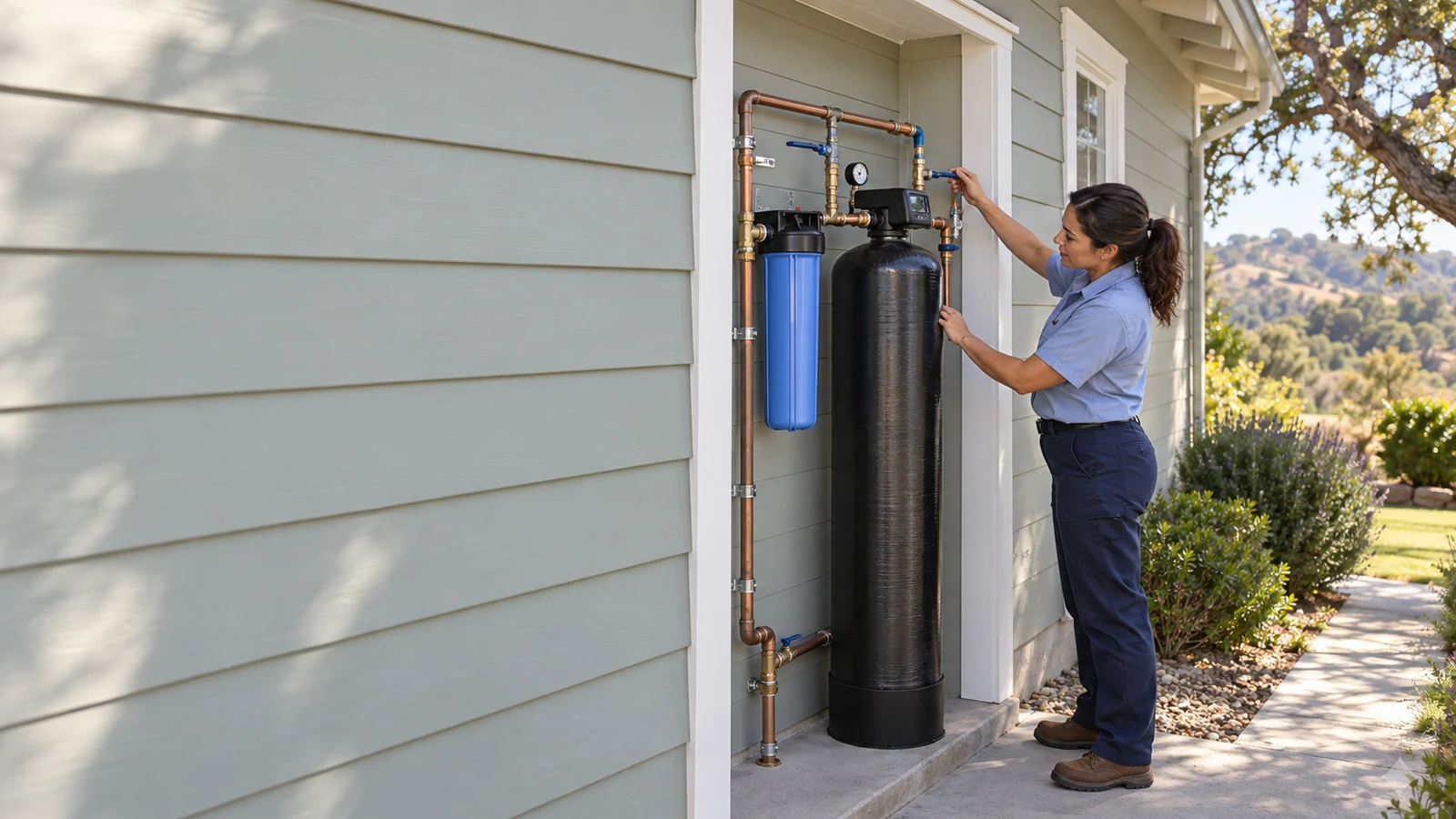
A whole-house filter should not be presented as a cure for every difference between reservoir water and groundwater. Hardness is a separate treatment category, and a specific contaminant concern belongs with testing and media selected for that result. A defined treatment boundary is especially important before adding anything that will sit on the home’s main water line.
A condition that appears throughout the home can justify evaluating a main-line filter, provided the selected media is designed for that condition.
If mineral buildup is the priority, compare softening options first; whole-house filtration can be added only if there is a separate filtration goal.
Treating every gallon is unnecessary when the homeowner only wants a dedicated drinking-water result. Point-of-use RO can keep that job separate.
Use current water data when a recommendation depends on chemistry that cannot be established from appearance, taste or source type alone.
The City of Arroyo Grande’s 2025 Water Quality Report says the City uses both surface water and groundwater. Lopez Lake supplied 91% of total City water in 2025. Treated Lopez Water and treated State Water are delivered through the same distribution pipeline, while City wells provide groundwater. The City reports the combined surface-water/groundwater blend at an average hardness of about 18 grains per gallon.
Those are system-level facts, not a guaranteed reading at an individual faucet and not a treatment prescription. They help define the source context; the filtration decision still depends on the condition at the home, the treatment goal and the plumbing fit.
Confirm what serves the Arroyo Grande address, describe the condition at the home, and then choose media that can perform that job at residential flow. If hardness is the concern, use the local softener/testing path rather than expecting a standard whole-house filter to do a softener’s job.
Treat the main line conservatively. Put equipment there only when its benefit is needed throughout the home and its pressure loss is acceptable.
Use whole-house carbon when the homeowner wants a whole-home aesthetic improvement that the selected media is designed to provide.
Add sediment filtration when actual particulate or equipment protection justifies it, without over-restricting the main line.
Service existing filters so exhausted media, old cartridges or bypass problems are corrected before additional tanks are added.
In Arroyo Grande, the plan should account for the home’s pipe size, static and dynamic pressure, peak simultaneous use, installation location and future cartridge/media access. The system needs to work as plumbing first and treatment second.
Two tanks with similar dimensions can use very different valves, media volumes and internal distributors. Those differences affect pressure drop, contact time and how the system behaves during peak demand.
Design for the next service visit: The finished system should make sense at a glance. The homeowner and future technician should be able to identify the bypass, prefilter and main media stage without guessing.
If an Arroyo Grande homeowner already has one or more treatment tanks, the system should be traced in order. A filter, softener and RO can all coexist, but only if each stage has a defined job and the combined pressure loss remains reasonable.
Measure across the treatment train. A loaded cartridge, restrictive media bed, small valve or incorrect bypass position can each create a different kind of flow loss.
A tank with no maintenance record should be evaluated by equipment type, performance and use rather than assigned an arbitrary replacement interval.
If taste or odor returns, ask whether the original equipment was designed for that goal, whether it is due for service and whether source or plumbing conditions changed.
Different treatment goals can share the same property without sharing the same equipment. Assign each goal to the technology designed for it and keep the plumbing order intentional.
Softening belongs to the hardness problem; keep that function separate from whole-house carbon or sediment filtration.
For a dedicated drinking or cooking faucet, compare point-of-use reverse osmosis instead of treating the entire home for a one-faucet goal.
If the property uses a private well, use a source-specific plan based on that well and its test results. Do not copy Arroyo Grande City-system chemistry onto a private well.
Use the broader Arroyo Grande water-filtration page when the concern has not yet been sorted into softening, RO, whole-house filtration or well-water treatment.
The City’s 2025 Water Quality Report says Arroyo Grande uses surface water and groundwater. Lopez Lake supplied 91% of total City water in 2025; treated Lopez and treated State Water share the delivery pipeline, and City wells provide groundwater.
Not automatically. Source information gives useful context, but the filter should be selected for a defined household condition or goal. The City report’s average hardness is a separate softening/testing question.
For an Arroyo Grande home, bring the water concern and any existing equipment history to the conversation. We will separate the filtration job from hardness, drinking-water and private-well work before recommending changes.
Water Fixers Plumbing & Filtration • Serving California’s Central Coast • CA License #719792
CALL NOW! Se Habla Español!