BUELLTON, CA • WHOLE-HOUSE WATER FILTRATION
Whole-house water filtration in Buellton should address a defined concern throughout the home or an existing filter that needs service. The City reports groundwater from the Buellton Uplands and Santa Ynez River underflow, supplemented by State Water Project water. That public-system context does not establish what is at one faucet or prove a home needs a filter. Water Fixers can evaluate the water goal, current equipment and main-line plumbing before recommending a treatment stage.
Water Fixers Plumbing & Filtration • CA License #719792 • Se Habla Español
Match the treatment to the concern. A whole-house filter may be appropriate for a defined house-wide taste, odor or particulate goal. Mineral scale belongs with softening, a dedicated drinking faucet with reverse osmosis, and a named constituent concern with appropriate testing. The City’s source information is context, not a diagnosis for every property.
Whole-home treatment is worth considering when the identified result is needed at several fixtures. Choose media and cartridges with documented performance for that goal and enough rated flow for the main line.
If scale or mineral spotting is the concern, evaluate water softening. Standard carbon or sediment filtration does not remove hardness.
If the priority is water for drinking, cooking or ice, compare RO before putting additional media on the entire main line.
Unknown water conditions should be measured before equipment is selected, especially when the concern involves a named constituent.
For customers served by the City of Buellton, the City’s 2025 Annual Water Supply Report identifies the Buellton Uplands Groundwater Basin and Santa Ynez River underflow as groundwater sources, with State Water Project water supplementing supply. Check the actual provider and current information for the property before using a public-system report to plan treatment.
Source information helps frame questions; it does not measure water at a particular faucet. Confirm the household goal and use appropriate testing when treatment depends on a specific condition.
The Buellton water-quality guide explains local supply context. For a filtration decision, compare that information with the property’s provider, the condition observed at home and any existing treatment.
More tanks do not automatically mean better water. A strong plan uses only the media and prefiltration needed for the identified household objective.
Use carbon media for a defined aesthetic goal only when the selected product has documented performance for that target. Not every carbon filter has the same reduction claims.
Use a sediment stage when particulate is present or equipment needs protection. Select a serviceable cartridge that does not unnecessarily restrict household flow.
Evaluate existing point-of-entry equipment for pressure loss and maintenance before adding new stages.
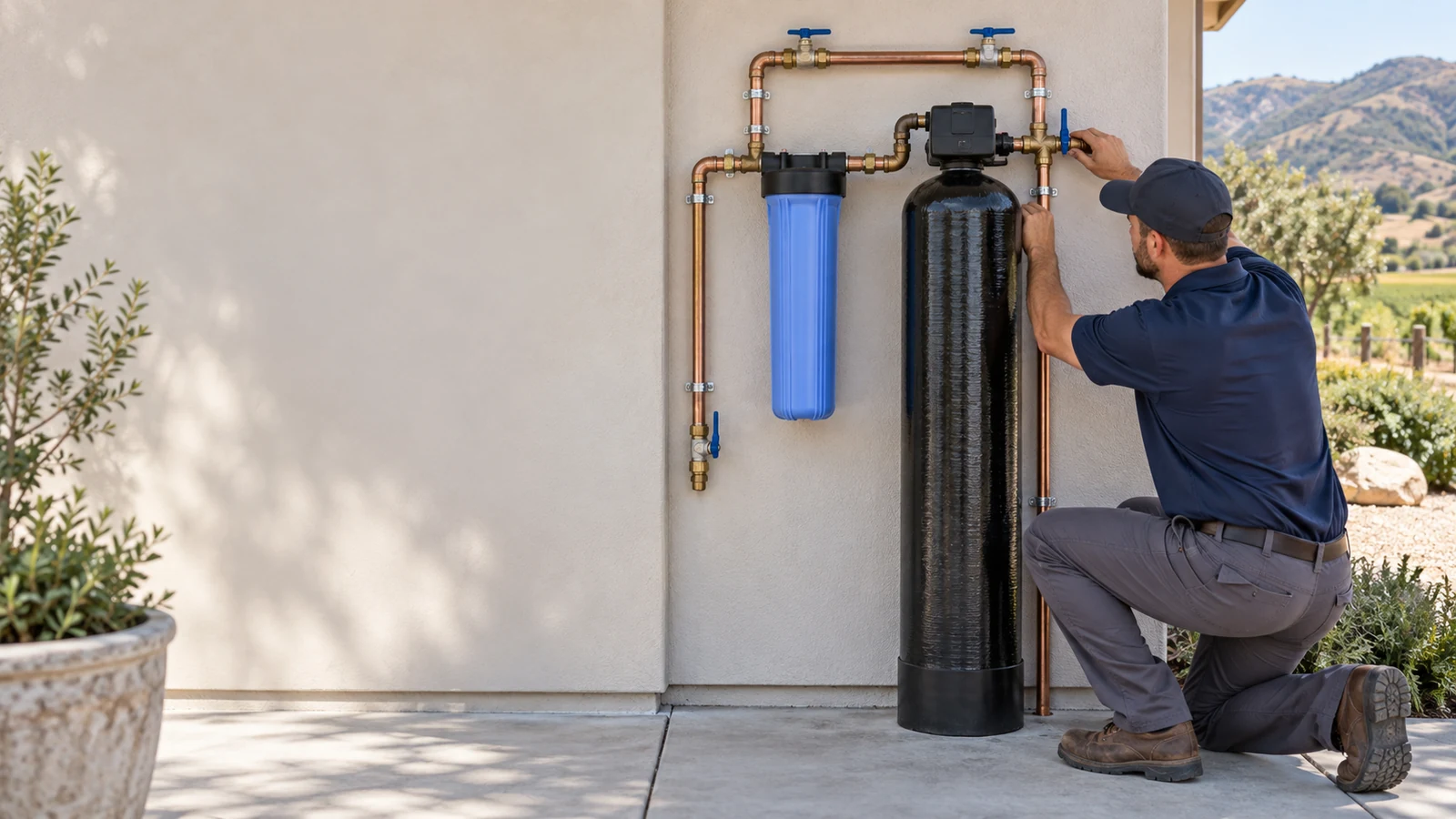
A main-line filter should support normal simultaneous fixture use. Compare the home’s expected peak flow with the ratings of the housing, media tank, control valve and connecting pipe. Measure pressure before and during flow, and leave enough room to operate the bypass and service the cartridge or media.
Physical size alone does not show service capacity. Look at the valve, media, housing and plumbing connections together when assessing flow.
Plan for future service: Accessible housings, logical valves and clean plumbing connections make maintenance practical.
If a Buellton home has both a filter and softener, identify the function and condition of each stage. Check bypass positions and measure flow or pressure loss before deciding which component needs service.
Compare pressure across the treatment stages under demand and inspect the cartridge. Identify the restrictive component before replacing equipment.
A tank with no maintenance record should be evaluated by equipment type, performance and use rather than assigned an arbitrary replacement interval.
Review the original treatment goal, maintenance record and current water condition before assuming the whole system needs replacement.
Some homes benefit from more than one treatment technology. The key is to know what each stage contributes so equipment is not duplicated and maintenance stays understandable.
Send mineral buildup, scale and spotting to hardness treatment rather than expecting carbon media to do that job.
For a dedicated drinking or cooking faucet, compare point-of-use reverse osmosis instead of treating the entire home for a one-faucet goal.
If the property uses a private or shared well, base treatment on that source and current testing. Do not apply the City’s public-system report to a well without confirming the property’s water service.
Use the central Water Filtration guide to compare categories when you have not yet identified the best treatment path for the household goal.
Tell Water Fixers what you want to change, which utility or source serves the property, and whether treatment equipment is already installed. We can inspect the main-line plumbing and help choose an appropriate filtration or service path.
Water Fixers Plumbing & Filtration • Serving California’s Central Coast • CA License #719792
CALL NOW! Se Habla Español!