
TEMPLETON, CA • WHOLE-HOUSE WATER FILTRATION
Whole house water filtration in templeton should be tied to a defined household result. Templeton has a strong local-well component to its public water system, but a city page should not collapse that into a private-well story. Whole-house filtration for a district-served home is a point-of-entry service based on the household goal, while private wells remain a separate treatment category. Before equipment is selected, Water Fixers separates filtration from hardness treatment, drinking-water RO and private-well work.
Water Fixers Plumbing & Filtration • CA License #719792 • Se Habla Español
The word “well” in a public-system description does not mean every Templeton property has a private well or needs specialty well-water treatment. Hardness, RO and named-contaminant concerns should each follow their own diagnostic route. Water Fixers uses the symptom and source context to decide which service deserves the next step.
House-wide taste, odor or particulate complaints can fit point-of-entry treatment when the media and service flow are a good match.
Scale is not a reason by itself to add a carbon tank. The hardness service should own that diagnosis.
A dedicated drinking and cooking faucet can often be treated more efficiently with point-of-use reverse osmosis than with whole-home equipment.
When the symptom does not identify the cause, testing is a better first purchase than an unproven specialty filter.
Templeton CSD operates a well-based public water system and participates in broader North County supply planning that includes local groundwater and Nacimiento-related resources. Current district information should be used for the property rather than reducing Templeton to one generic “well-water” profile. For this page, that research supports a well-heavy public system with broader regional supply planning, best served by current provider facts and property-specific goals.
A community water source is not a diagnosis. It becomes useful only when paired with the condition at the property and the result the homeowner wants.
For a Templeton property, provider/source confirmation and a clear homeowner goal are more useful than copying a neighboring home’s treatment setup.
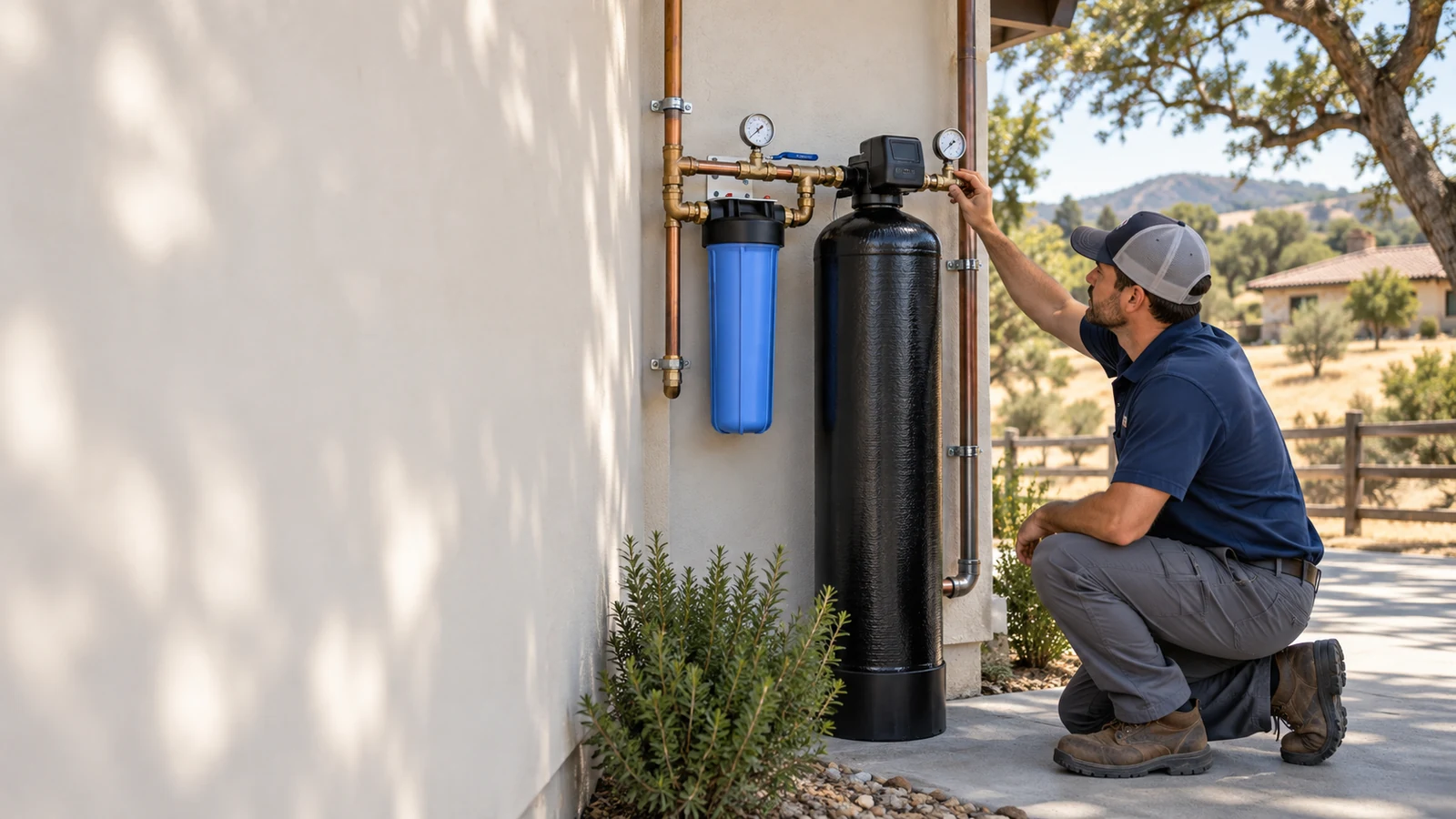
A whole-house system is easier to own when every component answers a simple question: what does this stage change, how is it serviced, and what flow can it handle?
Match carbon or sediment treatment to the specific whole-home condition the homeowner wants to change.
Keep district-served public water separate from private-well treatment and testing.
Size equipment for North County homes that may have higher fixture demand, longer plumbing runs or separate irrigation branches.
A Templeton installation should confirm the domestic main, pressure at the point of entry, peak household demand and whether irrigation should bypass treatment. A large tank with small valves can still be restrictive, so the whole flow path matters.
Two tanks with similar dimensions can use very different valves, media volumes and internal distributors. Those differences affect pressure drop, contact time and how the system behaves during peak demand.
Design for the next service visit: Serviceability is part of performance. Clean unions, logical valve placement and accessible housings reduce the chance that maintenance gets deferred because the system is difficult to work on.
For existing Templeton equipment, Water Fixers can check whether the sediment stage is overloaded, whether carbon media is overdue, and whether a softener or other stage is causing a pressure complaint that is being blamed on the filter.
Low flow can come from a clogged disposable filter, an undersized valve, compacted media or another plumbing condition. Test the restriction instead of guessing.
A tank with no maintenance record should be evaluated by equipment type, performance and use rather than assigned an arbitrary replacement interval.
Confirm that the installed media was meant for the condition the homeowner still notices. An exhausted filter and a filter aimed at the wrong problem can feel similar at the faucet.
A filter, softener and RO system can coexist, but they should never be described as interchangeable. Clear roles lead to cleaner plumbing and clearer service decisions.
Use the softener service when scale and mineral hardness are the condition to change.
For a dedicated drinking or cooking faucet, compare point-of-use reverse osmosis instead of treating the entire home for a one-faucet goal.
A private well needs its own source-specific testing and treatment process. Do not apply municipal-water assumptions to a well.
For a wider comparison of household treatment choices, use the main Water Filtration page before narrowing the recommendation.
Whether the Templeton home has no treatment yet or several older tanks, the next step can stay simple: identify the objective, verify the plumbing and service condition, then choose only the equipment needed for that job.
Water Fixers Plumbing & Filtration • Serving California’s Central Coast • CA License #719792
CALL NOW! Se Habla Español!