VANDENBERG VILLAGE, CA • WHOLE-HOUSE WATER FILTRATION
Whole-house water filtration in Vandenberg Village should address a defined need at the home or an existing filter that needs service. Vandenberg Village Community Services District (VVCSD) operates groundwater wells and a pressure-filter treatment system for its community supply. Household point-of-entry equipment treats water downstream of that public system; it should be selected for the actual concern, expected flow and main-line plumbing rather than for the source type alone.
Water Fixers Plumbing & Filtration • CA License #719792 • Se Habla Español
Start with what you want to change at home. A condition across several fixtures may justify evaluating point-of-entry filtration. Scale belongs with softening, water for one drinking faucet with reverse osmosis, and a specific constituent question with appropriate testing. Community treatment is already part of VVCSD’s system, so a household filter should have its own clear purpose.
If a taste, odor or particulate concern appears throughout the home, identify it before choosing media. A whole-house filter should have documented performance for the target and sufficient rated flow for normal household use.
If mineral buildup or spotting is the priority, evaluate hardness and softening. A standard carbon or sediment filter is not a softener.
For drinking and cooking at one faucet, consider point-of-use reverse osmosis before adding a treatment stage to the entire main line.
Use current water information and appropriate testing when a recommendation depends on a named constituent. Appearance or the fact that the district uses groundwater is not a property diagnosis.
VVCSD reports three groundwater wells and a pressure-filter treatment system. Its current water-quality reporting describes the community supply, while a 2026 district notice describes maintenance and media replacement in the filter vessel. This confirms that the public system includes treatment before distribution; it does not establish a household need for more filtration or a particular contaminant level at one address.
Review current district reporting for the community system, then evaluate the concern and any existing equipment at the home. Keep public treatment and household treatment separate when deciding what, if anything, to add.
The Vandenberg Village water-quality guide provides broader district context. For a whole-house filter, focus on the result you want at home, current observations and a serviceable installation after the meter.
Use only the stages needed for the identified household goal. A suitable bypass, accessible equipment and adequate flow matter as much as the media choice.
Choose media with documented performance for the identified taste, odor or other supported whole-home goal. No carbon system should be presented as a universal reduction device.
Use a household sediment stage if a property-specific concern or equipment need supports it. The district’s upstream filtration alone does not prove a home needs a cartridge, and an overly fine one can restrict flow.
Identify and service useful existing equipment before adding another tank. Check bypass operation, media or cartridge history and pressure loss.
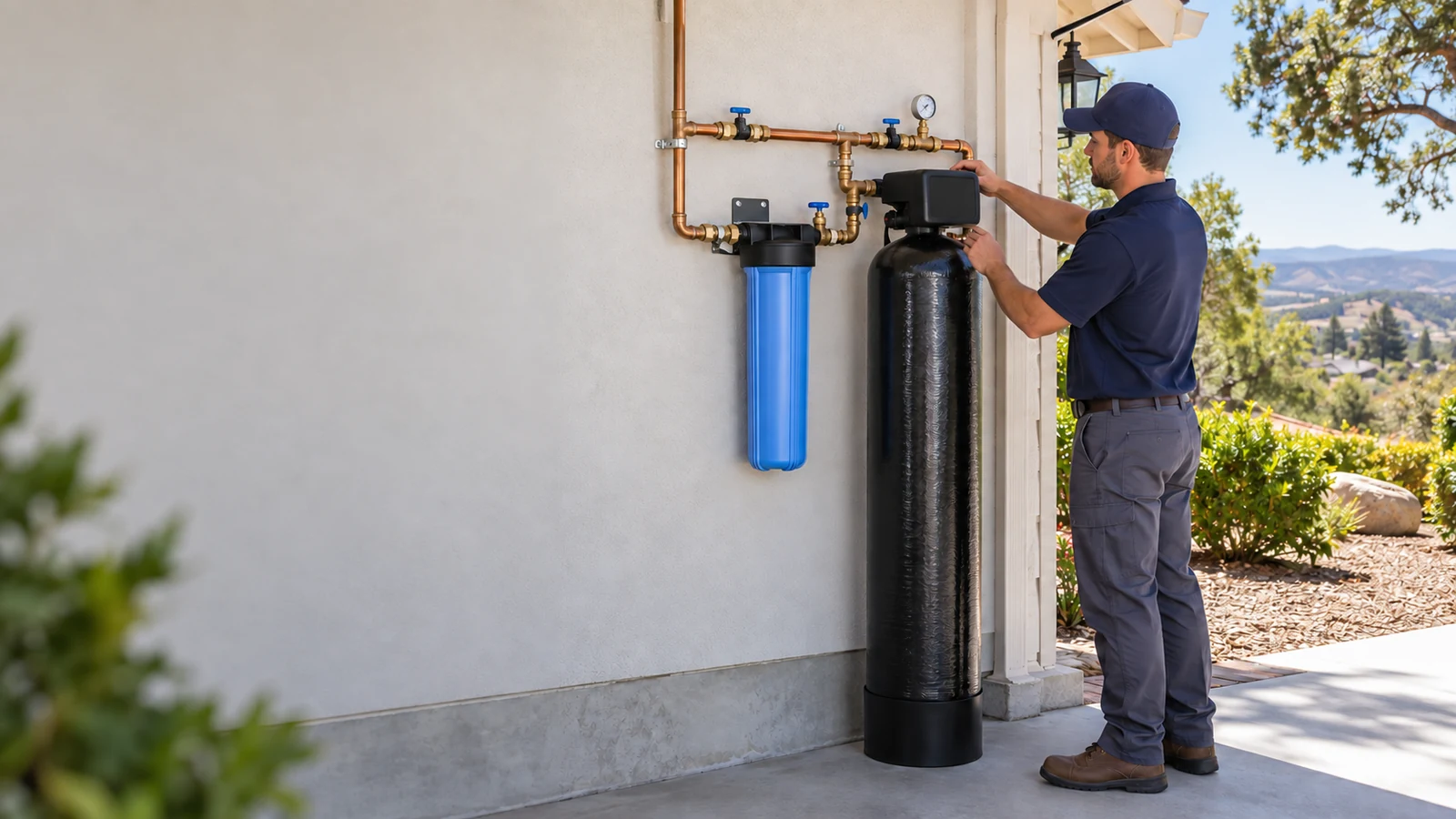
First confirm the actual main-line layout and expected simultaneous fixture demand. Compare the housing, valve, media and connecting pipe with that flow. Check pressure under demand, leave room to service housings and tanks, and make the isolation and bypass positions clear. Those practical details depend on the individual property.
Tank size alone does not indicate service flow. The valve, media, housing area and connecting pipe all affect performance.
Plan for the next service visit: Clear access to housings, valves and unions makes future filter changes practical.
If the home already has a point-of-entry filter, find out what it is treating and how it is performing. District filtration occurs before distribution; household equipment should be evaluated separately for its own purpose and pressure loss.
A loaded cartridge, restrictive media, valve setting or other plumbing condition may reduce flow. Measure across the stages under demand before deciding what to replace.
Identify the equipment and media, review available service history, and use manufacturer guidance and current performance rather than guessing a replacement interval.
Check the original goal, current water condition, media and bypass before adding another stage or replacing the system.
Different treatment goals can share the same property without sharing the same equipment. Assign each goal to the technology designed for it and keep the plumbing order intentional.
Use the softener service when scale and mineral hardness are the condition to change.
For a dedicated drinking or cooking faucet, compare point-of-use reverse osmosis instead of treating the entire home for a one-faucet goal.
If the property has its own private or shared well, use the dedicated well-water service and current source-specific testing. VVCSD’s public-system report does not describe a private well.
Use the central Water Filtration guide when you are still comparing treatment categories and do not yet have a defined whole-house goal.
Tell Water Fixers what you notice at home and whether equipment is already installed. We can inspect the main-line layout, confirm the water source and help plan an appropriate, serviceable next step for a Vandenberg Village property.
Water Fixers Plumbing & Filtration • Serving California’s Central Coast • CA License #719792
CALL NOW! Se Habla Español!