
LOS ALAMOS, CA • WHOLE-HOUSE WATER FILTRATION
Whole-house water filtration in Los Alamos should start with the water concern at your property. The Los Alamos Community Services District draws its public supply from groundwater wells, but your treatment choice depends on the actual source, conditions at the taps and the job a filter can do. We check those details and the existing plumbing before recommending a main-line system.
Water Fixers Plumbing & Filtration • CA License #719792 • Se Habla Español
A source-water report cannot tell you by itself which filter a home needs. Taste, odor or particles at several fixtures may call for a whole-home evaluation. Scale calls for a hardness check; a drinking-water goal may fit a kitchen reverse-osmosis system. A named constituent needs current, relevant results before treatment is selected.
A condition that appears throughout the home can justify evaluating a main-line filter, provided the selected media is designed for that condition.
White deposits or scale can point to a hardness concern. Measure the water before choosing a softener; carbon or sediment filtration does not remove hardness.
For one drinking faucet, start with RO rather than assuming the main line needs another treatment stage.
Use current water data when a recommendation depends on chemistry that cannot be established from appearance, taste or source type alone.
California Drinking Water Watch lists the Los Alamos Community Services District as an active groundwater system. The District’s 2024 water-quality report identifies Wells 3A, 4, 5 and 6 drawing from the San Antonio Groundwater Basin. These facts describe the public system, not a result at every Los Alamos faucet. Confirm whether the property is district-served or uses a different source, then evaluate the specific concern. Read the District’s 2024 water-quality report.
Local water facts can change over time. Use current utility reporting for source details and use current property conditions for equipment decisions.
Confirm the water provider for the address, note which fixtures are affected and check the existing plumbing and equipment. Then choose filtration for the condition it can address.
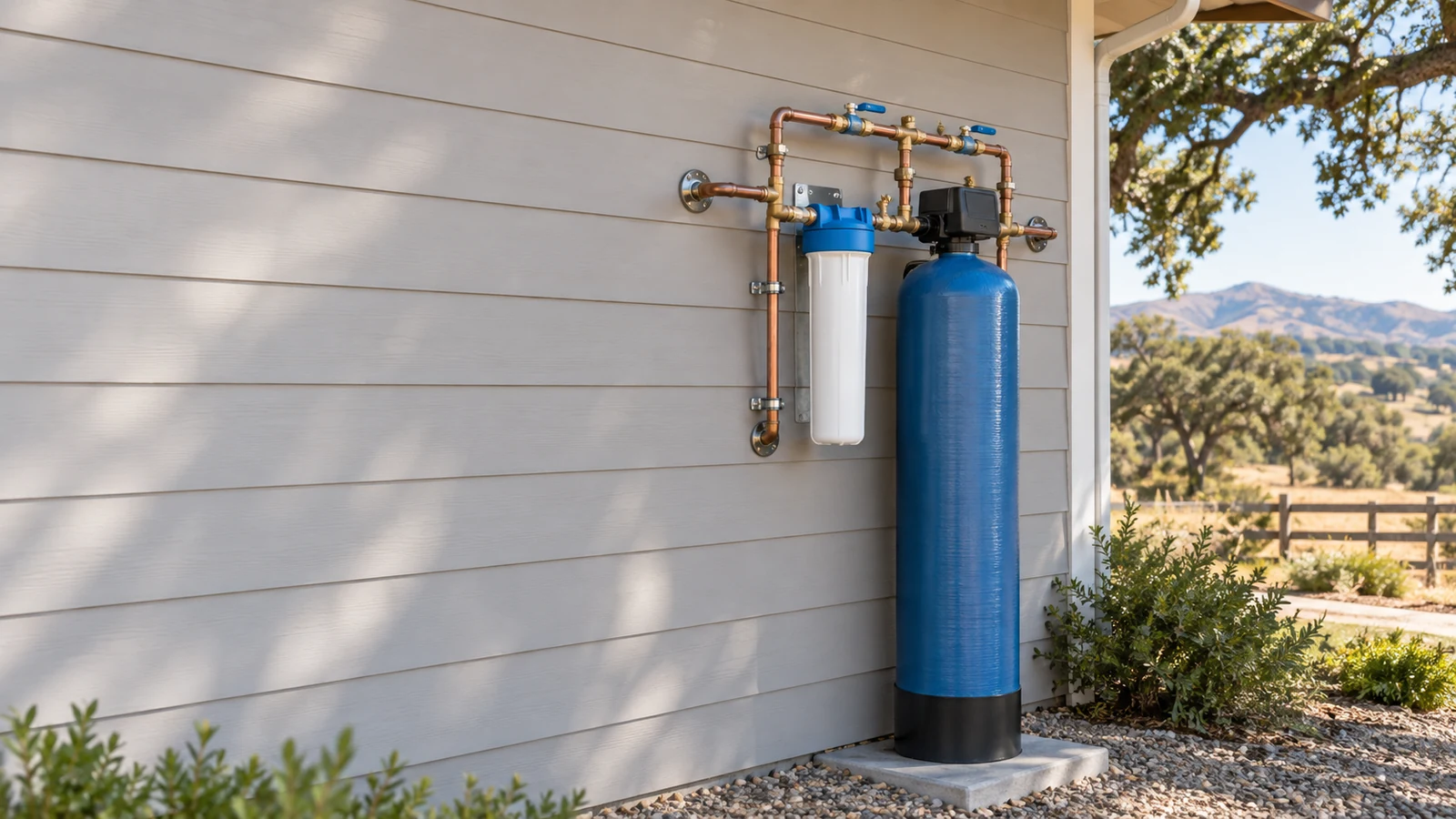
Point-of-entry equipment should be intentional. Each stage needs a reason, an adequate service-flow rating and a maintenance plan the homeowner can understand.
Use whole-home carbon or sediment filtration for a defined aesthetic or particulate concern that the selected media can address.
Start with current testing or official reporting when the concern names a specific constituent.
Keep a small-system installation serviceable so cartridges and media can be maintained without complicated plumbing work.
The design should reflect the property’s actual plumbing and access: size for peak flow, confirm pressure, place the bypass where it can be reached, and avoid filtering irrigation unless the homeowner has a reason to do so.
Two tanks with similar dimensions can use very different valves, media volumes and internal distributors. Those differences affect pressure drop, contact time and how the system behaves during peak demand.
Design for the next service visit: Serviceability is part of performance. Clean unions, logical valve placement and accessible housings reduce the chance that maintenance gets deferred because the system is difficult to work on.
If an existing filter is no longer meeting its goal, identify its media and control valve, review service history and measure flow and pressure before deciding whether maintenance or replacement makes sense.
Do not assume the largest tank is the restriction. Compare pressure on both sides of each stage and inspect the cartridge before replacing equipment.
Identify the media and control valve when possible, then compare service history with manufacturer guidance and the household’s actual water use.
When the water no longer feels like it did after installation, review both the treatment design and the maintenance status before replacing the entire setup.
Whole-home treatment gets confusing when every device is called a “filter.” Separate hardness control, point-of-use drinking water, private-well work and main-line filtration by function.
Softening belongs to the hardness problem; keep that function separate from whole-house carbon or sediment filtration.
For a dedicated drinking or cooking faucet, compare point-of-use reverse osmosis instead of treating the entire home for a one-faucet goal.
If the property has a private well, use source-specific testing and a dedicated well-water treatment evaluation.
If you are unsure whether the concern calls for a whole-home filter, softener or drinking-water system, start with a Los Alamos water-filtration evaluation.
Whether the Los Alamos home has no treatment yet or several older tanks, the next step can stay simple: identify the objective, verify the plumbing and service condition, then choose only the equipment needed for that job.
Water Fixers Plumbing & Filtration • Serving California’s Central Coast • CA License #719792
CALL NOW! Se Habla Español!