
SANTA MARIA, CA • WHOLE-HOUSE WATER FILTRATION
Whole-house water filtration in Santa Maria should be tied to a defined household result. For City-served properties, Santa Maria blends local groundwater with imported State Water before distribution, and the blend can vary. Source context matters, but the final equipment choice should match the condition at the property, the treatment goal, and the flow the plumbing must carry.
Water Fixers Plumbing & Filtration • CA License #719792 • Se Habla Español
White scale, mineral spotting and hardness are water-softener questions. Drinking and cooking water at a dedicated faucet are usually reverse-osmosis questions. A specific health or contaminant concern should begin with the right testing rather than a generic carbon tank. Water Fixers uses the symptom and source context to decide which service deserves the next step.
When taste, odor or visible particulate is noticed at fixtures across the house, point-of-entry filtration may be a sensible category to evaluate.
Crust, scale and mineral spotting are hardness clues; a standard carbon or sediment filter is not the same tool as a softener.
If the priority is water for drinking, cooking or ice, compare RO before putting additional media on the entire main line.
Unknown water conditions should be measured before equipment is selected, especially when the concern involves a named constituent.
The City of Santa Maria identifies two public-water sources: local groundwater and imported State Water. The supplies are blended before distribution. The City also notes that State Water arrives with a chloramine residual and that local groundwater contains more hardness and mineral content. Those facts can help frame a disinfectant taste-or-odor goal and keep filtration separate from hardness treatment, but they do not diagnose a particular home or prove that a filter is needed.
A community water source is context, not a property diagnosis. Confirm the actual source, the condition at the home, and the result the homeowner wants before selecting media, cartridge ratings, tank size, or treatment stages.
Use current Santa Maria source information as a starting point, then tie the treatment decision to this property rather than assuming one fixed blend, hardness level, contaminant profile, pressure condition, or filter need.
More tanks do not automatically mean better water. A strong plan uses only the media and prefiltration needed for the identified household objective.
Address an objectionable disinfectant taste or odor across the home when the condition is actually present and the selected carbon treatment is appropriate for the goal.
Capture visible particulate before it reaches household fixtures when sediment is actually present.
Improve an existing point-of-entry filter that has pressure loss, overdue media, a bypass problem or unclear maintenance history.
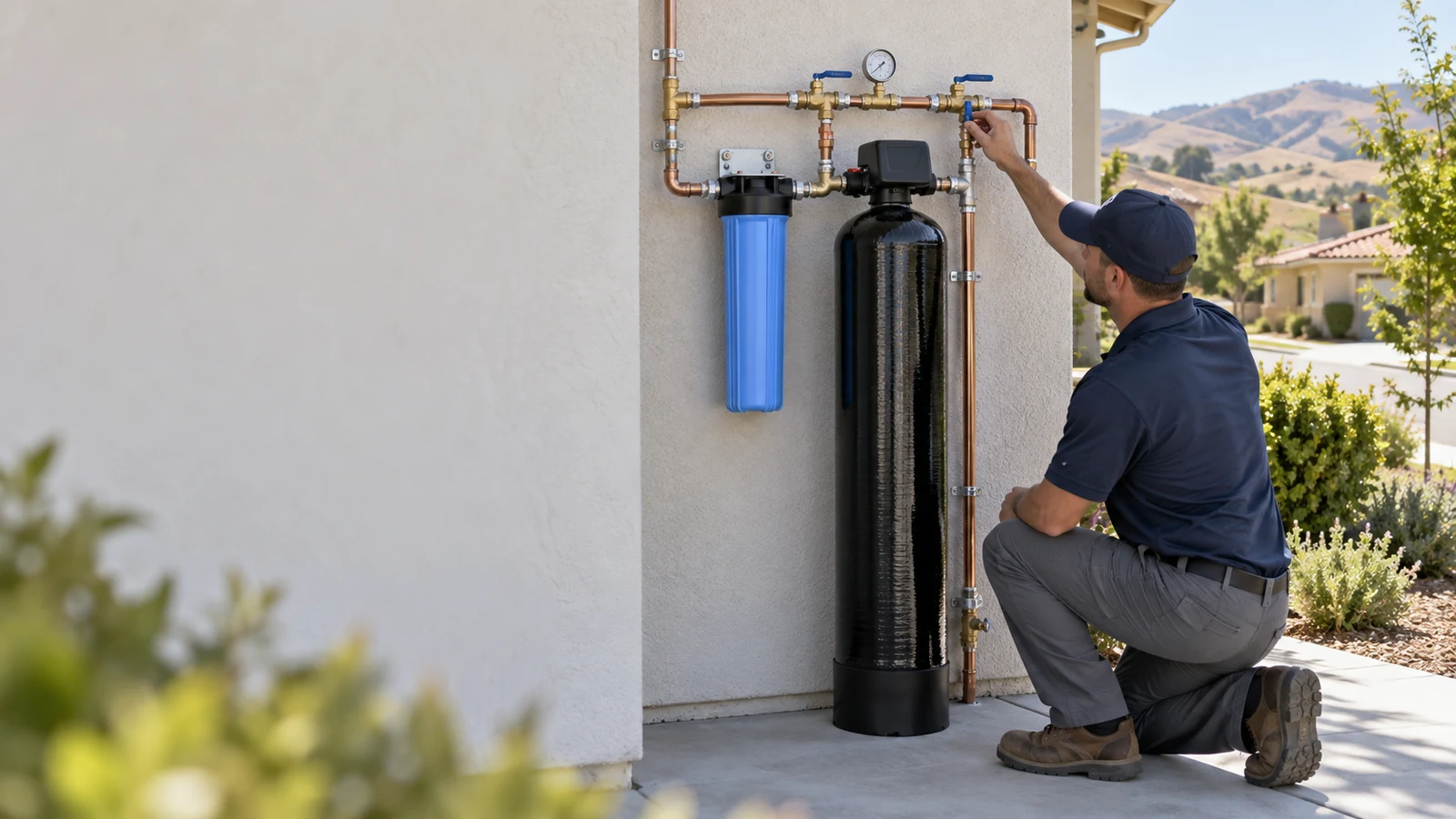
Because a point-of-entry system treats the water used by many fixtures at once, sizing must respect the home’s peak flow, main-line size and normal pressure. A Santa Maria installation should also leave the bypass, prefilter and media tank accessible for future service.
Whole-home equipment is a hydraulic component. Media selection and contact time matter, but so do port size, pressure loss and the plumbing on both sides of the tank.
Design for the next service visit: The finished system should make sense at a glance. The homeowner and future technician should be able to identify the bypass, prefilter and main media stage without guessing.
If a Santa Maria home already has filtration equipment, Water Fixers can start by identifying the media, checking cartridge condition and bypass position, comparing pressure before and after the equipment, and reviewing what the homeowner still wants to improve before recommending replacement.
A pressure complaint deserves measurements. Check the filter stage under demand before condemning every piece of treatment equipment.
A tank with no maintenance record should be evaluated by equipment type, performance and use rather than assigned an arbitrary replacement interval.
If taste or odor returns, ask whether the original equipment was designed for that goal, whether it is due for service and whether source or plumbing conditions changed.
Different treatment goals can share the same property without sharing the same equipment. Assign each goal to the technology designed for it and keep the plumbing order intentional.
Send mineral buildup, scale and spotting to hardness treatment rather than expecting carbon media to do that job.
A kitchen faucet has different flow and treatment requirements from a house main. Use the RO service when the goal is drinking and cooking water.
If the property actually uses a private or shared well, move the diagnosis to the dedicated Santa Maria well-water path. Well-water testing and treatment decisions should use the property’s real source and current conditions rather than City-system information.
Use the general filtration guide when the problem has not yet been sorted into softening, RO, whole-house filtration or well-water treatment.
If you are considering a main-line filter in Santa Maria, start with the symptom, the water source, and the existing plumbing. Water Fixers can help separate whole-house filtration from softening, reverse osmosis, testing, private-well treatment, and mechanical plumbing so the next step matches the actual goal.
Water Fixers Plumbing & Filtration • Serving California’s Central Coast • CA License #719792
CALL NOW! Se Habla Español!