
The City of Santa Maria uses two water sources: local groundwater and imported State Water. The City blends those supplies, and the balance can change as State Water availability and operating conditions change.
Treatment decisions should start with the water actually reaching the property, the symptom you want to address and the goal you want to accomplish. Use testing when equipment selection depends on actual hardness, sediment, taste, odor or another measurable condition. If a property uses a private well or another separate source, treat that as a different water system rather than applying City-water assumptions.
Water testing + plumbing + water treatment • CA License #719792 • Se Habla Español

Start by identifying what you want to change—hardness and scale, sediment, taste or odor, drinking water, or an existing-equipment problem. Then match the treatment to that target and the water actually reaching the property.
Scale and spotting can be signs of hardness, but the correct softener settings depend on measured hardness and household demand. Test the untreated water reaching the property before sizing or programming a softener rather than assigning one setting to every Santa Maria address.
For drinking and cooking water at a dedicated faucet, the Santa Maria reverse-osmosis page covers installation, service, filter changes, storage-tank delivery and membrane evaluation.
When a concern appears throughout the property, define the target before choosing media. Taste, odor, sediment and disinfectant-related goals do not all use the same filter. The Santa Maria water guide keeps deeper municipal-source information separate from service selection.
Visible particles or cartridges that load quickly deserve diagnosis before adding stages or changing micron ratings. Confirm what is actually present, review the existing housing and flow requirement, and use testing when the source of the loading is not clear.
Carbon can be useful for defined taste, odor or applicable disinfectant goals, but media type, flow and contact time need to match the actual water and treatment objective. Carbon is not a substitute for a softener when the primary issue is hardness.
If the condition is not established, review the current Santa Maria water guide and use appropriate testing before buying equipment or changing existing settings. If the property uses a separate or private source, identify that source first.
Use the focused service that matches the measured condition, the source, the treatment goal, or the equipment already installed at the property.
Use testing and the local guide when the condition or treatment target is not already established. Water Testing • Santa Maria Water Quality & Treatment Guide • Water Filtration & Treatment Hub
For confirmed hardness, scale, existing-softener service, maintenance, replacement planning and system comparison. Santa Maria Water Softener Services • Water Softeners • Water Softener Systems • Softener Maintenance • Softener Service & Repair
For local RO selection, installation, service, filters and point-of-use drinking-water maintenance. Reverse Osmosis – Santa Maria • RO Installation • Compare RO Systems • RO Service & Repair • RO Maintenance • RO Filter Replacement
For defined whole-home treatment goals such as particulate loading, taste, odor or an identified disinfectant concern. Whole-House Water Filtration • Filtration Systems • Sediment Filtration • Carbon Filtration • Filter Replacement
Some properties outside the City system or elsewhere in the Santa Maria Valley may use a private well or another separate source. Start with that actual source, pump and pressure behavior, sediment or staining, odor, existing treatment and appropriate testing. Do not apply City of Santa Maria reporting or a neighbor’s treatment settings to a separate source. Well Water • Well Water Services • Well Water Treatment
A treatment system shares the property’s plumbing, but an active leak, drain backup, failed shutoff, water-heater failure or pressure problem still needs mechanical diagnosis. Use this page for treatment goals and equipment service; use the Santa Maria plumbing page for plumbing failures.
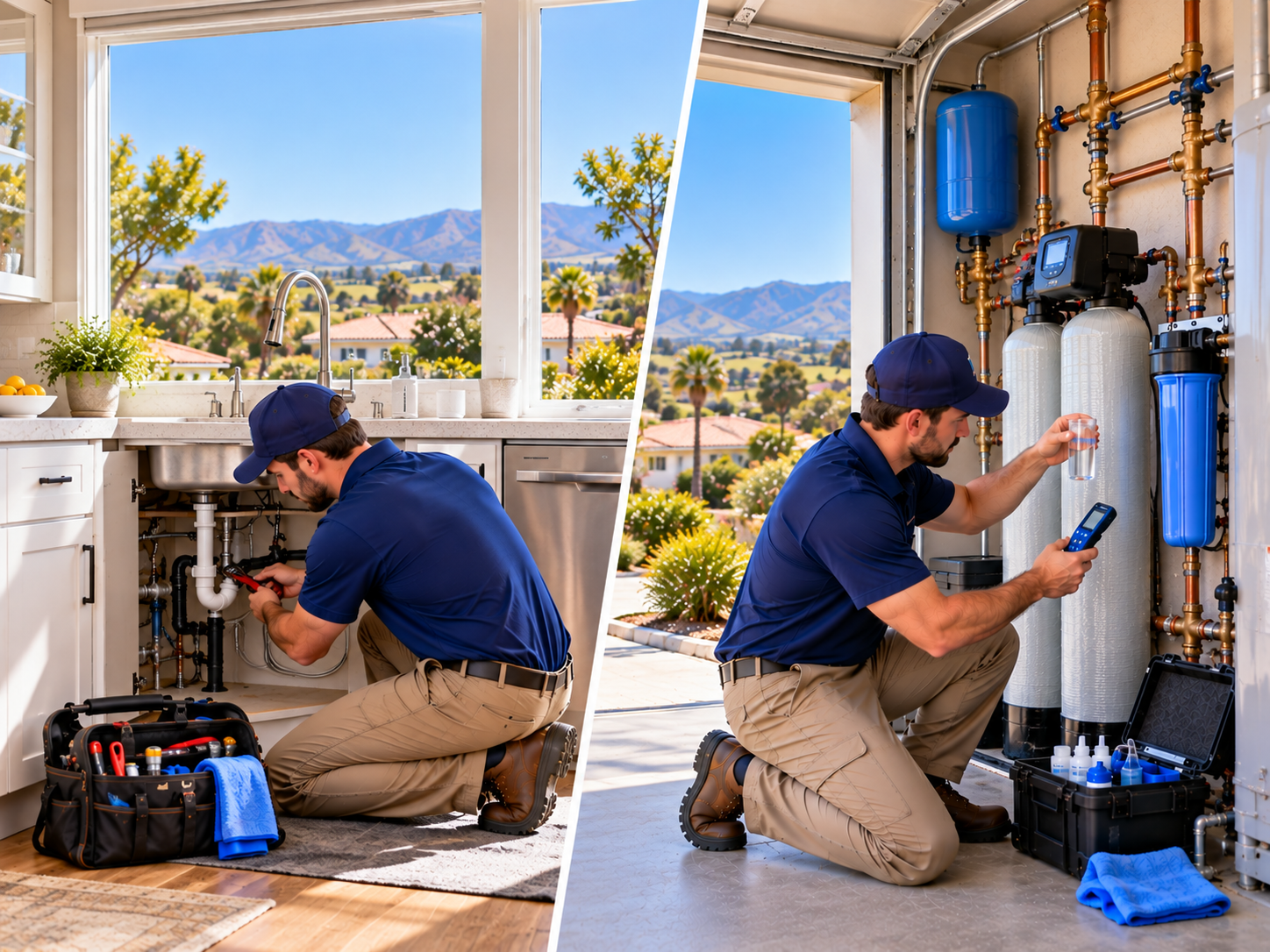
If the property already has a softener, whole-house filter, RO system, well filter or pressure equipment, identify what it is doing before adding another stage. Bypass position, cartridge loading, regeneration, pressure drop, pump cycling, leaks, service history and source water can all change the correct next step.
Hardness returning, unusual salt use, brine problems, leaking valves or regeneration issues may call for service rather than replacement. Verify untreated and treated hardness and compare current behavior with the system’s normal baseline before changing settings.
Low flow, leaks, taste changes, tank-delivery problems or overdue filters should be diagnosed along the RO service path in sequence instead of replacing parts at random.
Filter changes should match the installed housing, micron rating or media, flow requirement, source water and actual treatment goal.
The City of Santa Maria identifies two sources of supply: local groundwater and imported State Water. The City blends those supplies to reduce hardness and mineral content compared with local groundwater alone, while State Water availability can vary with hydrologic and operating conditions.
A treatment decision should use the current water reaching the property, the household goal and, when needed, testing. The Santa Maria Water Quality & Water Treatment Guide keeps deeper local-water information separate from this service page.

Water Fixers works on plumbing and treatment equipment, which matters when a water complaint overlaps with valves, pressure, water heaters, fixtures, reverse osmosis, a softener or an existing whole-house filtration system.
When the condition is uncertain, source information and testing help separate hardness, sediment, taste, odor and drinking-water goals. City water can change as the groundwater and State Water blend changes, and a private-well property should not inherit a municipal profile or another home’s equipment settings.
Maintenance, repair, a correct cartridge or membrane change, or a setting correction may restore an existing system without adding another treatment device.
Softening, whole-house filtration, reverse osmosis and source-specific treatment are different tools. The right path depends on the water source, the measured condition, the household goal and where the concern appears.
Use these answers to separate testing, softening, filtration, reverse osmosis, existing-equipment service and ordinary plumbing problems.
Tell Water Fixers what you want to change—scale, sediment, taste, odor, drinking water or something else—what water source serves the property, and what treatment equipment is already installed. That gives us the right starting point for testing, service or treatment planning.
CALL NOW! Se Habla Español!